
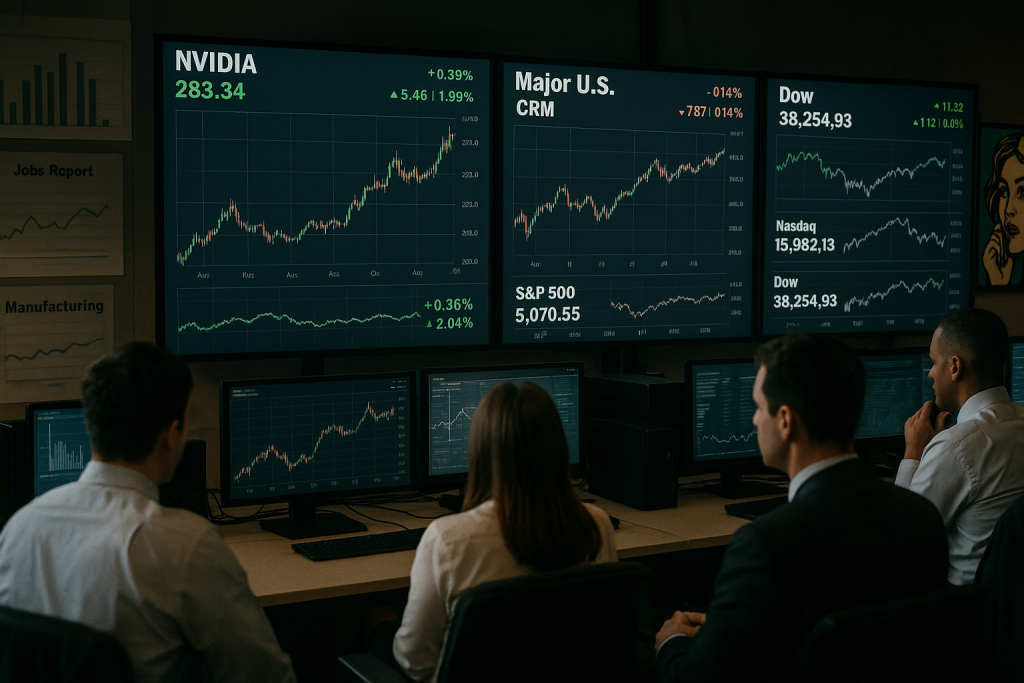


Wall Street’s resilience continues to puzzle even seasoned traders. Despite mounting evidence of a slowing U.S. economy, the major indices remain buoyant. The S&P 500 and Nasdaq Composite have held near record highs, with much of the momentum driven by artificial intelligence stocks – particularly Nvidia and Salesforce. But as cracks form beneath the surface in manufacturing, labor markets, and small-cap performance, some investors are beginning to ask a critical question: is the AI boom masking a broader economic slowdown?
The AI Rally: Still the Market’s Backbone
At the center of the market’s current strength is Nvidia . Following a blockbuster earnings report on May 22, Nvidia shares surged more than 10% over two sessions, pushing its market cap beyond $3.6 trillion and solidifying its position as the second-most valuable U.S. company. Salesforce added fuel to the fire after beating expectations and raising its guidance, reassuring investors that enterprise AI spending remains strong.
The semiconductor and cloud infrastructure sectors have been the main engines of growth. As large-cap tech stocks continue to attract institutional flows, they are lifting index performance and obscuring weaker trends in other parts of the economy. The so-called “AI Magnificent Seven” now accounts for nearly 33% of the S&P 500’s total market capitalization.
This level of concentration is not new, but it is accelerating. And while the story of AI revolutionizing productivity and reshaping the economy is compelling, it is increasingly being treated as a hedge against deteriorating macroeconomic data – rather than a supplement to strength elsewhere.
Jobs and Manufacturing Flash Caution
Outside the AI halo, the real economy is beginning to wobble. Job growth has slowed considerably. The latest ADP private payrolls report, released June 5, showed an increase of just 152,000 jobs in May – below the consensus forecast of 175,000 and well below the 250,000 monthly average seen in early 2024.
Wage growth also decelerated, which could be welcomed by the Federal Reserve in its inflation fight, but is less encouraging for consumers already facing high debt levels and waning savings. The unemployment rate remains low, but the labor force participation rate has stalled.
Meanwhile, the ISM Manufacturing Index posted its third consecutive reading below 50, signaling contraction. New orders and backlogs fell further, suggesting demand weakness, not just temporary supply issues. Industrial production remains flat, and regional Fed surveys point to subdued capital spending from businesses outside of tech.
Small Caps and Cyclical Stocks Underperform
The Russell 2000 index , which tracks smaller U.S. companies more sensitive to domestic conditions, has lagged behind the S&P 500 by over 10% this year. Financials, energy, and industrials – all sectors with heavy representation in the Russell – have struggled to gain traction.
This divergence is not just technical. It reflects a fundamental disconnect between AI-driven optimism and the challenges facing Main Street businesses. For example, regional banks continue to face deposit outflows and higher funding costs. Commercial real estate risk also remains elevated, adding pressure to balance sheets.
Consumer sentiment, although off its lows, has not fully recovered. Credit card delinquencies are rising, and auto loan defaults have reached their highest level since 2010. While the Nasdaq celebrates trillion-dollar valuations, many Americans are tightening budgets amid rising interest costs and softening income prospects.
The Fed Stays Cautious – But Not Dovish
Federal Reserve Chair Jerome Powell acknowledged the mixed signals in a recent speech, stating that while inflation is easing, it is not yet low enough to warrant rate cuts. Market expectations for a September rate cut have moderated, and Fed officials have warned that a resilient stock market should not be mistaken for a robust economy.
In fact, some policymakers have privately expressed concern that the AI trade is distorting financial conditions – creating a feedback loop that may delay necessary corrections in asset prices and risk-taking behavior.
Is the Market Priced for Perfection?
There’s no denying the transformative potential of AI. From autonomous vehicles to predictive health models, the technology promises significant efficiency gains. But markets may be pricing in these gains faster than they can be realized.
Valuations for leading AI firms are stretched. Nvidia trades at over 40 times forward earnings. Salesforce, Microsoft, and Amazon are all trading well above historical averages. If AI adoption slows or competition increases, those multiples could compress quickly.
Moreover, companies that do not directly benefit from AI efficiency – like small manufacturers, logistics providers, and brick-and-mortar retailers – are already grappling with higher costs and thinner margins. If market leadership continues to narrow, volatility could return abruptly when sentiment shifts.
Conclusion: A Tale of Two Economies
Right now, markets are telling two very different stories. One is about growth, innovation, and the future. The other is about caution, pressure, and uneven recovery. The AI boom has so far been strong enough to shield the major indices from broader economic concerns. But the divergence between Wall Street and the real economy cannot stretch forever.
Investors may want to enjoy the ride but keep their eyes on the road. Defensive positioning, broader diversification, and close monitoring of macroeconomic trends are all prudent strategies as summer begins.
Because once the AI hype cools – or the next weak jobs print hits – the market may be forced to reconcile the underlying economic truth it’s been so eager to ignore.




 Pump Radar
 Stock Alerts