
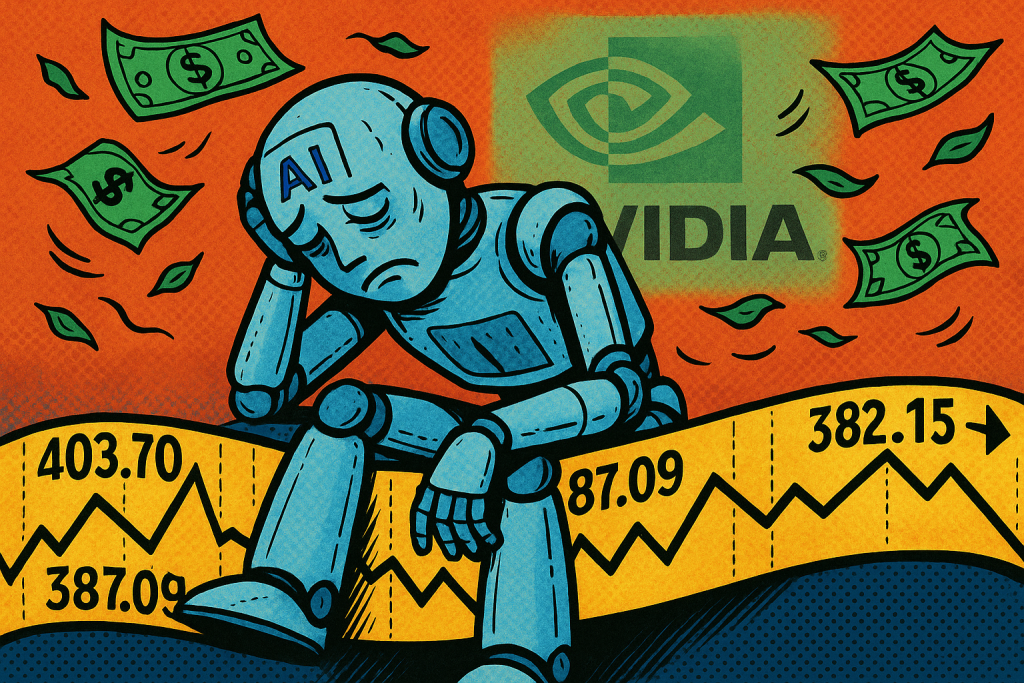


After months of powering market gains, Big Tech and AI darlings are suddenly catching their breath—and investors are wondering if it’s just a healthy pause or something more serious. Nvidia, Palantir , and a host of chipmakers have been the faces of this AI-led surge in 2025, but the past two weeks have felt… different.
A little less euphoria. A little more realism.
That’s not necessarily a bad thing. But it does raise new questions: Are we seeing profit-taking after parabolic moves, or is the market beginning to question whether the AI narrative has gotten ahead of itself?
Let’s unpack what’s happening and what it might mean for investors heading into the final stretch of summer.
Momentum Slows in the Market’s Favorite Trade
The Nasdaq, up nearly 25% year-to-date just a month ago, has cooled off. In recent sessions, we’ve seen back-to-back drops led by familiar names: Nvidia has given up a chunk of its $4 trillion market cap, Palantir is off its recent highs, and even sentiment around AI hardware plays like AMD and ASML has softened.
This isn’t a full-blown reversal. It’s more of a digestion phase. But for traders used to seeing tech stocks defy gravity, the change in tone is palpable.
Part of the shift comes from a simple reality: when you price in perfection, even small disappointments can sting.
Altman’s Warning: “We Might Be in a Bubble”
OpenAI CEO Sam Altman—yes, the same guy whose products helped spark the AI gold rush—recently admitted that parts of the AI market might be overhyped. While he remains bullish on the long-term potential of artificial general intelligence (AGI), he’s also warning that expectations have ballooned too quickly.
Altman’s comments echoed a broader mood among tech insiders: enthusiasm is still strong, but there’s growing awareness that building, training, and deploying these massive AI models takes real time, money, and infrastructure.
In other words, the road from vision to reality is long. And Wall Street may have gotten a little too far ahead of the curve.
Palantir, Chips, and the “Show Me” Phase
Palantir , once a poster child of AI optimism, has seen its stock fall nearly 20% from recent highs. Investors still love the company’s positioning in government and defense, but they’re asking tougher questions about execution and valuation.
The same is true across the chip sector. ON Semiconductor, ASML, and others tied to AI hardware have reported strong demand—but also supply chain bottlenecks and margin pressure. After months of “AI = Buy,” the market wants more proof that these companies can turn hype into sustainable growth.
We’ve entered what some analysts are calling the “show me” phase of the AI trade. That doesn’t mean the trade is over—it just means companies now have to back up the narrative with real numbers.
The Rotation: From Tech to Energy and Health?
As tech cools, fund flow data is starting to show early signs of rotation. While it’s too early to call it a full trend, sectors like energy and healthcare have seen modest inflows, and defensive names are starting to perk up.
Why? A mix of reasons. Some investors are simply locking in profits from AI plays. Others are getting more cautious ahead of the fall, when macro uncertainties—including interest rate policy, inflation data, and election noise—are likely to return in force.
There’s also a growing view that much of the AI upside for 2025 may already be priced in. That doesn’t mean the gains are done—but it does mean chasing momentum could be riskier from here.
Profit-Taking, Not Panic
Here’s the good news: most of this pullback looks like healthy consolidation, not fear-driven selling. The Nasdaq’s recent dip—just over 2%—came on moderate volume and without major technical breakdowns.
And while options data shows a slight uptick in hedging activity, there’s no panic in the VIX or credit markets. This isn’t a fire drill. It’s more like a breather.
That said, the second half of 2025 will bring new tests. Earnings season kicks off in a few weeks, and expectations for tech are sky-high. If companies miss—even slightly—there’s room for disappointment. And if macro data worsens, the market’s risk appetite could shrink quickly.
The AI Long Game Is Still Intact
None of this should shake the long-term thesis around AI. The transformative potential of large language models, automation tools, and AI infrastructure is real—and we’re still in the early innings.
But markets don’t move in straight lines. And even the best stories need pauses.
For investors, the key is to distinguish between tactical cooling and structural decline. Right now, all signs point to the former. Companies like Nvidia and Palantir are still innovating. Demand for AI talent and tools remains strong. Governments are throwing money at AI development. This isn’t a story that’s ending—it’s one that’s maturing.
What to Watch Next
-
Earnings reports from Big Tech in late July and early August. These will be critical in resetting expectations and guiding the next leg of the rally—or correction.
-
Rotation patterns in fund flow data. Are we seeing a short-term shuffle or a deeper rebalancing away from growth?
-
Sentiment indicators like the AAII survey and CNN Fear & Greed Index. Are retail investors still all-in on AI, or starting to diversify?
-
Geopolitical and macro shocks: especially anything that could threaten supply chains or chip manufacturing.
Final Take: Don’t Panic, But Don’t Sleep Either
The AI rally isn’t over—but it’s taking a break. Smart money isn’t running for the exits, but it is getting a little more selective. And that’s probably healthy.
For investors who’ve been on the sidelines, this dip might offer better entry points. For those who’ve ridden the wave, it’s a reminder to rebalance, stay grounded, and keep your eye on fundamentals.
Because in tech, hype may fuel the first leg—but execution drives the rest.

 Pump Radar
 Stock Alerts