
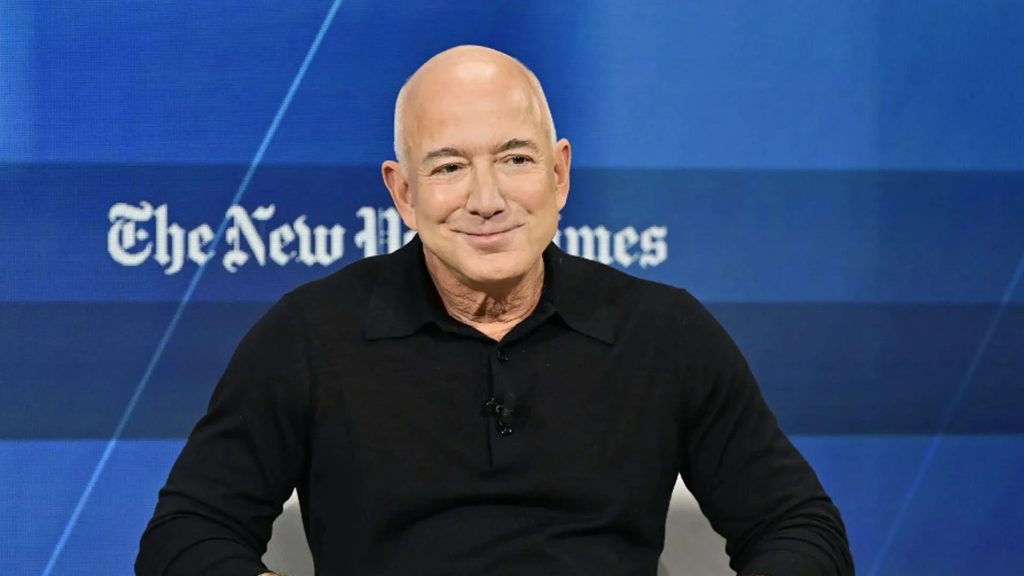


Amazon founder Jeff Bezos added his voice to the growing chorus of tech leaders cautioning that Wall Street’s excitement around artificial intelligence may be approaching bubble territory. Speaking at Italian Tech Week in Turin, Italy, Bezos noted that the current AI hype is driving investors to pour billions of dollars into both promising ventures and riskier, unproven ideas.
“When people get very excited, as they are today, about artificial intelligence, for example … every experiment gets funded, every company gets funded,” Bezos said. “The good ideas and the bad ideas. And investors have a hard time in the middle of this excitement, distinguishing between the good ideas and bad ideas. So that’s also probably happening today. But it doesn’t mean that anything that is happening isn’t real.”
Despite his cautionary stance, Bezos emphasized that AI is very much a tangible and transformative technology with the potential to reshape businesses and industries worldwide. “The biggest impact that AI is going to have is that it is going to impact every company in the world. It is going to make their quality go up and their productivity go up,” he said.
Amazon itself has been aggressively investing in AI technologies, building new data centers to meet growing demand for AI services while also designing its own chips to train and deploy AI applications. The company’s strategy reflects the broader industry trend, where firms are racing to integrate AI across cloud computing, e-commerce, and enterprise solutions.
The excitement around AI has produced massive market gains and soaring valuations for key players. Nvidia (NVDA), a leader in AI chips, has seen its stock surge approximately 1,350% over the past five years, giving the company a market capitalization of $4.6 trillion. OpenAI (OPAI.PVT), the developer behind ChatGPT, recently became the world’s most valuable privately held company at $500 billion following a secondary stock sale that allowed current and former employees to offload $6.6 billion in shares to outside investors.
Bezos also highlighted the speculative side of the AI frenzy, citing an example of investors pouring billions into a six-person AI startup that had not yet launched a product, valuing the firm at roughly $20 billion. He did not name the company, but his remarks underscored the challenges investors face in separating genuine innovation from hype-driven speculation.
Other industry leaders at Italian Tech Week shared similar concerns. Goldman Sachs CEO David Solomon pointed to the market froth created by rapid technological acceleration, noting that new tech often generates capital and new companies faster than actual value can be realized. “Whenever we’ve historically had a significant acceleration in a new technology that creates a lot of capital formation and therefore lots of interesting new companies around it, you generally see the market run ahead of the potential, because there are going to be winners and losers,” Solomon said.
For Bezos, the takeaway is clear: while speculative excess is real and can distort valuations in the short term, AI itself is a genuine, transformative technology that will improve productivity, enhance quality, and drive innovation across industries. His comments reflect a nuanced perspective, acknowledging both the risks of hype and the enduring promise of AI for businesses and society at large.


 Pump Radar
 Stock Alerts