
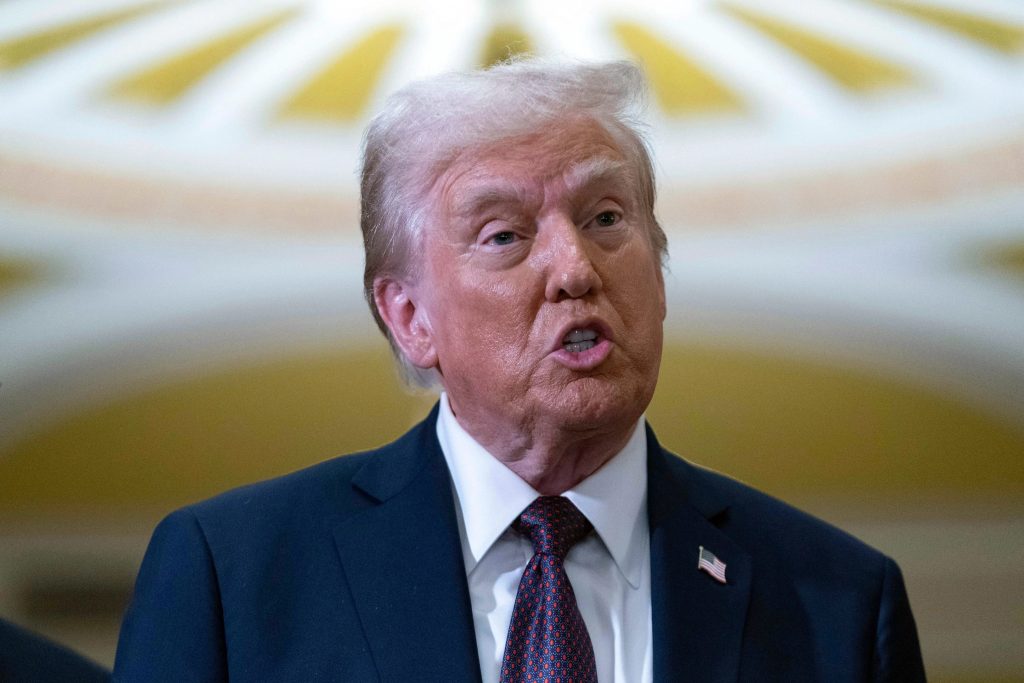


A New York state appeals court on Thursday struck down a civil fraud penalty exceeding $500 million that had been imposed on President Donald Trump and other defendants, while leaving non-monetary penalties intact. The decision marks a major legal victory for Trump, who has faced ongoing scrutiny over the valuation of his business assets.
The court ruled that while the trial judge’s “injunctive relief,” aimed at reforming the business practices and culture at the Trump Organization, was properly designed, the monetary fine was “excessive” and violated the Eighth Amendment of the U.S. Constitution. Specifically, the appeals court criticized the nearly half-billion-dollar payment order to the State of New York as disproportionate.
The original lawsuit, filed by New York State Attorney General Letitia James, alleged that Trump and his company engaged in business fraud by overvaluing assets in financial statements between 2014 and 2021. Manhattan Supreme Court Judge Arthur Engoron, in February 2024, found Trump liable and ordered total penalties of roughly $454 million. With accrued interest and other charges, the amount had surpassed $500 million by the time of the appeals ruling.
Trump hailed the court’s decision on his social media platform Truth Social, calling it a “TOTAL VICTORY in the FAKE New York State Attorney General Letitia James Case!” He said the original penalties were “hurting business all throughout New York State” and described the legal proceedings as a “Political Witch Hunt… in a business sense, the likes of which no one has ever seen before.” Eric Trump, the president’s son and co-operator of the Trump Organization, also celebrated on social media, saying, “After five years of hell, justice prevailed!”
In its opinion, the appeals court emphasized that the trial judge’s non-monetary injunctions were “well crafted to curb defendants’ business culture” at the Trump Organization. However, the court concluded that James “did not carry her initial burden” of proving the exact total of profits “causally connected” to the defendants’ violations. Judge Peter Moulton, in a concurring opinion, noted that the disgorgement calculation “was far from a reasonable approximation,” underlining the excessive nature of the financial penalty.
The Trump Organization now avoids the massive financial burden imposed by the penalty, though the company must still comply with restrictions designed to prevent future fraudulent business practices. Both the state attorney general and the defendants retain the right to appeal the decision, which leaves the door open for further legal proceedings.
The case stems from longstanding concerns over how Trump’s business valued assets and reported income. The original court ruling found that Trump’s financial statements had inflated the worth of certain properties by amounts ranging from $812 million to $2.2 billion. Attorney General James had argued that these inflated valuations misled lenders and other financial institutions, justifying the substantial penalties.
The appeals court ruling represents a rare and significant pushback against a high-profile civil penalty imposed on a sitting or former president. Legal experts note that while Trump avoids the monetary consequences for now, the decision does not erase the underlying findings of wrongdoing, and non-monetary injunctions still constrain the operations of the Trump Organization.
Trump and his allies quickly framed the decision as a political vindication, with the president emphasizing the purported economic harm the original penalty caused to businesses operating in New York. The case has been closely watched as a barometer of how aggressively state regulators can pursue civil claims against prominent business figures.
As of Thursday, CNBC had requested comment from both the Trump Organization and Attorney General James’s office regarding the appeals court ruling. The broader implications of the decision remain uncertain, particularly if the state seeks to challenge the ruling in further appeals.

 Pump Radar
 Stock Alerts