
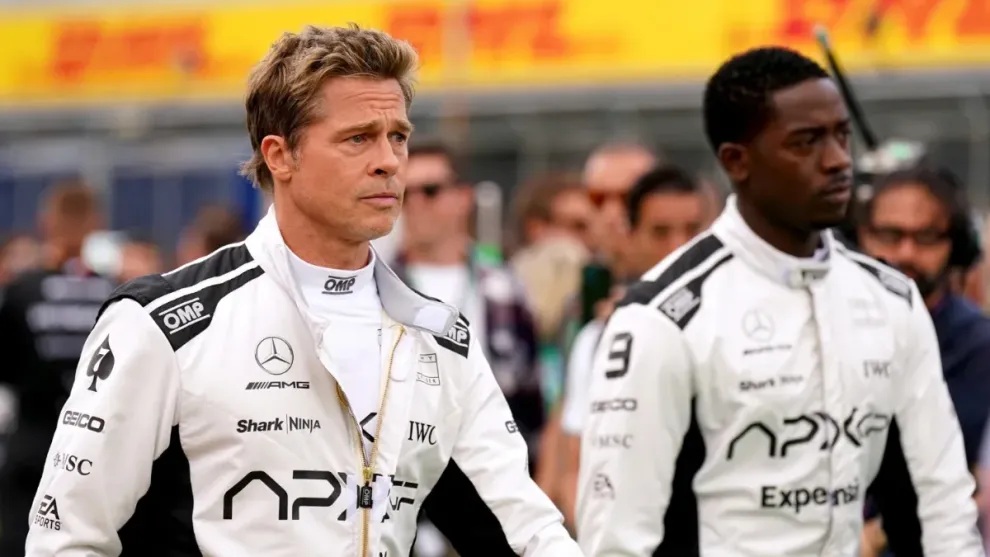


While Apple’s blockbuster debut of “F1” marked a high point for its services business, Wall Street’s lukewarm reaction to the company’s AI updates at WWDC reveals persistent underlying concerns.
Last month, Apple hit the red carpet with its first major film success. “F1” earned more than $155 million and garnered glowing reviews in its opening weekend — a milestone achievement for Apple TV+.
Apple’s services success shows what it can achieve with clearly defined, long-term goals. Its AI roadmap, however, still lacks that same clarity and momentum.
Apple rolled out two major initiatives in June — one that wowed and one that underwhelmed. At WWDC, it introduced developer previews of its new operating systems, showcasing several machine learning updates but offering little to excite investors. Weeks later, “F1” launched in theaters to major fanfare, serving as a cultural and commercial win.
While “F1” celebrated Apple’s storytelling power and brand pull, its AI showing — especially regarding Siri — raised red flags. “F1” demonstrated Apple’s ability to commit to and develop high-impact projects over time. When Apple TV+ launched in 2019, it had minimal content. Today, it’s putting out summer blockbusters, having invested steadily in content, talent, and infrastructure.
To market “F1,” Apple pulled out all the stops. It used the Wallet app to promote discounted tickets and had CEO Tim Cook appear alongside stars like Brad Pitt and Lewis Hamilton — the latter also a producer on the film.
Although services chief Eddy Cue recently said the film division must be profitable to “continue to do great things,” “F1” represents more than a financial play. It’s a powerful symbol of Apple’s brand and a key part of its growing services business, which includes everything from iCloud and Apple Music to advertising and extended warranties.
Movies make up only a small portion of the services segment — Apple generates over $1 billion in daily revenue — but they’re the only part that can put stars like George Clooney or Brad Pitt next to the Apple logo. And with “F1” proving Apple can deliver a hit, more tentpole releases may follow.
“Nothing breeds success or inspires future investment like a current success,” said Comscore senior media analyst Paul Dergarabedian.
Still, while “F1” is a sign of acceleration in services, Apple’s AI performance remains a “check engine” light.
At WWDC, Apple failed to satisfy hopes for a more powerful Siri. Though it introduced its broader Apple Intelligence platform in 2024, the voice assistant’s key upgrades — teased last year — were delayed again, now expected sometime in 2026. The company simply said it was “continuing its work to deliver” the features in the “coming year.”
“Current expectations for Apple Intelligence to kickstart a super upgrade cycle are too high, in our view,” wrote Jefferies analysts this week.
Siri, once a pioneer when it launched in 2011, has barely changed. Despite major advances in generative AI — from OpenAI, Google, and Anthropic — Siri still functions as a rigid, question-answer tool. Apple’s privacy-first stance, including limits on cloud processing, has further slowed development compared to competitors like Google, which are rapidly integrating AI assistants into their devices.
Some analysts say Apple has time, thanks to customer loyalty and its huge user base. But as Android devices grow more advanced, the risk of falling behind is growing. Adding to the pressure: Apple’s former design chief Jony Ive is now collaborating with OpenAI on new hardware.
“The three-year problem, which is within an investment time frame, is that Android is racing ahead,” Needham senior internet analyst Laura Martin said on CNBC this week.
Apple’s track record with services shows the power of long-term execution. But its AI strategy needs similar direction and urgency, as consumers and investors await bold steps forward.
Wall Street’s concern was amplified after Bloomberg reported Apple may replace Siri’s underlying technology with systems from Anthropic or OpenAI. That would break from Apple’s usual approach of developing and owning its foundational tech — such as processors, maps, or the touchscreen.
If Apple turns to outside partners, it would signal that its own foundation models aren’t yet up to the task.
“They’ve fallen farther and farther behind, and they need to supercharge their generative AI efforts,” Martin said. “They can’t do that internally.”
According to Bloomberg, Apple might pay billions for Anthropic’s AI software — a stark contrast to its current deals like the one with Alphabet, where Apple receives $20 billion annually to prioritize Google Search.
Apple hasn’t confirmed or commented on the report, but investors welcomed the idea, and the stock rose.
Meanwhile, competitors are aggressively recruiting top AI talent. Meta recently hired 11 AI scientists from OpenAI, Google, and Anthropic, while also bringing on Scale AI’s CEO as part of a $14.3 billion initiative. Google, Microsoft, and Amazon have each made similar billion-dollar moves to land elite teams.
Apple, by contrast, has been quiet on the AI hiring front. While Cook appears alongside celebrities, the company’s absence in the AI talent race suggests the real competition may be passing Apple by.

 Pump Radar
 Stock Alerts