
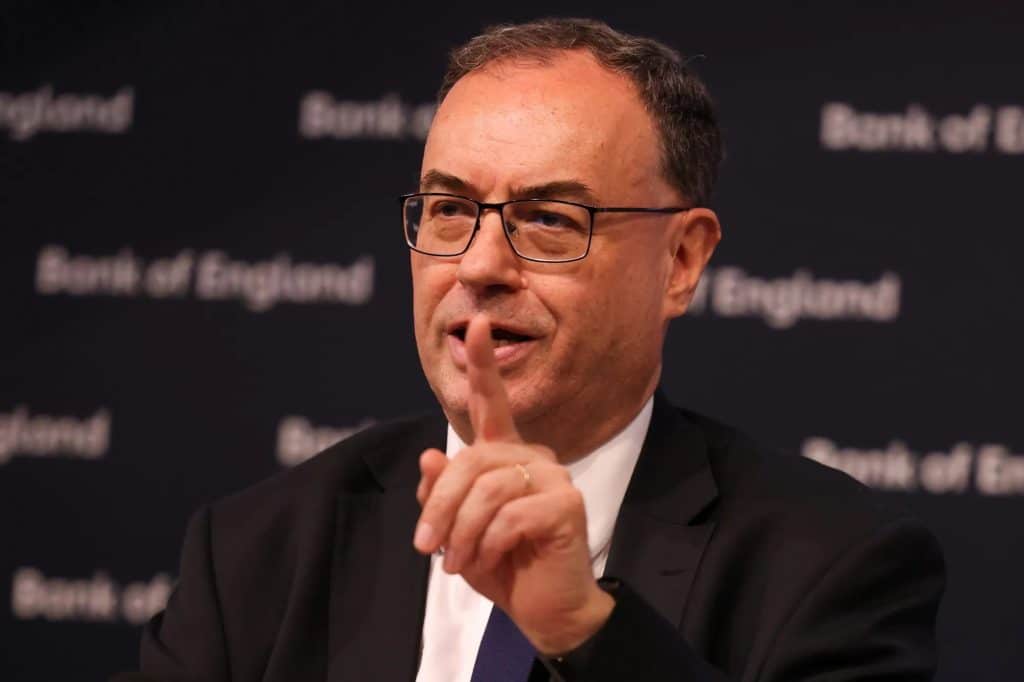


Bank of England Governor Andrew Bailey on Tuesday emphasized the importance of the International Monetary Fund (IMF) in addressing rising economic imbalances across the globe, particularly those stemming from the United States and China.
In a speech prepared for delivery at the annual Mansion House dinner attended by key figures in Britain’s financial community, Bailey acknowledged the Trump administration’s concerns about potential IMF overreach. Nonetheless, he argued that global economic challenges—such as the large U.S. trade and current account deficits, and China’s surpluses coupled with weak domestic demand—must be tackled through coordinated international efforts.
“If it is only done at the national level, we will get less good policymaking,” Bailey was set to say.
Bailey has previously voiced strong support for multilateral institutions like the IMF, particularly amid rising trade tensions following President Trump’s implementation of steep import tariffs and threats of further measures.
The IMF has recently criticized another aspect of Trump’s economic policy: proposed large-scale tax cuts. In response, U.S. Treasury Secretary Scott Bessent accused the IMF of straying from its core mission of promoting economic stability and surveillance.
Bailey noted that nations with significant deficits are often most vulnerable to market pressures.
“We have seen market disturbance this year. We have to be highly alert to financial stability risks – something that I can assure you we are following closely,” he said.
Bailey also pointed to China’s need to boost domestic demand as part of a broader international strategy to address “excess imbalances before dangerous levels of trade restrictions come into play, and before we face the prospect of difficult adjustment with macroeconomic volatility and financial instability.”
He urged the IMF to use its convening power to bring member nations—particularly the United States—into dialogue and collaborate with the World Trade Organization to deliver a more comprehensive assessment of the global trade environment.
“I think it helps to remember that the key challenge we all face is to increase growth in the world economy: to grow the pie to support living standards for the people we serve, all of the time,” Bailey said. “It is as simple as that.”
Bailey also noted that, in his new role as chair of the Financial Stability Board, which coordinates global financial regulation, he plans to work with the IMF to develop resilience tests for the global financial system, including hedge funds and banks.
In addition, Bailey expressed support for expanding digital payment technologies for retail transactions and bank accounts but remained skeptical about the necessity of a retail central bank digital currency. He also emphasized that stablecoins should not be seen as a replacement for commercial bank money.

 Pump Radar
 Stock Alerts