
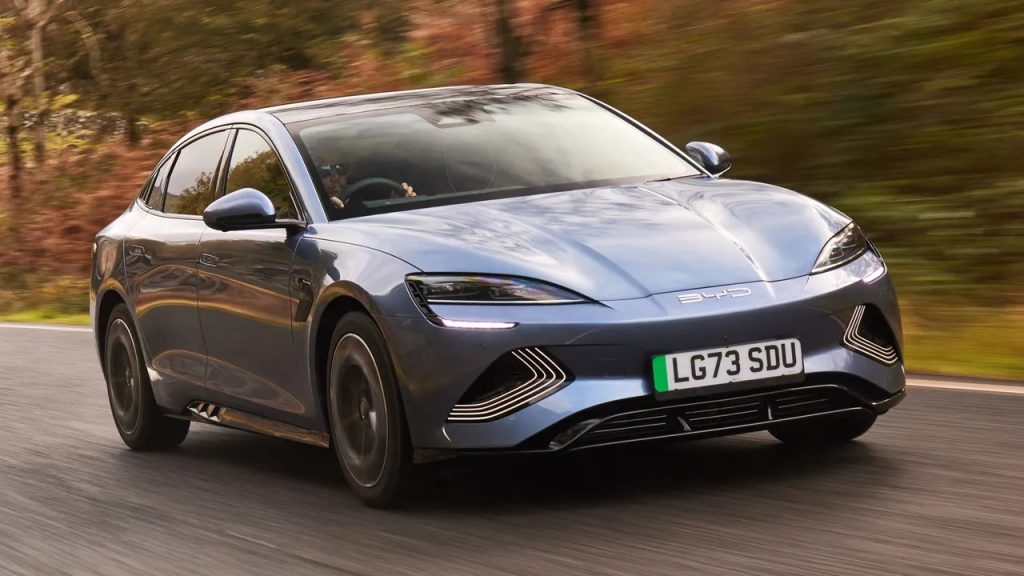


Shares of Chinese electric vehicle manufacturer BYD (1211.HK) slipped on Monday following news that Berkshire Hathaway has completely sold off its stake in the company.
The Warren Buffett-led conglomerate began gradually reducing its holdings in BYD in 2022, but a recent financial filing by Berkshire Hathaway Energy—the subsidiary that held the shares—showed the investment valued at zero at the end of the first quarter, confirming that the divestment is now complete.
Hong Kong-listed BYD shares fell over 3% during Monday’s trading session.
A Berkshire spokesperson confirmed the full exit to CNBC, though the company did not immediately respond to requests for comment from Yahoo Finance. BYD, however, acknowledged the news.
“We’re grateful to [Charlie] Munger and Buffett for their recognition of BYD, and for their 17 years of investment, support, and companionship,” BYD PR executive Li Yunfei wrote on Weibo Monday, according to Bloomberg.
Munger, Buffett’s longtime partner and Berkshire vice chair for 45 years until his passing in 2023, had played a key role in introducing Buffett to BYD.
Berkshire first invested in BYD in September 2008, during the global financial crisis, acquiring 225 million shares for approximately $230 million. By the time Berkshire began reducing its position in 2022, the stake had grown to roughly $7.7 billion.
Buffett reportedly took an interest in BYD after Munger praised founder Wang Chuanfu. “This guy,” Munger said, “is a combination of Thomas Edison and Jack Welch — something like Edison in solving technical problems, and something like Welch in getting done what he needs to do. I have never seen anything like it,” according to Fortune.
Despite the historical enthusiasm, Berkshire may have deemed this an opportune time to exit amid challenges in both BYD and the broader auto sector.
Earlier this year, BYD’s battery electric vehicle (BEV) registrations surpassed Tesla’s in Europe for the first time in May, reflecting strong demand. However, recent reports indicate the company’s explosive growth may be slowing. According to Reuters, BYD has cut its 2025 sales target in China by up to 16% to 4.6 million vehicles, marking its slowest growth in five years.
The company faces a highly competitive EV market in China and potential oversaturation, which could weigh on future growth.
Even with the dip on Monday, BYD shares remain up more than 23% year-to-date, reflecting resilience despite headwinds and market volatility.

 Pump Radar
 Stock Alerts