
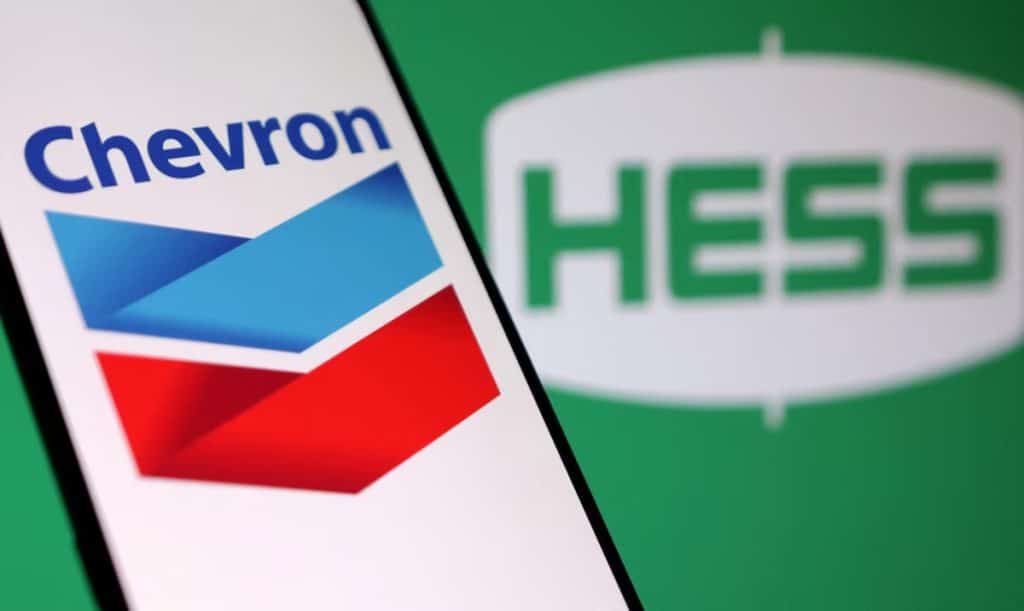


Chevron (CVX) is set to finalize its $53 billion all-stock acquisition of Hess (HES) following a favorable ruling from an arbitration panel at the International Chamber of Commerce in Paris. The decision clears the way for Chevron to close the deal, shutting out rival bidder ExxonMobil (XOM) and ending a high-stakes standoff that’s gripped the oil industry for nearly two years.
Shares of both Chevron and Hess rallied after the ruling, though Chevron’s stock later dipped by around 1.5%.
The centerpiece of the deal is Hess’s 30% stake in the Stabroek offshore oil block in Guyana—an area estimated to contain more than 11 billion barrels of oil, according to Reuters. Chevron and Exxon have been vying for control of this asset since 2023.
“This is a ‘once-in-several-lifetimes type of asset,’” said David Sweeney, co-head of the global energy and resources sector at international law firm Clifford Chance, in a statement to Yahoo Finance.
The Stabroek project has been instrumental in transforming Guyana into one of the world’s fastest-growing economies, per April data from the International Monetary Fund.
Chevron Chairman and CEO Mike Wirth hailed the merger, stating, “This merger of two great American companies brings together the best in the industry. The combination enhances and extends our growth profile well into the next decade, which we believe will drive greater long-term value to shareholders.” Hess referred media inquiries to Chevron’s public comments.
Exxon, which holds a 45% stake and operates the Stabroek block, partnered with Hess in 2014 after Hess bought out Shell’s (SHEL) share. China’s CNOOC owns the remaining 25%.
Following the arbitration decision, Exxon responded: “We disagree with the ICC panel’s interpretation but respect the arbitration and dispute resolution process. Given the significant value we’ve created in the development of the Guyana resource, we believed we had a clear duty to our investors to consider our preemption rights to protect the value we created through our innovation and hard work at a time when no one knew just how successful this venture would become.”
After Chevron announced its plans to acquire Hess in October 2023, Exxon and CNOOC contested the deal, citing preemption rights. The dispute over those rights became the central issue in the ICC’s decision. “The majors … are always opportunistic and smart about what they do, so if there is something out there that is worth acquiring, likely they will be willing to acquire it,” Sweeney noted.
Among oil majors—Exxon, Chevron, BP (BP), Shell, TotalEnergies (TTE), and Eni (E)—Chevron has recently lagged behind. In 2024, the company’s earnings fell to $18.3 billion from $24.7 billion in 2023, and it announced plans to cut up to 20% of its workforce by the end of 2025.
Chevron’s stock has gained around 71% over the past five years, compared to Exxon’s nearly 150%, and trails the S&P 500’s 95% gain in the same period.
“This accretive transaction is expected to drive significant free cash flow and production growth into the 2030s,” Chevron CFO Eimear Bonner said in a public statement Friday.
Bank of America analysts echoed the optimism, writing in a July 10 note: “The proposed Hess deal would be transformative for Chevron, adding advantaged oil volumes … and provide geographic diversification.” They also noted it could strengthen Chevron’s position in negotiating contract extensions in Kazakhstan.
The Chevron-Hess deal ranks among the largest energy M&A transactions in recent years, second only to Exxon’s $60 billion acquisition of Pioneer Natural Resources in May 2024.
According to PwC, the energy sector has already seen more than $150 billion in M&A activity in the first half of 2025. The firm estimates the “how we fuel and power” segment—key to powering AI infrastructure—could reach $6 trillion in value by 2035.
While this deal doesn’t necessarily forecast a wave of megamergers, Sweeney told Yahoo Finance that it could inspire activity. “I would look at it and ask myself, if I was buying and selling assets and running them, ‘Alright, is there something I can make out of this plus a number of other different acquisitions that I can cobble together?’” he said.
“The industry is going to be around, and every time there’s an acquisition like this — because this is just one of many — it tends to spur opportunities.”

 Pump Radar
 Stock Alerts