
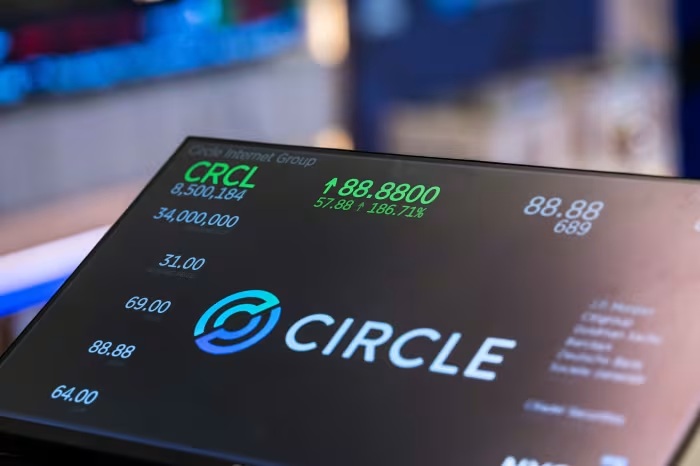


Circle (CRCL), the stablecoin issuer behind the popular USDC digital dollar, saw its stock rise 2% in afternoon trading on Tuesday following its release of better-than-expected quarterly revenue results — marking the company’s first positive surprise since going public.
The company reported total revenue of $658 million for the second quarter, narrowly beating analyst estimates of $647 million. This growth was driven largely by the surge in USDC stablecoin circulation, which CEO Jeremy Allaire described as the “fastest-growing major stablecoin over the past year.”
At the end of the quarter, USDC in circulation reached $61.3 billion, up 90% year over year, and had expanded further to $65.2 billion as of August 10, reflecting continued robust demand. Speaking to Yahoo Finance, Allaire noted, “Overall activity globally in the digital asset economy has been growing steadily. We’re seeing increasing adoption of dollar digital currencies like USDC as both a store of value and a medium for cross-border settlements.”
He added, “Use cases continue to expand, and people are recognizing USDC as a high-utility, new form of money that’s transforming how value moves worldwide.”
Alongside revenue growth, Circle announced plans to launch ARC, a new blockchain network aimed at enabling stablecoin finance with fast, predictable, and low-cost transaction fees. “Our goal with ARC is to create a platform where institutions can pay blockchain fees in a simple, stable manner that’s easy to account for,” Allaire explained during the company’s earnings call. The network is scheduled to launch in the second half of 2025.
Since its IPO, Circle stock has surged roughly 480% from its $31 debut price, buoyed by an influx of crypto-friendly legislation including the GENIUS Act, which establishes regulatory guardrails for digital tokens backed by assets like the U.S. dollar. This legislation has positioned Circle at the center of optimism about the future of stablecoins and their broader adoption.
Circle’s revenue model heavily depends on interest income generated from short-term U.S. Treasury bills backing its USDC stablecoin reserves. This income rose 50% year over year to $634 million, fueled primarily by the 86% growth in USDC circulation. Despite concerns that a Federal Reserve interest rate cut could reduce yields on Treasury bills, Allaire expressed confidence that the rising velocity of stablecoin usage will more than offset any decline.
“We believe lower interest rates will accelerate our business growth, as more capital circulates in the economy and money velocity increases,” he said. “This high-utility form of money is poised to expand further as it sees wider use.”
However, Circle’s business also relies on partnerships such as with Coinbase (COIN), which serves as a major distribution channel. Analyst Ed Engel from Compass Point recently raised concerns about rising distribution costs as the company expands its network and continues sharing a portion of its interest income with partners.
Engel noted that Circle’s gross profit margin guidance of 36% to 38% for fiscal year 2025 “slightly underwhelmed,” implying second-half margins may dip below the 39% margin posted in the first half. He suggested that recent partnerships do not appear to be improving near-term margins and reiterated a Sell rating with a $130 price target on the stock.
Despite these cautious views, other analysts see Circle as a key vehicle for investors to gain exposure to the growing stablecoin market. Jeff Cantwell of Seaport Research called CRCL “the purest stablecoin play in the public markets right now,” predicting further share price gains as the company explores new opportunities with partners. Cantwell maintains a Buy rating and a $280 price target on the stock.
Circle’s strong results and upbeat outlook come amid a generally buoyant market environment, where crypto assets have rallied on expectations of upcoming Federal Reserve rate cuts and renewed political support for crypto, including efforts to allow crypto investments in 401(k) retirement plans championed by President Trump.
Ahead of earnings, Wall Street analysts held mixed opinions on Circle, with nine Buy ratings, five Hold ratings, and four Sell ratings, reflecting a balance of optimism and caution around the company’s prospects in a rapidly evolving digital asset landscape.



 Pump Radar
 Stock Alerts