
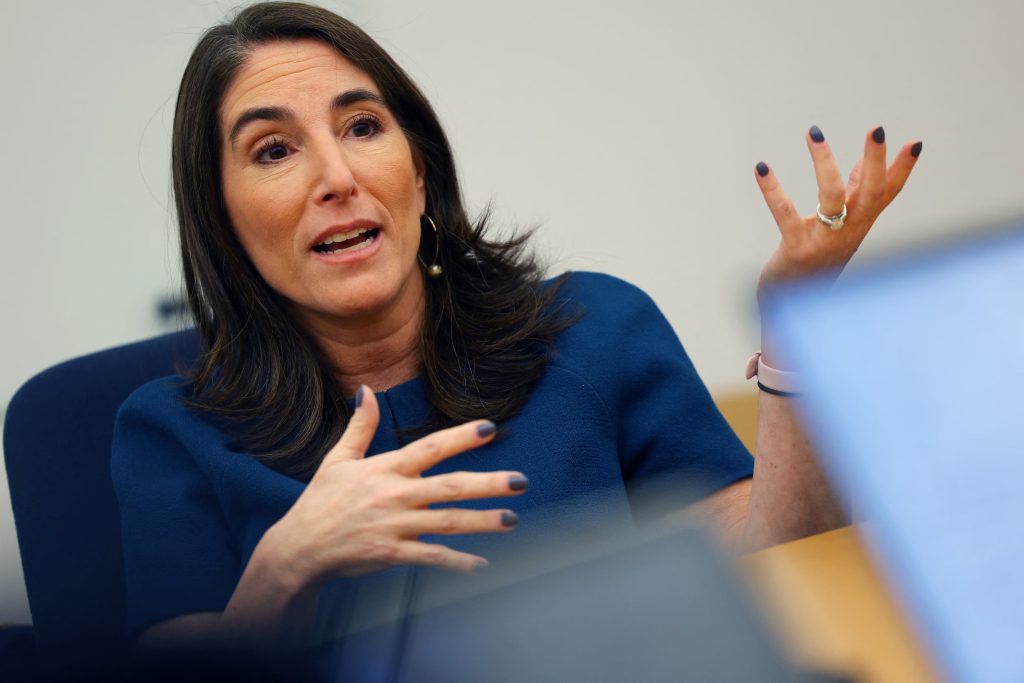


Cleveland Federal Reserve President Beth Hammack on Monday highlighted the difficulties the U.S. central bank faces as it attempts to balance controlling stubborn inflation with supporting jobs in a complex economic environment. Speaking on CNBC’s Squawk Box Europe, Hammack described the current period as “a challenging time for monetary policy.”
Hammack emphasized her ongoing concern over inflation, noting that the Fed has consistently missed its 2% inflation target for more than four and a half years. She highlighted price pressures not only in headline and core inflation but particularly within the services sector, which remains a focal point of her concern. “I continue to be worried about where we are from an inflation perspective,” she said, stressing that inflation remains stubbornly above the central bank’s goal.
When asked whether cutting interest rates might be a mistake in the current economic climate, Hammack acknowledged the difficulty of the decision. She said the Fed faces pressure on both sides of its dual mandate, balancing the need to keep prices in check while supporting employment. “So, again, to me, when I balance those two sides of our mandate, I think we really need to maintain a restrictive stance of policy so that we can get inflation back down to our goal,” she added.
Her comments follow a series of stronger-than-expected economic reports that have tempered Wall Street’s expectations for rapid rate cuts. Earlier this month, the Fed implemented a widely anticipated quarter-point rate reduction, lowering the benchmark overnight lending rate to a range of 4.00%-4.25%, and signaled two more cuts could come before year-end. Yet robust economic data since then have prompted investors to scale back expectations for aggressive monetary easing.
Investor focus is now shifting to the September nonfarm payrolls report, scheduled for Friday, although its release could be impacted by a potential government shutdown. Hammack characterized the U.S. labor market as reasonably healthy and broadly in balance, but stressed that inflation remains a persistent threat. She does not anticipate prices returning to the Fed’s 2% target until late 2027 or early 2028, underscoring the long-term challenge the central bank faces.
Hammack, a former Goldman Sachs executive, is not a voting member of the Federal Open Market Committee (FOMC) this year, yet her insights carry weight given her position and expertise. Her remarks echo a broader concern within the Fed about two-sided risks in the current economic environment.
According to recently released data, U.S. core inflation remained largely unchanged in August. The personal consumption expenditures (PCE) price index rose 0.3% for the month, bringing the annual headline inflation rate to 2.7%, while the core PCE, which excludes food and energy, increased 0.2% for the month, registering 2.9% on an annual basis.
Hammack has previously indicated caution regarding rate cuts as long as inflation remains elevated. Her stance aligns with Fed Chair Jerome Powell, who on September 23 described the current environment as “tricky,” noting that near-term risks to inflation are tilted upward, while risks to employment lean downward. Powell added that “two-sided risks mean that there is no risk-free path” for monetary policy, highlighting the delicate balancing act facing the Fed.
As the U.S. central bank continues to navigate these competing pressures, policymakers will need to weigh the persistent threat of inflation against the goal of supporting economic growth and employment, making the months ahead particularly consequential for the trajectory of interest rates and broader economic conditions.


 Pump Radar
 Stock Alerts