
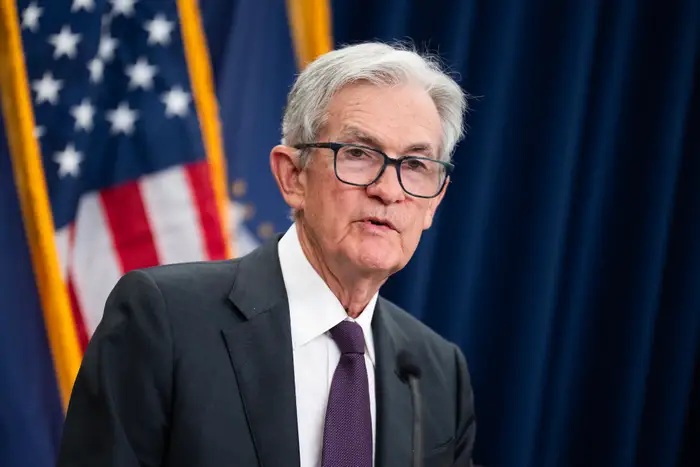


Federal Reserve Chair Jerome Powell on Tuesday acknowledged that asset prices, particularly stocks, are currently at elevated levels, while emphasizing that the situation does not yet signal major financial stability concerns. Speaking at an event in Providence, Rhode Island, Powell offered a candid assessment of the U.S. equity market amid a period of strong gains and record-setting benchmarks for major averages.
During his remarks, Powell was asked about the degree to which he and his colleagues at the Fed monitor market valuations and whether they exhibit any tolerance for higher-than-usual asset prices.
“We do look at overall financial conditions, and we ask ourselves whether our policies are affecting financial conditions in a way that is what we’re trying to achieve,” Powell said. “But you’re right, by many measures, for example, equity prices are fairly highly valued.”
Powell’s comments come in the wake of a sustained rally in U.S. financial markets. In the lead-up to last week’s Federal Open Market Committee (FOMC) meeting, stocks and other assets surged as investors anticipated a potential cut to the central bank’s benchmark overnight lending rate. Following the FOMC’s decision on Wednesday to lower the rate by a quarter percentage point, stock prices continued to climb, with major indices hitting new record highs in rapid succession.
In his discussion, Powell also addressed how market participants incorporate expectations of monetary policy into pricing decisions.
“Markets listen to us and follow, and they make an estimation of where they think rates are going. And so they’ll price things in,” he explained, noting that this dynamic affects a broad range of financial instruments, including equities, bonds, and mortgage rates.
Despite acknowledging that valuations appear high, Powell stressed that current conditions do not indicate an imminent risk to financial stability. He emphasized that the Fed continually evaluates financial conditions as part of its broader mandate to support maximum employment and price stability, but said that elevated asset prices alone are not a signal of systemic risk at this time.
Powell’s remarks highlight the delicate balancing act facing the Fed as it navigates the dual mandate of fostering economic growth while keeping inflation in check. Elevated stock prices can reflect investor optimism about the economy, but they also raise questions about potential overvaluation and the risks it could pose if market sentiment shifts abruptly. By monitoring financial conditions, the Fed aims to understand how its interest rate decisions ripple through markets, influencing borrowing costs, investment decisions, and consumer spending.
Analysts have noted that the recent rally has been fueled in part by investor expectations that the Fed may adopt a more accommodative stance in the near term, particularly as inflation data shows signs of moderation and economic growth remains steady but unspectacular. Powell’s acknowledgment that equities are “fairly highly valued” underscores the central bank’s awareness of market exuberance, even as officials remain confident that broader financial stability is not immediately threatened.
As the Fed continues to navigate the post-rate-cut environment, Powell’s comments serve as a reminder that while markets may respond enthusiastically to monetary policy signals, the central bank’s assessment of overall economic and financial stability remains nuanced, taking into account both valuations and underlying economic fundamentals.
“This is not a time of elevated financial stability risks,” Powell concluded, reassuring investors that while asset prices are high, the broader U.S. financial system remains resilient.


 Pump Radar
 Stock Alerts