
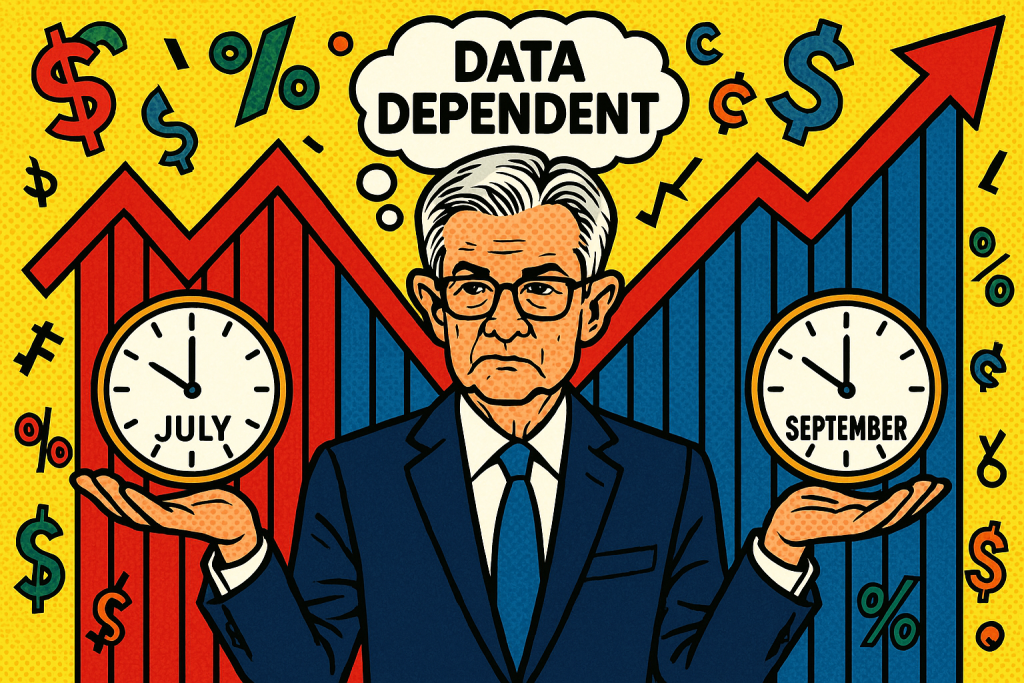


When Jerome Powell says “data-dependent,” Wall Street leans in. And lately, there’s been a lot to analyze. After weeks of soft signals – weak PMI data, sluggish private sector hiring, and sticky inflation tied to tariffs – investors are wondering: is July too soon for the Fed to make its move?
With the next batch of FOMC minutes due Wednesday, we’re heading into a pivotal moment. Powell’s recent comments at Sintra left the door cracked open for a rate cut, but not wide enough for consensus. The Fed Chair didn’t rule out a July move – but he didn’t endorse it either.
And that’s the puzzle: inflation may be cooling in places, but not fast enough for comfort. Meanwhile, jobs data is giving mixed signals. So what’s next?
Let’s break down why the Federal Reserve is facing its toughest balancing act yet – and how investors should be thinking ahead of this week’s big reveal.
Headline Strength, Hidden Weakness
June’s jobs report surprised to the upside on the surface. The U.S. economy added 147,000 jobs, beating expectations. That might sound solid – but look closer.
Nearly half of those gains came from government hiring. Private sector job creation is slowing. The unemployment rate dipped slightly to 4.1%, but labor force participation barely budged.
This suggests a labor market that’s losing steam under the hood – even if the top-line numbers don’t scream recession. That kind of tension is exactly what complicates the Fed’s thinking. Do they respond to the trend, or the headline?
Manufacturing Is Feeling the Heat
Another red flag: the June ISM Manufacturing PMI clocked in at 49.0. That’s below the 50-mark that separates growth from contraction – and it’s not a one-off.
This marks the third straight month of contraction. More concerning? Input prices are rising fast, in large part due to trade policy uncertainty and newly proposed tariffs. That’s inflationary in nature – and potentially long-lasting if political rhetoric continues heating up.
Powell has acknowledged this. While avoiding the word “stagflation,” his tone at the European Central Bank forum in Sintra was clearly more cautious than confident. Yes, the Fed is open to rate cuts – but not without a better read on how tariffs and fiscal expansion will hit the economy.
Futures Are Moving – But Still Split
Before Powell spoke in Sintra, the odds of a July rate cut were fairly low – around 20% based on futures data. After his comments? That ticked up to 25%, reflecting just enough uncertainty to keep traders hedging.
By contrast, expectations for a September cut are much stronger, currently hovering around 65–70%. That timeline gives the Fed another CPI report, another jobs report, and time to analyze how tariffs filter through global supply chains.
The takeaway? Investors are still betting that the Fed cuts this year – but they don’t see Powell moving hastily. Especially not in July.
Sticky Inflation Is Still a Problem
Despite slowing wage growth and declining used car prices, other areas of inflation remain elevated – especially those tied to housing and services.
And now, tariffs on key imports – particularly tech components and AI software – are adding fresh inflationary pressure. The Biden administration’s muted stance on rolling back trade barriers has created even more uncertainty.
This is what makes Powell’s job so tricky. Inflation is no longer just about demand. It’s becoming entangled with supply-side and political variables – things monetary policy can’t fix easily.
So even if the economy shows signs of weakness, the Fed may hesitate. Why? Because inflation that’s driven by policy or geopolitics doesn’t necessarily respond to rate cuts.
The Fed’s Split Personality
Behind Powell’s measured tone lies a divided Federal Reserve. Some governors, like Austan Goolsbee and Raphael Bostic, have hinted they’re open to a cut sooner rather than later. Others remain firmly in “wait and see” mode.
That internal split is part of what markets will be watching when the FOMC minutes drop. Was June’s hold unanimous? Or were there signs of dissent? And how did Powell frame the risks – both to inflation and to growth?
This matters because the market is trying to game the Fed’s next few moves. July might be too soon. September seems more likely. But a shock data point or geopolitical event could upend that path entirely.
What Investors Should Watch This Week
- FOMC Minutes (Wednesday): Pay attention to how officials discussed inflation, labor, and trade. Watch for language around “patience” or “data-driven” pivots.
- Jobless Claims (Thursday): Weekly data can offer a near real-time read on labor market softness.
- Tariff News: Any movement on trade deals – especially with China – could shift inflation expectations fast.
Final Thoughts: It’s a Powell Puzzle
In many ways, July isn’t about action – it’s about tone. And Powell has mastered the art of ambiguity. The Fed isn’t rushing, but it’s also not blind to risk.
The real message? The central bank wants options. And right now, keeping rates steady buys time – while still signaling concern about downside risk.
For investors, that means staying flexible. Markets are increasingly data-sensitive. Every economic release, every political headline has the potential to tip sentiment.
So is July too soon to cut? Probably. But if the Fed’s puzzle pieces don’t align by September, expect the conversation to get much louder.
Because when Powell speaks, it’s not just about what he says – it’s about what he doesn’t.


 Pump Radar
 Stock Alerts