
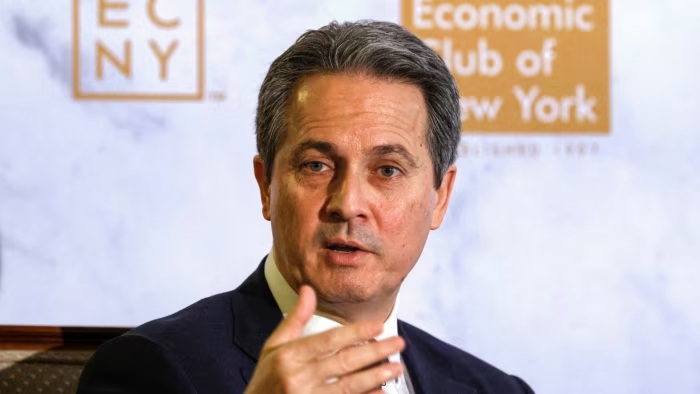


St. Louis Federal Reserve President Alberto Musalem, long viewed as one of the central bank’s more hawkish voices, on Wednesday signaled a notable softening of his stance, suggesting he could support a rate cut later this year if labor market conditions deteriorate further. Speaking at the Peterson Institute for International Economics in Washington, D.C., Musalem said he expects the job market to cool gradually and downplayed long-term concerns about inflation — comments that mark a shift from his previous warnings about persistent price pressures.
“With the pace of hiring low, any increase in layoffs could produce a more substantial labor market weakening than would occur in a more active market,” Musalem said. While he added that he is “not hearing from businesses about an imminent increase in layoffs,” he noted that “real GDP growth that is somewhat below potential and profit margin pressures related to tariffs could contribute to such an outcome.”
On inflation, Musalem said he expects the price effects from tariffs to work their way through the economy over the next two to three quarters, with the impact fading thereafter. That’s a significant departure for a policymaker who has spent much of this year warning about the risk of elevated inflation and cautioning against easing policy prematurely.
The Federal Reserve’s next policy meeting is scheduled for September 16-17, and investors are widely expecting the central bank to make its first rate cut of 2025. Musalem’s remarks add to a growing chorus of officials signaling that the Fed may soon pivot to a more accommodative stance as the economy slows.
Fed Governor Chris Waller reinforced that view in a separate appearance on CNBC Wednesday, saying he wants to see a cut at the next meeting because the job market appears to be weakening and he wants to head off a sharper downturn. “I’ve been clear that I think we should be cutting by the next meeting,” Waller said. “The labor market has come in much softer … and you want to get ahead of having the labor market go down because usually when the labor market turns bad, it turns fast in a nonlinear fashion, it doesn’t just kind of creep up.”
Waller added that he envisions multiple cuts over the next three to six months to bring the Fed’s benchmark interest rate down to about 3% — the so-called “neutral rate” designed to neither stimulate nor restrict economic growth.
Musalem’s pivot underscores the balancing act facing the central bank. After raising rates aggressively to curb inflation, policymakers are now weighing the risk of overtightening and choking off job growth against the danger of cutting too soon while price pressures still linger. For a hawk like Musalem to publicly acknowledge a fading inflation impulse and potential downside risks to the labor market signals just how much the Fed’s calculus may be shifting heading into its September meeting.
 Pump Radar
 Stock Alerts