
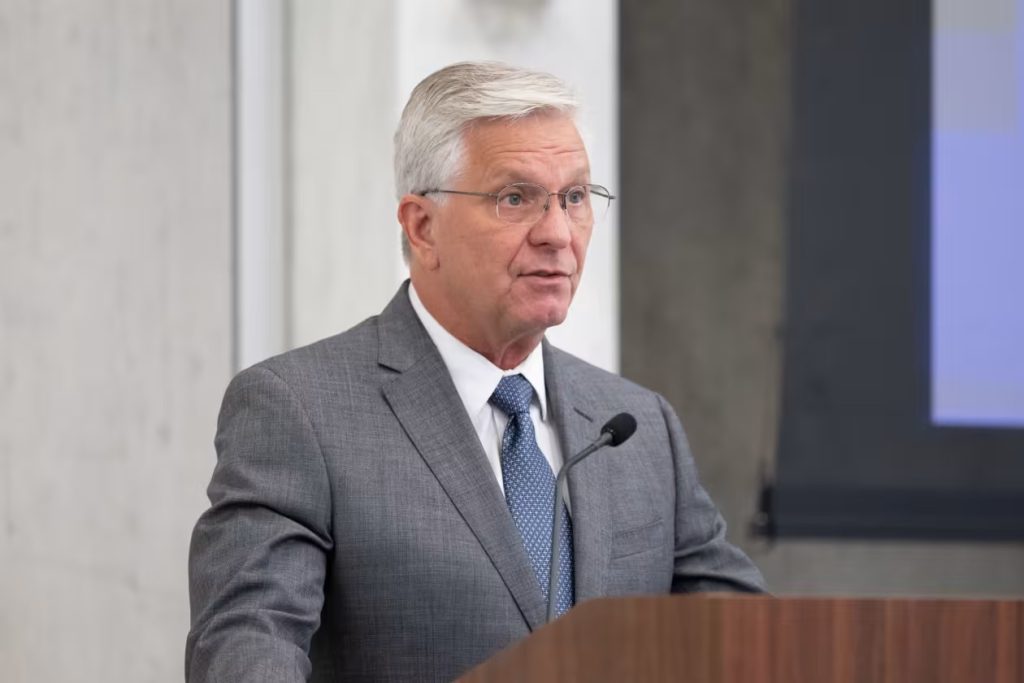


Federal Reserve Governor Christopher Waller on Thursday reiterated his call for the U.S. central bank to begin cutting interest rates next month, signaling that further reductions could follow over the coming months to bring policy closer to a neutral stance. Speaking at the Economic Club of Miami, Waller said he would support a 25-basis-point cut at the Federal Open Market Committee (FOMC) meeting on September 16–17, framing it as a proactive step to support the economy amid signs of labor-market softening.
“While there are signs of a weakening labor market, I worry that conditions could deteriorate further and quite rapidly,” Waller said. “It is important that the FOMC not wait until such a deterioration is under way and risk falling behind the curve in setting appropriate monetary policy.” He emphasized that his recommendation for a modest one-quarter-point cut could change depending on the upcoming August jobs report, due next Friday, as well as inflation data.
Waller described the current Fed policy rate range of 4.25% to 4.50% as above neutral, which he estimates at roughly 3%, meaning monetary policy is still somewhat restrictive. “The time has come to ease monetary policy and move it to a more neutral stance,” he said, adding that additional rate cuts are likely over the next three to six months, with the pace determined by incoming economic data.
Answering questions following his speech, Waller noted that the sequence of cuts may not be uniform. “It could be a sequence of cuts; it may be a couple, then you may want to pause,” he said. “We know we want to head towards neutral; it’s just a question of how fast we get there.” He also indicated that upward price pressures stemming from tariffs are likely to peak by the end of this year or early 2026, implying that inflationary risks may be temporary.
Waller further stressed the importance of acting before conditions worsen. “I fully expect more rate cuts as the labor market continues to soften; growth is probably still going to be slow in the second half of the year,” he said. “Because monetary policy works with long lags, you don’t want to wait.”
The remarks echo Waller’s previous stance on monetary easing. He, along with fellow Fed Governor Michelle Bowman, dissented from the Fed’s decision on July 30 to hold rates steady, citing concerns about a weakening labor market. Both governors, appointed by former President Donald Trump, have been mentioned as potential successors to Fed Chair Jerome Powell, who has faced public pressure from Trump to lower rates more aggressively.
Waller’s comments underscore the Fed’s careful balancing act: supporting economic growth without letting inflation expectations drift higher, all while responding to signs that the labor market may be slowing. Investors and analysts will now closely monitor the September FOMC meeting and August payroll report, as the central bank charts its path toward a neutral policy stance while managing uncertainty from tariffs and global growth pressures.

 Pump Radar
 Stock Alerts