
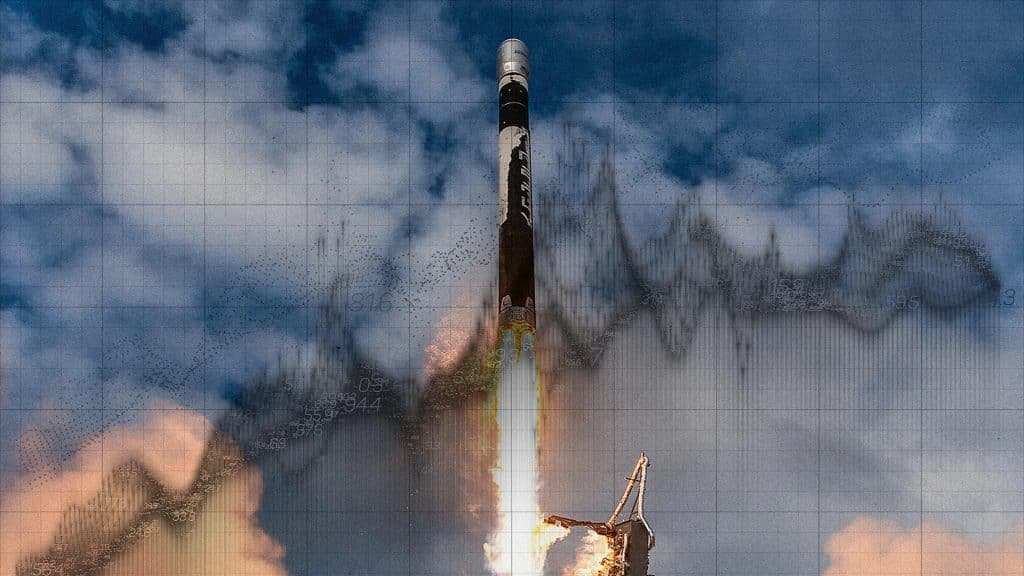


Firefly Aerospace is now aiming for a valuation of up to $6.04 billion in its upcoming U.S. initial public offering, according to a company filing on Monday. This marks an increase in the pricing range amid growing investor interest in space-related companies.
The Texas-based space and defense technology startup plans to raise up to $696.6 million by offering 16.2 million shares priced between $41 and $43 each. Last week, when Firefly launched its IPO roadshow, it initially targeted $631.8 million at a $5.5 billion valuation at the high end of its range.
The increase in expected funds is due to the company raising its price range from $35 to $39 per share to the current $41–$43 range. Firefly Aerospace will trade on the Nasdaq under the ticker symbol ‘FLY’.
The company’s S-1 filing reveals that it had $176.9 million in cash and cash equivalents as of March 31, alongside $173.6 million in debt, of which $136.1 million is from a term loan.
Firefly highlighted its strategic partnerships as a competitive advantage, including an alliance with SpaceX. It has also teamed up with Blue Origin’s subsidiary to acquire a rover that will accompany its lunar lander on an upcoming NASA mission.
The IPO is being led by major underwriters Goldman Sachs, JPMorgan Chase, and Wells Fargo Securities. Firefly has also secured an option for these underwriters to purchase an additional 5% of the shares being offered, at the company’s request.
Founded in 2017, Firefly Aerospace specializes in small- to medium-lift launch vehicles, orbital spacecraft, and lunar landers. The company touts the ability to launch satellites into orbit on as little as 24 hours’ notice.
The company’s IPO arrives amid a renewed surge in the space industry, driven by billionaire-led ventures like Elon Musk’s SpaceX investing heavily in space exploration, while emerging startups increasingly seek capital through public markets.
In recent months, space technology firm Voyager went public in June, and reusable rocket developer Innovative Rocket Technologies announced intentions to go public via a $400 million special purpose acquisition company (SPAC) merger.

 Pump Radar
 Stock Alerts