
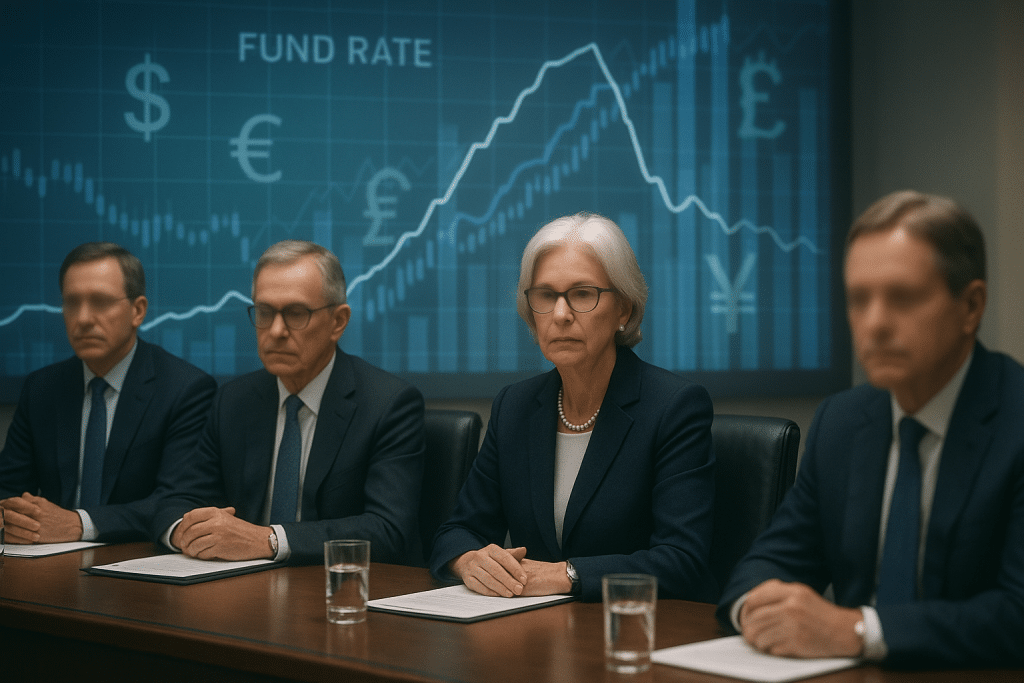


As global markets continue to juggle inflation pressures, geopolitical flare-ups, and growth concerns, all eyes are on central banks.- and the messages they’re sending. This past week, the G‑7 finance ministers met in Italy, offering hints at policy coordination, while the U.S. Federal Reserve maintained its cautious stance on interest rates. Meanwhile, the European Central Bank and the Bank of Japan each struck distinct tones, sparking debates over whether a synchronized pivot toward rate cuts is on the horizon – or still far off.
Let’s break it down. The narrative of “higher for longer” has dominated most of 2024 and early 2025. But as inflation metrics begin to cool across key economies and recessionary signals creep into the data, the pressure is mounting. Investors want clarity – and maybe even a bit of relief.
What Happened at the G‑7?
The G‑7 finance ministers – representing the U.S., Canada, U.K., Germany, France, Italy, and Japan – didn’t unveil any blockbuster decisions, but their messaging matters. For one, there was a clear acknowledgment that inflation, while improved, remains sticky in some sectors. At the same time, several members highlighted growing concerns over sluggish growth, especially in Europe and Japan.
The group’s communique didn’t call directly for interest rate cuts, but it did emphasize the need for “agile” monetary responses and closer policy monitoring. That word – agile – suggests flexibility, which markets often interpret as code for “get ready for pivots.”
Perhaps more telling was what wasn’t said. The G‑7 avoided any harsh language around currency volatility, which some had expected given the yen’s dramatic decline this year. That gave the BOJ room to maneuver without international pushback.
The Fed Holds Ground – for Now
In the U.S., Federal Reserve Chair Jerome Powell reiterated a familiar theme: the Fed needs more data before making a move. During last week’s FOMC meeting, rates were held steady, and the dot plot revealed that policymakers only expect one cut in 2025, down from earlier expectations of three.
Still, Powell didn’t close the door. He acknowledged that the labor market is showing signs of loosening, wage growth is moderating, and inflation is moving in the right direction. But it’s not enough yet.
The Fed’s main worry? Cutting too soon and reigniting inflation.
Market watchers are betting otherwise. Futures markets now price in a nearly 60% chance of a rate cut by September. Powell might not be ready to commit, but investors are reading between the lines – and pricing in a pivot.
The ECB Blinks First
Across the Atlantic, the European Central Bank broke ranks. Earlier this month, it delivered its first rate cut since 2019, citing easing inflation and stagnating economic growth in Germany and France.
President Christine Lagarde stressed that future cuts would be “data-dependent,” but this first move was significant. It signals that at least one major central bank believes the inflation battle is far enough along to consider supporting growth.
The ECB’s action is important for global equities too. A softer euro tends to help European exporters, and looser monetary policy can spark risk-on appetite across emerging markets and global small caps.
Japan: A Different Game
Then there’s Japan. While other central banks are debating when to cut, the BOJ is still easing out of its ultra-loose policy. The yen has fallen to multi-decade lows against the dollar, and inflation remains below target despite rising import costs.
The BOJ didn’t move rates at its June meeting, but Governor Kazuo Ueda hinted that rate normalization could resume later this summer. For now, Japan’s dovish stance is keeping global carry trades alive and supporting asset risk-taking in Asia.
Still, the divergence between Japan and the rest of the G‑7 creates a dilemma. If the BOJ tightens too quickly while others cut, it could upend currency markets. But if it stays too loose, it risks capital flight and inflation importation.
So, What Does This Mean for Equities?
Let’s be clear: central bank decisions are not just academic. They ripple across markets. When one major economy pivots, others often follow – or at least react.
Here’s what to watch:
- U.S. Tech and Growth Stocks: These names tend to benefit from lower rates due to their long-dated cash flows. If the Fed signals a cut, even a small one, expect renewed strength in tech-heavy indices like the Nasdaq.
- European Cyclicals: With the ECB already easing, cyclical sectors like autos, materials, and financials could see momentum, especially if China demand stabilizes.
- Emerging Markets: Lower rates in developed markets typically support EM currencies and equities. Watch for breakouts in Brazil, India, and Indonesia if rate cuts accelerate globally.
- Safe Havens vs Risk Assets: If geopolitical tensions stay elevated while central banks cut, gold and Treasury bonds may continue to attract capital even as equities rise. It’s a rare but not impossible combination – one that could create uncorrelated returns.
The Wildcard: Inflation Surprises
Despite optimism, markets remain sensitive to inflation data. If core inflation proves stickier than expected – especially in the U.S. – the Fed may delay cuts into 2026. Conversely, a sharp drop in CPI over the summer could force their hand.
Global coordination matters too. If the ECB continues cutting while the Fed holds, the dollar will strengthen, which could put pressure on U.S. exporters and support global disinflation. It’s a delicate dance – and investors know it.
Final Takeaway
The G‑7 and central bank positioning have shifted the narrative from “how high will rates go?” to “when can we start coming down?” But it’s not a synchronized march – at least not yet.
The ECB has made its move. The BOJ is cautiously testing the waters. The Fed is standing on the shore, clipboard in hand, waiting for the data tide to come in.
For investors, that means staying nimble. Rate cuts may be coming – but they won’t arrive all at once. And in that space of uncertainty, volatility will thrive.
So watch the data. Listen to the speeches. And don’t forget – when policy changes come, markets often move fast.




 Pump Radar
 Stock Alerts