
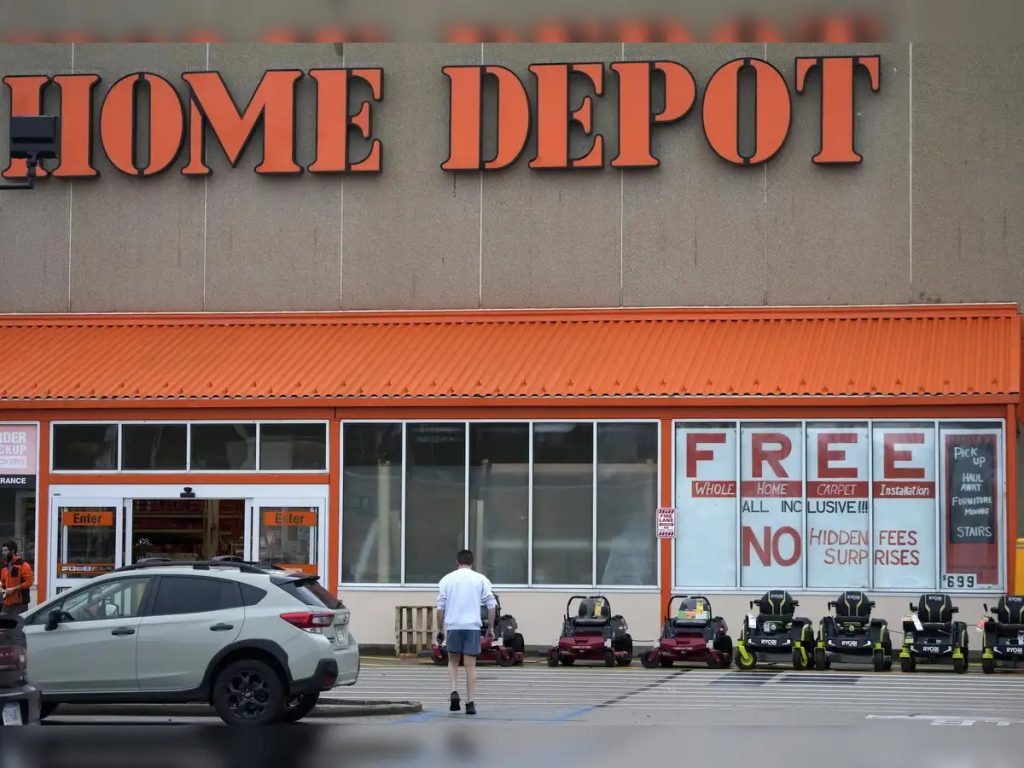


Shares of Home Depot (NYSE: HD) climbed about 4% in early trading on Tuesday after the home improvement giant reaffirmed its full-year outlook, even though its fiscal second-quarter earnings and revenue came in slightly below Wall Street expectations. The company reiterated its guidance for total sales growth of 2.8% for the full year and comparable sales growth of roughly 1%, which strips out one-time factors such as store openings and calendar shifts.
For the quarter ending Aug. 3, Home Depot reported net income of $4.55 billion, or $4.58 per share, slightly lower than the $4.56 billion, or $4.60 per share, recorded in the year-ago period. Revenue totaled $45.28 billion, up nearly 5% from $43.18 billion a year earlier but slightly below the consensus estimate of $45.36 billion. Adjusting for one-time items, including those related to intangible assets, the company reported $4.68 per share, versus the $4.71 per share analysts had expected. This marks the first quarter since May 2014 in which Home Depot missed on both earnings and revenue expectations.
Despite the miss, company executives pointed to underlying momentum in several areas. Chief Financial Officer Richard McPhail noted that Home Depot continues to see a “deferral mindset” among homeowners that emerged around mid-2023, as some consumers postpone large projects due to economic uncertainty. Yet, he highlighted growth in big-ticket purchases—defined as transactions over $1,000—which rose 2.6% compared with the year-ago quarter. Additionally, 12 of the company’s 16 merchandising departments posted year-over-year sales gains, and comparable sales improved each month of the quarter, with increases of 0.3% in May, 0.5% in June, and 3.3% in July.
CEO Ted Decker emphasized during the earnings call that while lower mortgage rates could provide some relief, general economic uncertainty remains the primary reason homeowners defer large projects. “The No. 1 reason for deferring the large project is general economic uncertainty,” he said, noting that factors like labor availability and project costs are secondary considerations.
Home Depot has increasingly looked to professional contractors to drive growth amid a slower housing market. The company’s pro customer base, which includes contractors and construction professionals, accounts for roughly 55% of sales, while do-it-yourself (DIY) customers make up the remaining 45% when including acquisitions like SRS Distribution. In recent years, Home Depot has bolstered its pro segment through acquisitions, including the $18.25 billion purchase of SRS Distribution last year and its planned $4.3 billion acquisition of specialty building products distributor GMS, expected to close by the end of Home Depot’s fiscal year in late January.
Sales trends showed strength across both pro and DIY segments. Categories popular with pros, including lumber, concrete, and decking, performed well, while seasonal DIY items like grills and live gardening goods also saw strong demand. Online sales climbed about 12% year over year, supported by faster delivery times. Comparable sales in the U.S. grew 1.4%, while overall business-wide comparable sales increased 1%, despite a roughly 0.4% drag from foreign exchange fluctuations. This marked only the second quarter in the past 11 in which Home Depot reported year-over-year comparable sales growth, signaling the strongest performance in more than two years.
While tariffs and rising import costs have introduced uncertainty for retailers, Home Depot said it has largely absorbed these costs without raising prices across its stores. Most imported products sold in the quarter were received before the latest tariff increases, and the company has not altered its pricing strategy in response to U.S. trade policy shifts.
Customer spending patterns indicate a resilient base. Total transactions across Home Depot’s stores and website fell slightly to 446.8 million from 451 million a year earlier, yet the average transaction value rose to $90.01 from $88.90. Homeowners, who comprise roughly 90% of the DIY customer segment, and pro contractors generally maintain stronger financial footing, helping Home Depot navigate the current cost environment.
Home Depot’s shares ended Monday at $394.70, up approximately 1.5% year to date, trailing the nearly 10% gain of the S&P 500 over the same period. Despite the modest earnings miss, investors appeared reassured by the company’s steady outlook, growth in high-value categories, and ongoing investments in professional customer channels.

 Pump Radar
 Stock Alerts