
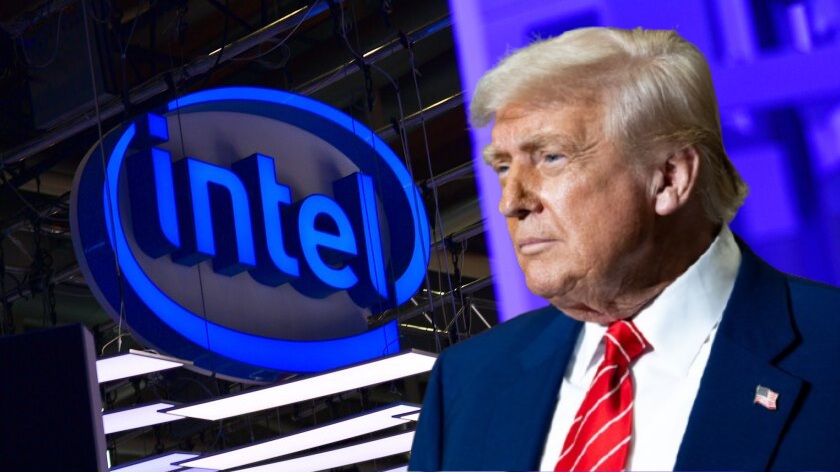


The U.S. government has made one of its most significant bets yet on domestic semiconductor production, taking a 9.9% stake in Intel (INTC) with an $8.9 billion investment. The deal, announced late Friday, underscores Washington’s push to bolster advanced chipmaking capacity on U.S. soil amid growing competition with Asia.
According to Intel, the government purchased 433.3 million shares at $20.47 each. The ownership will remain passive, with no Board representation, governance authority, or information rights. As part of the agreement, the government also pledged to align its votes with Intel’s Board of Directors, ensuring the company retains control.
The investment draws from federal funding previously promised to Intel but not yet delivered. Of the $8.9 billion, $5.7 billion comes from outstanding CHIPS and Science Act grants, while $3.2 billion comes from the Secure Enclave program, which supports trusted and secure semiconductor production for defense purposes. Combined with $2.2 billion in CHIPS grants Intel has already received, the federal government has now funneled $11.1 billion into the company.
Intel reaffirmed its commitment to the Secure Enclave initiative, vowing to continue supplying the Department of Defense with secure chips. “President Trump’s focus on U.S. chip manufacturing is driving historic investments in a vital industry that is integral to the country’s economic and national security,” CEO Lip-Bu Tan said. “We are grateful for the confidence the President and the Administration have placed in Intel, and we look forward to working to advance U.S. technology and manufacturing leadership.”
President Donald Trump previewed the move earlier on Friday, saying his administration would acquire a 10% stake in what he called an “ailing” but strategically essential chipmaker. He touted the plan as a “great deal.” Intel’s stock responded positively, closing up 5.5% on the day before slipping 1% in after-hours trading as investors digested details of the arrangement.
As part of the transaction, the U.S. government also secured a five-year warrant giving it the option to acquire another 5% of Intel shares at $20, but only if Intel loses majority ownership of its foundry business.
The support comes at a critical juncture for Intel. Once the undisputed leader in chips, the company has faced mounting challenges across its operations. Its manufacturing unit is losing money, while its legacy PC business continues to cede market share to rivals Advanced Micro Devices (AMD) and Qualcomm (QCOM). In the booming artificial intelligence sector, Intel has fallen far behind AMD and Nvidia (NVDA), whose cutting-edge processors dominate the industry.
Intel’s struggles have forced dramatic restructuring under CEO Lip-Bu Tan. The company’s market capitalization has sunk to $111 billion—less than half its 2021 peak. To cut costs, Tan has laid off 15% of Intel’s workforce, canceled plans for new facilities in Europe, and pushed back construction on its $20 billion Ohio chip complex. He has also scaled back the ambitious global expansion strategy laid out by his predecessor, Pat Gelsinger.
Despite the setbacks, Intel remains the only U.S.-based company capable of manufacturing advanced, leading-edge chips at scale. That unique position makes the company a linchpin in Washington’s strategy to reshore critical supply chains and reduce dependence on Asian foundries like Taiwan Semiconductor Manufacturing Company (TSMC).
The investment also comes on the heels of SoftBank Group’s announcement earlier this week that it will inject $2 billion into Intel, underscoring renewed interest in stabilizing the chipmaker as it navigates its turnaround.
Intel is working to build momentum in its foundry business, which manufactures chips for outside companies. Microsoft (MSFT) and Amazon (AMZN) have already signed agreements to use Intel’s new 18A process technology, though Intel itself remains the foundry unit’s largest customer. The company hopes these partnerships will help it claw back relevance in an increasingly competitive landscape.
For now, Intel continues to battle declining share in its PC and server chip segments, where AMD’s gains have been reinforced by its strong AI product pipeline. Meanwhile, Nvidia’s dominance in AI processors has left Intel trailing in one of the fastest-growing markets in tech.
Still, Washington’s investment signals a strong vote of confidence in Intel’s long-term role in U.S. technology leadership, even as the company grapples with execution risks. With $11.1 billion in federal funding behind it, Intel now has fresh backing to push forward with its turnaround and maintain its place as the cornerstone of America’s semiconductor strategy.



 Pump Radar
 Stock Alerts