
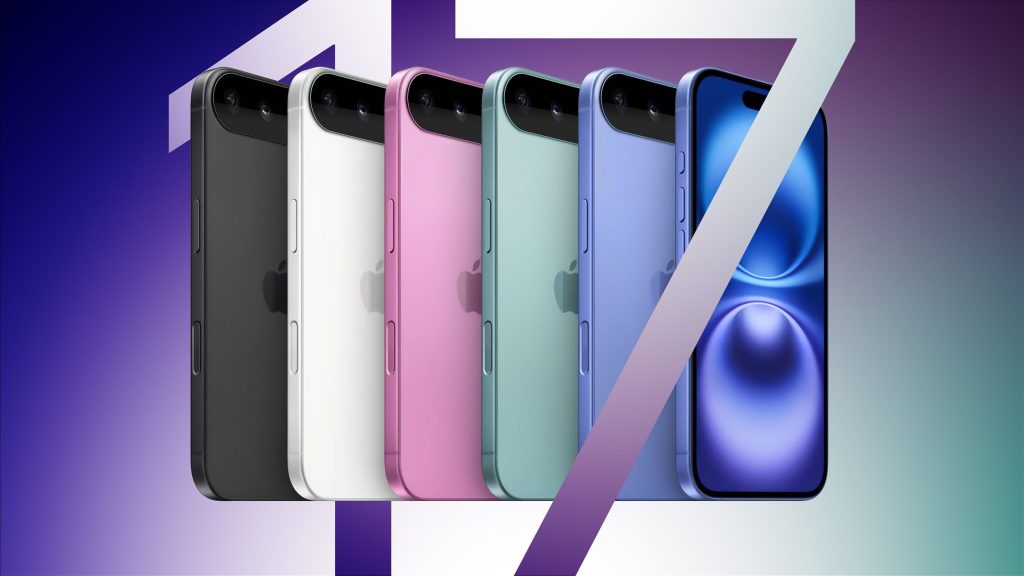


Apple is expected to unveil its latest hardware lineup on September 9, continuing its traditional fall launch cycle. The spotlight will likely fall on the iPhone 17 series, with additional updates for the Apple Watch and AirPods. Rumors ahead of the event suggest a mix of bold design changes, slimmer form factors, and new health and tech features.
iPhone 17, 17 Pro, and 17 Pro Max
The iPhone 17 lineup is rumored to receive a significant redesign, bringing the base model closer to the Pro series in terms of features and aesthetics. The iPhone 17 may sport a slightly larger 6.3-inch display, up 0.2 inches from the iPhone 16, along with a 120Hz refresh rate—a major upgrade from the current 60Hz screens. The front-facing camera is expected to be upgraded to 24 megapixels, and new colors, such as purple and green, may be introduced.
Pro models are expected to see notable changes on the rear. Concept renders show three cameras arranged in a rectangular bar stretching across the back, with the flash, light sensor, and microphone aligned to the right side. The Apple logo is likely to remain centered for symmetry and visual appeal. Notably, the iPhone 17 Pro may switch from a titanium band to aluminum, reducing weight and manufacturing costs, while the Pro Max could become slightly thicker to accommodate a larger battery—a significant improvement in battery life.
Pricing rumors suggest the iPhone 17 will cost around $800, the Pro $1,050, and the Pro Max $1,250. Leaks also indicate fewer storage options for Pro models, likely offering 256GB, 512GB, and 1TB, down from the previous four-tier system. In addition to the phones themselves, Apple may release new “TechWoven” cases for the Pro models, featuring premium woven materials and optional crossbody straps, replacing the older FineWoven line.
iPhone Air
Perhaps the most talked-about device is the iPhone Air, Apple’s rumored slimmest iPhone yet, which could replace the Plus model. At just 5.5 mm thick (approximately 0.08 inches thinner than current iPhones), the iPhone Air is expected to feature a 6.6-inch screen, offering a sleek, ultra-thin profile that competes with rivals like the Samsung Galaxy S25 Edge.
The Air may adopt a simplified design with a single rear camera and no bottom speaker, relying solely on the top earpiece for audio. Pricing is rumored around $950, with color options including black, silver, and light gold. Analysts see this as Apple’s response to the market trend toward slimmer smartphones and a potential stepping stone toward the company’s anticipated foldable phone, expected in 2026.
Apple Watch Series 11, Ultra 3, and SE 3
After a two-year interval, Apple Watch fans may see major updates. The Apple Watch Ultra 3 could feature faster charging, 5G support, satellite connectivity, and a larger display. One of the most exciting anticipated upgrades for the Ultra 3 and Series 11 is blood pressure monitoring, potentially alerting users to abnormal readings. Apple may also incorporate sleep apnea tracking, though Bloomberg’s Mark Gurman notes these features might be delayed for further refinement.
The Series 11 could also include incremental upgrades, while the SE 3 may see only minor changes such as a slightly larger display or a rumored plastic casing. Pricing leaks indicate $250 for SE 3, $400 for Series 11, and $800 for Ultra 3.
AirPods Pro 3
Following the 2022 launch of the AirPods Pro 2, Apple may introduce AirPods Pro 3, featuring a slimmer case, smaller earbuds, and touch-sensitive controls. The expected inclusion of the H3 chip could enhance active noise cancellation and adaptive audio, delivering improved sound quality and smarter environmental adjustments.
Apple’s upcoming event promises to combine design innovation, technical upgrades, and new health features, maintaining the company’s leadership in both consumer electronics and wearable technology. With the iPhone 17, iPhone Air, updated Apple Watches, and AirPods Pro 3, the September launch could set the stage for a strong holiday season while hinting at Apple’s longer-term ambitions in foldable devices and ultra-slim smartphones.


 Pump Radar
 Stock Alerts