
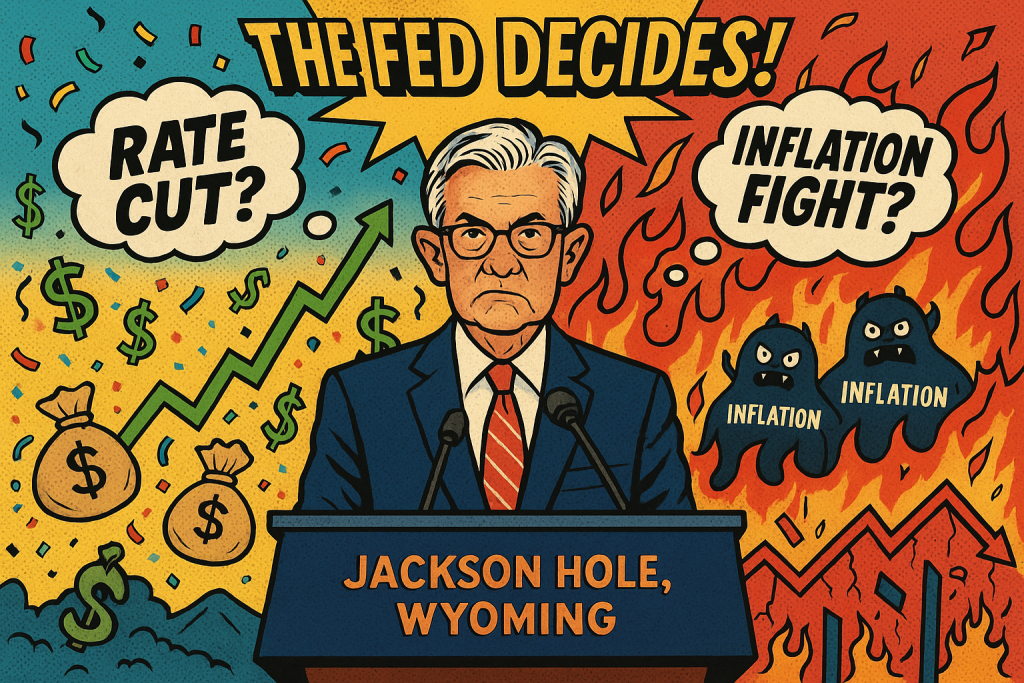


The financial world is holding its breath as Federal Reserve Chair Jerome Powell prepares to take the stage at Jackson Hole. With a crucial September FOMC meeting just weeks away, Powell’s speech this Friday could either confirm the first rate cut in over a year—or inject fresh uncertainty into an already jumpy market.
So far, 2025 has been a wild ride. Inflation, while moderating, has refused to go quietly. Stocks have roared higher on hopes of Fed easing. Bond yields have seesawed. And now, Jackson Hole could be the pivot point.
Why This Jackson Hole Matters More Than Usual
Markets aren’t just listening to Powell this time—they’re clinging to every word.
At stake is whether the Federal Reserve believes the fight against inflation is finally over, or if recent data suggests more caution is needed. A rate cut in September has been heavily priced in by futures markets, but recent signals have made that bet feel shakier.
The Split Inside the Fed
Last week’s release of the July FOMC meeting minutes revealed something we haven’t seen in years: open disagreement among Fed officials.
Two members—Governor Michelle Bowman and Governor Christopher Waller—came out strongly in favor of a rate cut before year-end, citing slower job growth and weakening consumer demand. But the majority of the committee voiced concern that inflation might remain “sticky,” especially in services and energy, due to Trump’s revived tariffs.
This division is unusual. The Fed typically moves with a unified voice. Powell’s speech could either unify expectations—or deepen the divide between the market and the central bank.
CPI and PPI Throw a Curveball
While June’s Consumer Price Index (CPI) report gave bulls something to cheer about—showing core inflation easing to 3.2% YoY—July’s Producer Price Index (PPI) was an unwelcome surprise.
PPI jumped 0.9% month-over-month and came in at 3.3% on an annualized basis, well above expectations. The rise was largely driven by energy and industrial inputs, both areas heavily impacted by ongoing tariffs on steel, aluminum, and critical imports.
For investors, this is a red flag: the inflation pipeline may still be active, even if consumer-facing prices appear calm.
Bond Markets Are Flashing Mixed Signals
Treasury yields are struggling to make up their mind.
The 2-year yield, which closely tracks Fed rate expectations, has dropped from 4.4% to under 3.8% over the last month—suggesting traders are confident a cut is imminent. Meanwhile, the 10-year yield remains stubbornly high near 4.3%, hinting at long-term concerns around inflation and ballooning federal debt.
This dislocation is creating confusion. A flatter or inverted yield curve usually signals recession risk. But with stocks near record highs, it’s unclear whether the market is being wise—or delusional.
Three Ways Powell Could Move the Market
What Powell says Friday could send shockwaves—or nothing at all. But history shows Jackson Hole often moves markets.
Here are the three most likely scenarios:
1. He Signals a September Cut (The Bullish Scenario)
If Powell leans into recent dovish voices and cites softening labor and inflation trends, markets will likely rally. Tech stocks, in particular, could surge, extending 2025’s momentum-driven rally.
2. He Doubles Down on Caution (The Hawkish Scenario)
If Powell emphasizes lingering inflation risks or hints that cuts are premature, brace for a pullback. Growth stocks would likely retreat. Bond yields could spike. Volatility (measured by the VIX) might jump.
3. He Goes Neutral (The “Data-Dependent” Scenario)
This is the most probable path—Powell sticks to the script, saying future moves will depend on incoming data. The market reaction would likely be muted initially but could shift rapidly if the next inflation or jobs report surprises.
Why Traders Are So Nervous
It’s not just what Powell says—it’s how the market is positioned.
After months of inflows into risk assets, equity valuations are stretched. The Nasdaq 100 is trading at a 31x forward P/E ratio, eerily similar to levels seen in 2000. Investors are assuming cuts are coming and the soft landing is locked in.
But Powell could change that narrative. Evercore ISI recently warned that a hawkish tone could trigger a 10-15% correction, especially if coupled with weak earnings or more hot inflation prints.
What to Watch Post-Jackson Hole
Once Powell finishes speaking, watch these key indicators:
-
Treasury Yields: A sharp move in 2-year or 10-year rates will reflect the bond market’s verdict.
-
The Dollar Index (DXY): A stronger dollar would signal hawkish expectations. A dip would confirm dovish leanings.
-
Volatility Index (VIX): If Powell spooks markets, expect the VIX to jump above 18.
-
Sector Rotation: Tech and growth stocks may pull back in favor of value, healthcare, or industrials if rate cuts seem less certain.
Final Word: The Pressure Is On
Powell’s task is unenviable. He must thread the needle between reassuring markets and staying vigilant on inflation. If he’s too soft, he risks fueling more speculation and asset bubbles. Too firm, and he may rattle confidence and tighten financial conditions prematurely.
Either way, Jackson Hole will be more than just another speech—it will be a policy signal watched around the world. The Fed chair might not want to move markets, but chances are, he will.
Get your popcorn ready.


 Pump Radar
 Stock Alerts