
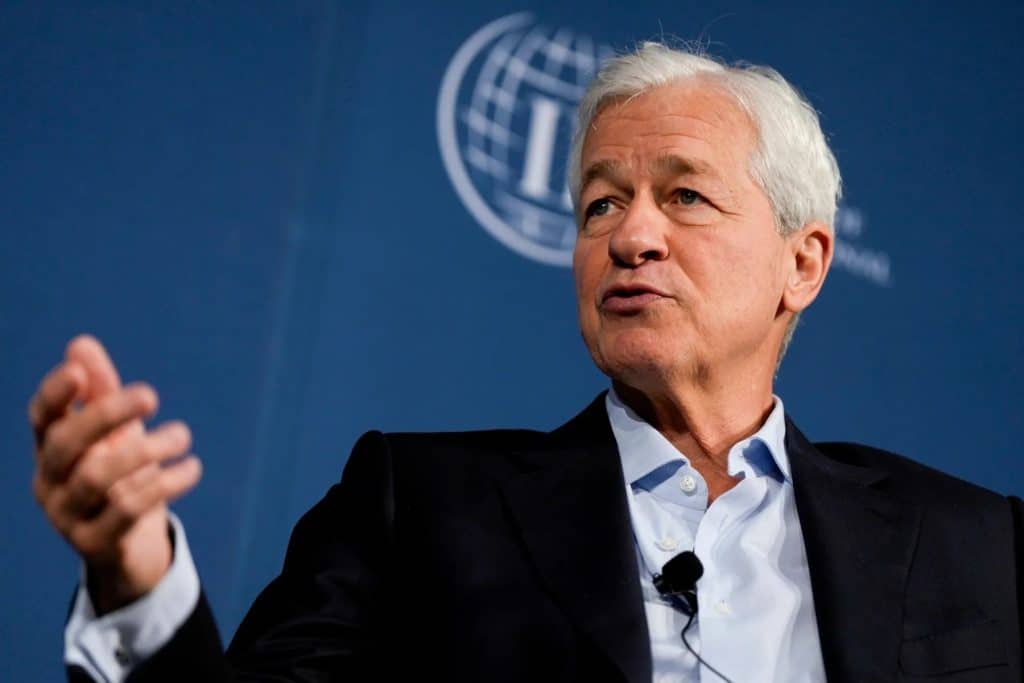


Dimon says Trump tariffs may make ‘the soft landing a little bit softer’ instead of sinking the economy.
JPMorgan Chase (JPM) CEO Jamie Dimon expressed a cautiously optimistic view Tuesday on how former President Donald Trump’s proposed tariffs could impact the U.S. economy in the months ahead.
“Maybe in July, August, September, October, you’ll start to see ‘did it have an effect?’” Dimon said while speaking at a Morgan Stanley-hosted conference in New York.
“My guess is it did, hopefully not dramatic. May just make the soft landing a little bit softer as opposed to the ship go down.”
He added that the tariffs could lead to a slight dip in employment and a mild uptick in inflation. “Come down, or come down a little bit,” Dimon said of job levels, while predicting that “inflation will go up a little bit.”
(Read more: What Trump’s tariffs mean for the economy and your wallet)
Dimon wasn’t alone in weighing in on the potential economic effects of tariffs. Citigroup’s (C) global investment banking clients are now preparing for a 10% “floor” on tariff rates and are modeling scenarios between 10% and 20%, according to Viswas Raghavan, head of banking at Citi, who also spoke at the conference.
“Look, there is a lot of anxiety,” Raghavan said, referring to corporate boardrooms evaluating the impact of potential tariffs on upcoming deals.
Despite the uncertainty, Citigroup expects investment banking fees for the second quarter to rise in the “mid-single digits” year-over-year. Trading revenue is projected to grow in the “mid- to high-single digits” over the same period.
However, Raghavan noted that Citi anticipates a rise in overall credit costs, estimating an increase of “a few 100 million dollars” from the $2.7 billion it recorded in Q1.
Morgan Stanley (MS) CEO Ted Pick also weighed in, saying that the second quarter began slowly, especially following the Trump administration’s early April “Liberation Day” tariff announcements.
“The second quarter did start ‘slow, really pausing in a big way,’” Pick said, adding, “but now it has picked up and I think we’ll see how the last couple weeks go, but looks like it’s going to finish strong.”
He described current conditions as a “tale of two quarters” for investment banking specifically.
Executives also expressed support for the Trump administration’s efforts to revisit certain capital rules requiring banks to hold extra buffers against potential downturns.
“We actually are relevant in not just powering the real economy, but to be helpful when there is a wobble … And that’s why I think it is opportune for a repositioning of some of the regulatory framework,” Pick said.
Meanwhile, Federal Reserve Governor Michelle Bowman announced last week that the Fed will hold a conference next month to examine whether current capital requirements for large banks are appropriate.
“I would like to be part of fixing the system and making it safer and helping the smaller banks,” Dimon added.
 Pump Radar
 Stock Alerts