
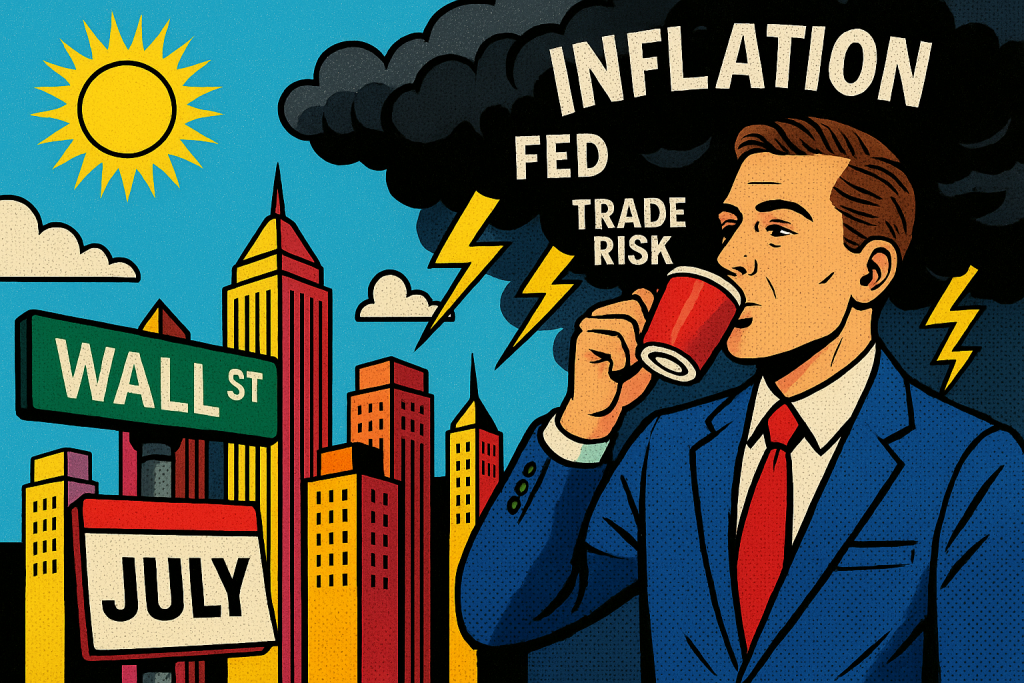


As the S&P 500 flirts with record highs and the tech-heavy Nasdaq continues its AI-fueled ascent, it’s easy to assume that markets are confidently marching into the second half of 2025. A strong June jobs report, steady gold prices, and a subdued volatility index (VIX) suggest calm. But under the surface, there are growing signs that markets may be missing—or willfully ignoring—the storm clouds gathering for July.
This isn’t a call for panic. But it is a reminder that sometimes, when everything feels a little too quiet, it’s because the noise hasn’t started yet.
A Strong Jobs Report—and a Shift in Expectations
On the face of it, the June employment numbers looked like exactly what the markets wanted to see. Payrolls increased by 147,000, unemployment remained low, and wage growth cooled slightly. That should, in theory, keep the Federal Reserve on track for potential rate cuts later this year.
But here’s where things start to turn. Instead of reinforcing a dovish narrative, the solid jobs report actually cooled near-term rate cut expectations. Traders quickly dialed back bets on a July cut, now looking toward September or later for any meaningful policy shift. In other words, the kind of soft landing scenario that stocks have priced in may take longer to play out than bulls anticipate.
And there’s more macro data on the way. This week’s Federal Reserve meeting minutes and June CPI reading could either confirm the “everything’s fine” mood or flip the script entirely. If inflation surprises to the upside, or if the Fed leans hawkish in its language, July’s serene equity environment could be shattered in a flash.
Volatility Is Low—But Should It Be?
The VIX, Wall Street’s so-called “fear gauge,” continues to hover around 16–17, far below the panic levels of 2022–2023 and well under the historical average during periods of policy risk. That might seem like a positive signal—until you consider how much uncertainty is being ignored.
From a technical standpoint, the VIX’s 50-day average has actually drifted closer to 20, indicating that even mild shocks could result in outsized volatility. And while index levels remain high, recent research shows that the VIX often underestimates near-term risk during times of rising debt, shifting trade policy, and macro ambiguity.
The takeaway? Complacency has crept in. Markets are acting as if volatility is in the rearview mirror, when in fact it may be waiting around the next turn.
Gold Is Quiet, Too—For Now
Gold prices have pulled back slightly from April’s peak of $3,500 per ounce and are currently holding near $3,337. This cooling has been interpreted by some as a sign of investor confidence returning to equities. But gold’s stability could just as easily reflect hesitation—a wait-and-see moment before broader capital flows realign.
Analysts from HSBC and Goldman Sachs have pointed out that central bank buying, geopolitical risks, and a weakening dollar still provide a bullish backdrop for gold. But short-term momentum has faded. If July data starts to look unfriendly to equities, don’t be surprised if gold suddenly finds its footing again as a safe-haven hedge.
Global FX Markets Are Getting Tense
Meanwhile, the U.S. dollar is showing signs of strain. After months of strength, it’s now trading at some of its weakest levels in years. This decline is being driven by rising fiscal deficits, persistent inflation uncertainty, and growing expectations that the Fed will eventually be forced to cut rates—whether it wants to or not.
And it’s not just the dollar. Global currency markets are reflecting a larger set of worries: trade disruptions, tariff resets, and political instability in Europe and parts of Asia are creating a sense of pressure that has yet to fully hit stock markets. Currency moves are often a canary in the coal mine, hinting at imbalances and risks before they fully materialize elsewhere.
Are Investors Too Comfortable?
Deutsche Bank recently warned that investors have become “dangerously complacent.” They point to a series of mispriced risks, from global trade tension to the rapid growth of sovereign debt, that aren’t reflected in current equity valuations. With U.S. deficits ballooning and geopolitical tensions simmering beneath the surface, it’s fair to ask whether the optimism priced into equities is justified.
Asset managers seem to agree—at least behind the scenes. Reuters reports that many institutions are quietly building protection into their portfolios, hedging against the possibility of an August or September sell-off. Defensive posturing includes increased allocations to gold, longer-dated treasuries, and options strategies tied to volatility spikes.
What Happens Next?
The short answer: it depends. If the Fed minutes and June CPI report come in dovish and inflation shows further signs of cooling, markets may continue their upward trend. That would support the current soft-landing thesis and extend the summer rally.
But if data surprises to the upside—or if policymakers hint at sticking with restrictive rates through the fall—then July could become a turning point. Volatility would rise, growth expectations would reset, and high-flying tech valuations could be tested.
The same goes for external shocks. A sudden tariff escalation, a breakdown in international trade negotiations, or an unforeseen geopolitical event could quickly shift sentiment. With the VIX low, gold steady, and the dollar sliding, markets appear to be saying “nothing to see here.” History, of course, suggests that such tranquility often precedes a jolt.
Final Thoughts
This weekend’s calm may feel earned after months of strong market performance. But beneath the surface, July is loaded with potential triggers that could shake investor confidence. From policy missteps to macro surprises, the environment is anything but risk-free.
For investors, this might be a good time to revisit portfolios, shore up hedges, and remember that markets don’t stay quiet forever. When everything feels too stable, it’s often because something is just about to change.


 Pump Radar
 Stock Alerts