
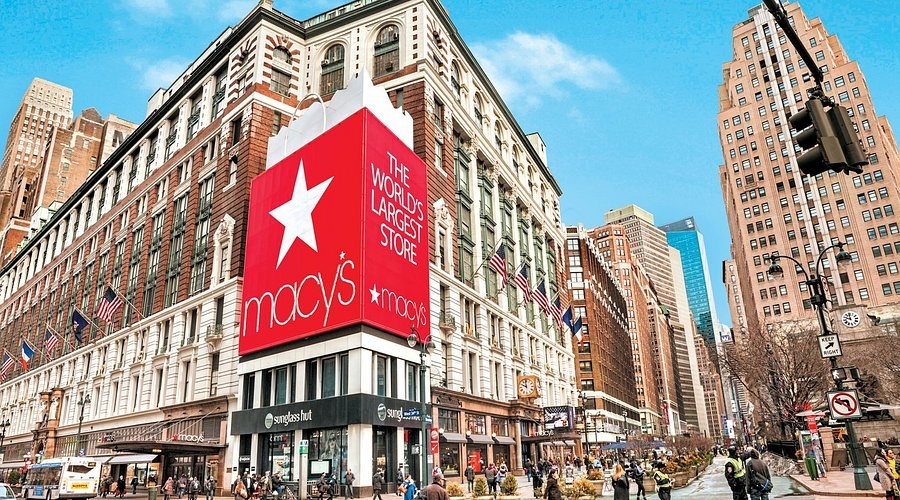


Macy’s shares surged by nearly 20% Wednesday morning after the storied department store posted fiscal second-quarter earnings that handily beat Wall Street forecasts and raised its outlook for the rest of the year. The upbeat results, driven by stronger sales trends in its newly revamped stores, marked a sharp turnaround from last quarter, when the retailer cut guidance and warned of tariff-related pressures.
In its revised forecast, Macy’s now expects adjusted earnings of $1.70 to $2.05 per share for the full year, up from the previous range of $1.60 to $2.00 per share. Revenue is now projected to reach between $21.15 billion and $21.45 billion, compared with the earlier outlook of $21.0 billion to $21.4 billion. The company credited better-than-expected consumer demand and operational improvements for the raised guidance.
“We’re just well positioned right now for the environment we’re in to take share, to deliver for our customers and to provide a better experience,” CEO Tony Spring told CNBC following the earnings release. Spring said Macy’s has incorporated tariff impacts into its projections and remains cautiously optimistic about the balance of the year. “Tariffs are real. It’s a component of the business,” he said, “but we have tail winds that we are trying to mitigate against those headwinds.”
Those tailwinds, Spring said, include a stronger in-store experience, fresher merchandise assortments, and tighter inventory management across the company’s three nameplates: Macy’s, Bloomingdale’s, and Bluemercury. “That’s a better customer experience, that’s a newer assortment, that’s less redundancy in our assortment, that’s now a business that’s growing across all three nameplates in our portfolio and a healthy inventory position going into the fall season,” he added.
The company reported that its best-performing group of 125 stores — which have been targeted for higher staffing and renovations — outpaced the broader Macy’s brand, delivering 1.1% comparable sales growth on an owned basis. Bloomingdale’s posted comparable sales growth of 3.6% on an owned basis, while Bluemercury recorded a 1.2% gain. These specialty banners have consistently outperformed the Macy’s namesake stores, highlighting the benefits of focusing on higher-income shoppers and beauty-focused formats.
Consumer spending also remained resilient despite ongoing price increases. Spring said shoppers are still buying fresh items and fashion, particularly in categories such as denim, women’s contemporary apparel, and watches — areas Macy’s is leaning into to keep its momentum going. “When you think about the strength of a department store or a marketplace, it’s when multiple categories are working,” Spring noted.
Here’s how Macy’s performed in the fiscal second quarter, which ended Aug. 2, compared with Wall Street estimates compiled by LSEG:
- Adjusted earnings per share: 41 cents versus 18 cents expected
- Revenue: $4.81 billion versus $4.76 billion expected
Net income for the quarter was $87 million, or 31 cents per share, compared with $150 million, or 53 cents per share, a year earlier. Net sales fell slightly from $4.94 billion in the year-ago period to $4.81 billion. Adjusted earnings per share came in at 41 cents. The company also reported a $28 million increase in credit card net revenue to $153 million.
Macy’s had slashed its guidance last quarter and raised prices on certain products to offset tariff costs. CFO Tom Edwards told analysts Wednesday that the retailer is still exploring selective price adjustments but remains intent on staying competitive. “We’re adjusting prices, but as appropriate, not broad-based and really assessing it with our partners in an effort to remain competitive,” Edwards said. “I believe that we are really well positioned to navigate through this time given our business model.”
The strong second-quarter performance and raised outlook have given investors new confidence in the company’s turnaround strategy. With consumers still spending, Macy’s is betting that store renovations, sharper assortments, and disciplined inventory management will help it weather tariff pressures and sustain growth through the rest of 2025.

 Pump Radar
 Stock Alerts