
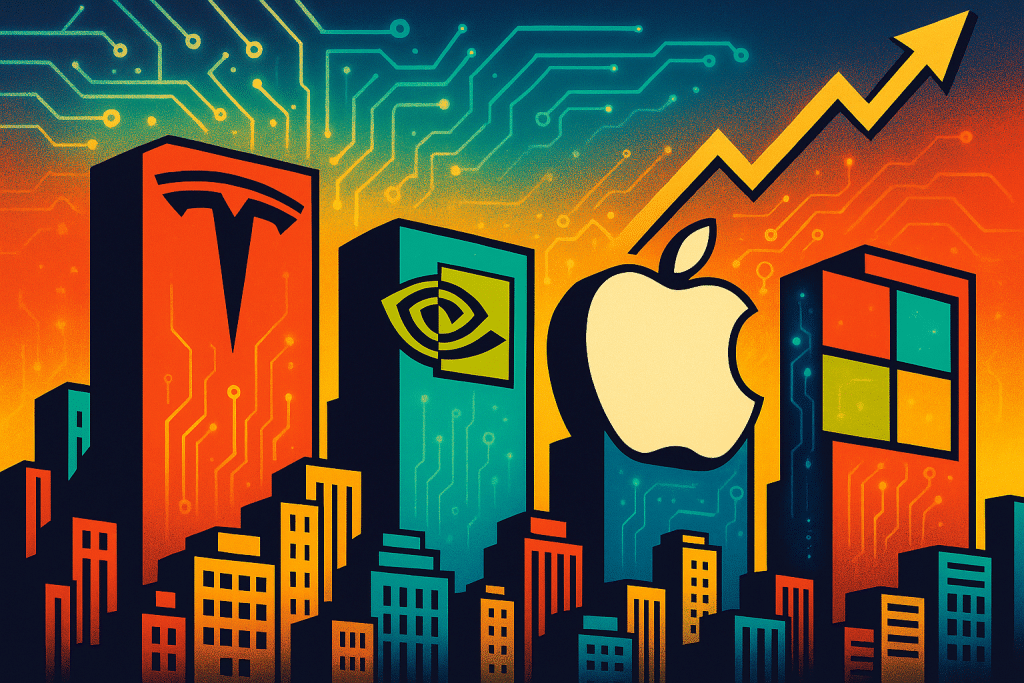


It’s a rally – but only if you’re looking at the right tickers. If you’ve glanced at the S&P 500 or Nasdaq this past week, things might seem bullish. Big gains. Headlines celebrating all-time highs. But take a closer look, and a different story emerges. This isn’t a broad-based market surge. It’s a story about tech. Specifically, mega-cap tech.
Names like Tesla , Nvidia , Apple , and Microsoft are doing the heavy lifting. Meanwhile, small caps, cyclical sectors, and even much of the broader market are still flatlining. That divergence is raising eyebrows on Wall Street – and it’s why some analysts are calling this rally both impressive and fragile.
Let’s break down what’s driving this narrow wave of strength, how benchmarks are being influenced by just a few players, and what it might mean for the weeks ahead.
The Robotaxi Boost: Tesla’s 10% Surge
Let’s start with one of the week’s headline-grabbers: Tesla. The stock jumped nearly 10% after CEO Elon Musk reaffirmed plans for a robotaxi unveiling scheduled for August. Musk has long teased the prospect of a fully autonomous vehicle, and investors, as usual, responded swiftly to the buzz.
Whether or not robotaxis materialize in the short term, the key point is perception. Tesla remains one of the most sentiment-driven stocks on the market. And that sentiment spilled over into other high-growth tech names, especially those tied to automation, AI, and mobility.
AI Is Still Hot: Software and Chips Move Higher
Beyond Tesla , the artificial intelligence trade remains alive and well. Nvidia notched another gain this week as investor appetite for AI infrastructure shows little sign of fading. Software names like Microsoft and Oracle also pushed higher, riding coattails of the AI demand cycle and steady cloud growth.
The narrative hasn’t changed: companies that enable, power, or scale AI are still top of mind. That trend has helped tech outperform not just this week, but all year.
This trendline is reinforced in the numbers. The Nasdaq 100 rose over 2.5% on the week, with more than half of that contribution coming from just a handful of names. Nvidia , Microsoft , Apple , and Amazon now account for an outsized portion of the index’s momentum.
Narrow Breadth, Wide Concern
Here’s where the caution comes in. While these tech giants are pulling the indexes higher, market breadth – the number of stocks actually participating in the rally – is thinning.
Take the S&P 500 . Sure, it looks strong on paper, closing above 5,300 and nearing record levels. But under the surface, fewer than 40% of stocks in the index are trading above their 50-day moving average. That’s not a sign of healthy participation – it’s a sign that a small elite group is doing most of the work.
Small-cap benchmarks like the Russell 2000 have lagged. Financials, industrials, and energy have shown mixed or negative returns for the week. Even consumer discretionary is starting to wobble under weaker-than-expected spending data from May.
This divergence between mega-cap tech and everything else is what some strategists call a “fragile rally.” It’s strong in headline numbers, but weak in support.
Volatility Remains Muted
Interestingly, despite the uneven internals, market volatility remains subdued. The CBOE Volatility Index , often dubbed the “fear gauge,” stayed below 18 throughout the week. That’s historically low and suggests that investors, for now, are not pricing in significant downside risk.
But low volatility isn’t always a sign of confidence – it can also signal complacency. When markets lean heavily on a narrow group of stocks, any stumble from those leaders could have outsized impact. Traders are well aware of that, and it’s one reason some are quietly rotating into defensive positions or raising cash, just in case.
Institutional Behavior: Quiet but Strategic
Behind the scenes, institutions haven’t gone all-in. According to fund flow data and options activity, many large investors are riding the tech wave while hedging exposure. There’s caution in the air – particularly with a Federal Reserve meeting and inflation data on deck.
Institutions know what retail often forgets: rallies driven by a small number of stocks are harder to sustain. If those mega-caps falter, there’s often little else to hold up the market.
That’s not to say this is a bubble. Far from it. Most of these companies – especially in AI – are generating real revenue and growth. But the valuations are steep, and many portfolio managers are wary of chasing the highs without broader confirmation.
What to Watch Next
The question going into next week isn’t whether tech can keep going – it’s whether the rest of the market will follow.
Key earnings from second-tier tech and small-cap industrials could shift the tone. A positive surprise in CPI or PPI data might also breathe life into rate-sensitive sectors like housing and financials.
But the broader risk remains: if tech takes a breather and other sectors don’t step up, we could see a pullback – or at least a consolidation phase.
So far, though, dip buyers haven’t been shy. That continues to be the theme of 2025. For now, the playbook still leans bullish – just don’t ignore the flashing caution lights on market breadth.
Final Thoughts
Markets are complex. But sometimes, the message is simple: this rally is real, but it’s resting on a narrow base.
Mega-cap tech has been here before. It’s not unusual for Nvidia , Tesla , or Apple to drive outsized gains. But without broader participation, this kind of rally is tough to maintain.
The bulls are in control. But they’re relying on a handful of star players to carry the weight. And that’s a setup that demands close attention.


 Pump Radar
 Stock Alerts