
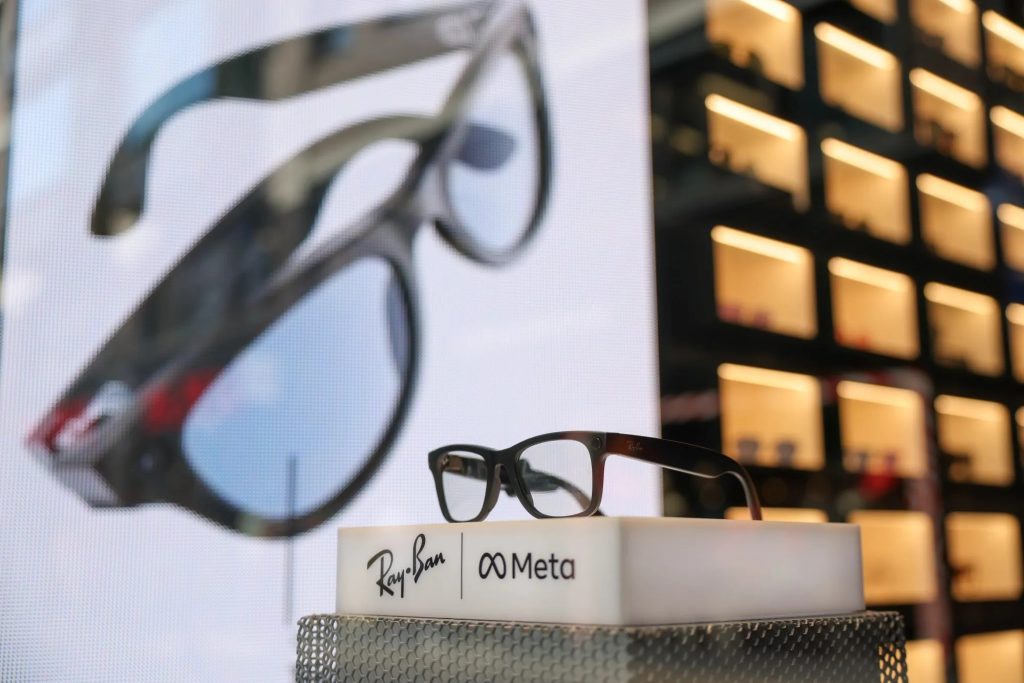


Meta Platforms Inc. (META) has taken a minority stake in the world’s largest eyewear manufacturer, EssilorLuxottica SA, reinforcing its growing commitment to the booming smart glasses sector, according to people familiar with the matter.
Facebook parent Meta acquired just under 3% of the Ray-Ban maker, a stake valued at approximately €3 billion ($3.5 billion) based on market prices, said the people, who requested anonymity because the discussions are private.
Meta, headquartered in Menlo Park, California, is reportedly considering expanding its investment to roughly 5% over time, though those plans remain fluid.
Shares of EssilorLuxottica jumped the most in three months on the Paris exchange following the news. Analysts at Bernstein interpreted Meta’s move as a strong vote of confidence in the eyewear maker and the broader smart glasses market, stating, “This represents another step in Meta’s commitment to the smart-glasses category.”
Representatives for both Meta and EssilorLuxottica declined to comment on the transaction.
The two companies have collaborated for years on AI-powered eyewear. Meta currently offers a line of Ray-Ban smart glasses — first launched in 2021 — that feature built-in cameras and an AI assistant capable of image-captioning and providing real-time stock updates.
Just last month, Meta also rolled out Oakley-branded glasses in partnership with EssilorLuxottica. The eyewear maker’s CEO Francesco Milleri had previously revealed Meta’s interest in acquiring a stake, a plan that had not materialized until now.
EssilorLuxottica’s shares climbed as much as 7.1% on Wednesday, lifting its market value to €117.3 billion. Meanwhile, Meta shares were up less than 1% in premarket U.S. trading.
Warby Parker, a competing eyewear company, saw its shares rise 4.5% on Tuesday in the wake of Bloomberg’s initial report.
The investment aligns with Meta CEO Mark Zuckerberg’s long-term AI strategy, which has become one of the company’s highest priorities and most significant expenditures. Smart glasses play a key role in that vision.
Zuckerberg has previously noted that while Meta has long been reliant on devices made by others to deliver its services, smart glasses present a rare opportunity to build its own hardware and control distribution. “Smart glasses are a key part of that plan,” he’s said.
By partnering closely with EssilorLuxottica, Meta gains access to the company’s manufacturing expertise and global distribution network — two elements critical to transforming smart glasses into a mass-market product. For EssilorLuxottica, the deal deepens its foothold in the tech world, positioning it to benefit from Meta’s ambitious hardware plans.
Unlike full augmented reality (AR) devices, the current generation of smart glasses offers information overlays without altering a user’s environment. According to Bernstein analysts, full AR is “some years away from being practical,” and even Apple has recently pivoted toward non-AR smart glasses.
The smart glasses market is projected to grow from $1.93 billion in 2024 to $8.26 billion by 2030, according to GrandView Research.
Other tech giants are also making moves in this space. Google has teamed up with Kering Eyewear in France, and China’s Xiaomi recently announced its entry into the smart glasses market. Analysts at Jefferies noted, “We would not be surprised to see new entrants soon,” indicating that smart glasses may be on the verge of mainstream adoption.
 Pump Radar
 Stock Alerts