
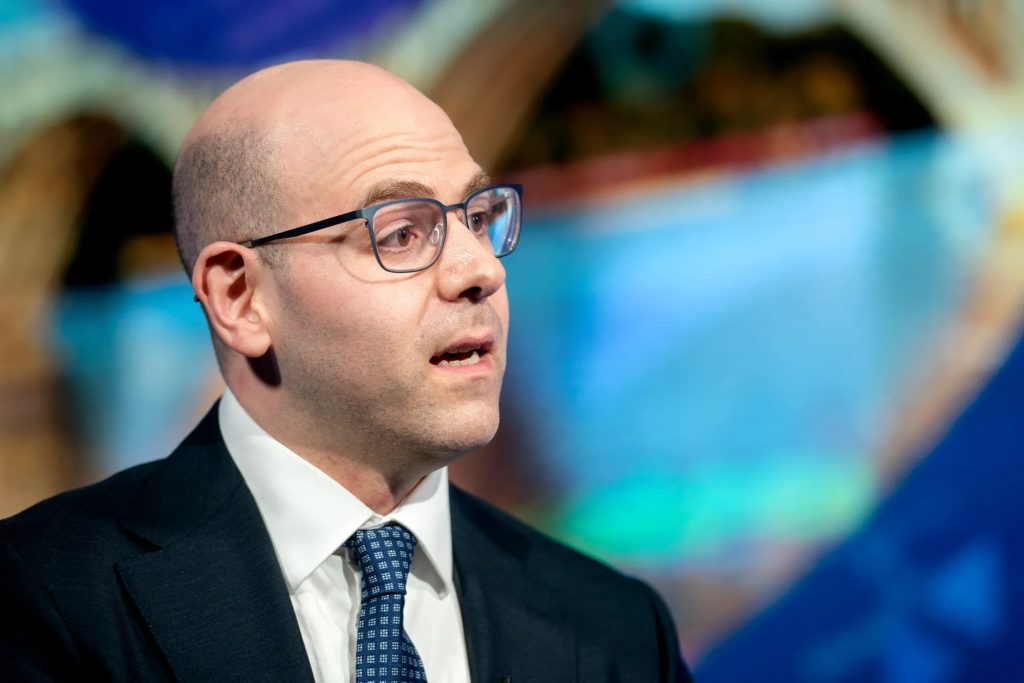


Federal Reserve Governor Stephen Miran said Monday he believes the central bank’s benchmark interest rate is sitting at an excessively high level, warning that keeping policy this tight risks unnecessary job losses and higher unemployment across the U.S. economy.
Speaking at the Economic Club of New York, Miran described the Fed’s current stance as “well into restrictive territory.” He argued that short-term rates are about two full percentage points too tight and said the policy rate should be closer to the mid-2% range—well below today’s 4.0%-4.25% target range.
“Leaving short-term interest rates roughly 2 percentage points too tight risks unnecessary layoffs and higher unemployment,” he said.
Miran dissented from last week’s decision by the Federal Open Market Committee to cut rates by a quarter point, saying he favored a larger 50-basis-point reduction instead. He has penciled in five more cuts for 2025, compared with the median of his colleagues who see only two more moves this year.
A longtime White House economic adviser, Miran has taken a leave of absence to serve on the Fed’s Board of Governors. He argued Monday that changes in immigration and fiscal policy are making the Fed’s policy stance more restrictive than many realize.
According to Miran, the U.S. has shifted from what he called “effectively open borders” to “potentially negative net migration.” He estimated that as many as 2 million immigrants with permanent legal status could leave the country by year-end, slowing annual population growth from 1% to 0.4%. That would, he said, put downward pressure on inflation—particularly on rents.
He predicted rent inflation in the Consumer Price Index (CPI) will drop from about 3.5% now to below 1.5% by 2027, which would in turn lower the Fed’s preferred inflation gauge, the Personal Consumption Expenditures (PCE) index, by roughly 0.3 percentage point from its current 2.9% reading. A new PCE report is due later this week.
While acknowledging the Fed’s dual mandate—price stability and maximum employment—Miran stressed that his main worry is the labor market. Keeping policy too tight for too long, he said, increases the risk of violating the employment side of that mandate.
He also sought to downplay concerns about tariffs, saying relatively small changes in goods prices have led to “unreasonable levels of concern” over inflation.
Not all Fed officials share Miran’s urgency. Alberto Musalem, president of the Federal Reserve Bank of St. Louis, also spoke Monday. Musalem said he supported last week’s quarter-point rate cut as a “precautionary move” to guard against rising unemployment but warned there is limited room for further easing without risking a rebound in inflation.
“The stance of monetary policy now lies between modestly restrictive and neutral, which I view as appropriate,” Musalem said in Washington. “However, I believe there is limited room for easing further without policy becoming overly accommodative.”
Musalem pointed to record-high stock markets and narrow credit spreads as signs of an economy still well-supported by financial conditions. He also cautioned that ignoring one-time effects of tariffs on inflation could lead to longer-lasting price pressures if such policies persist.
Finally, Musalem said he believes the real policy rate—the nominal rate adjusted for inflation—is close to neutral now. For it to fall further, he said, risks would need to shift significantly, particularly if inflation looks likely to remain above the Fed’s 2% target.
“Should further signs of labor market weakness emerge, I would support additional reductions in the policy rate,” he concluded.


 Pump Radar
 Stock Alerts