
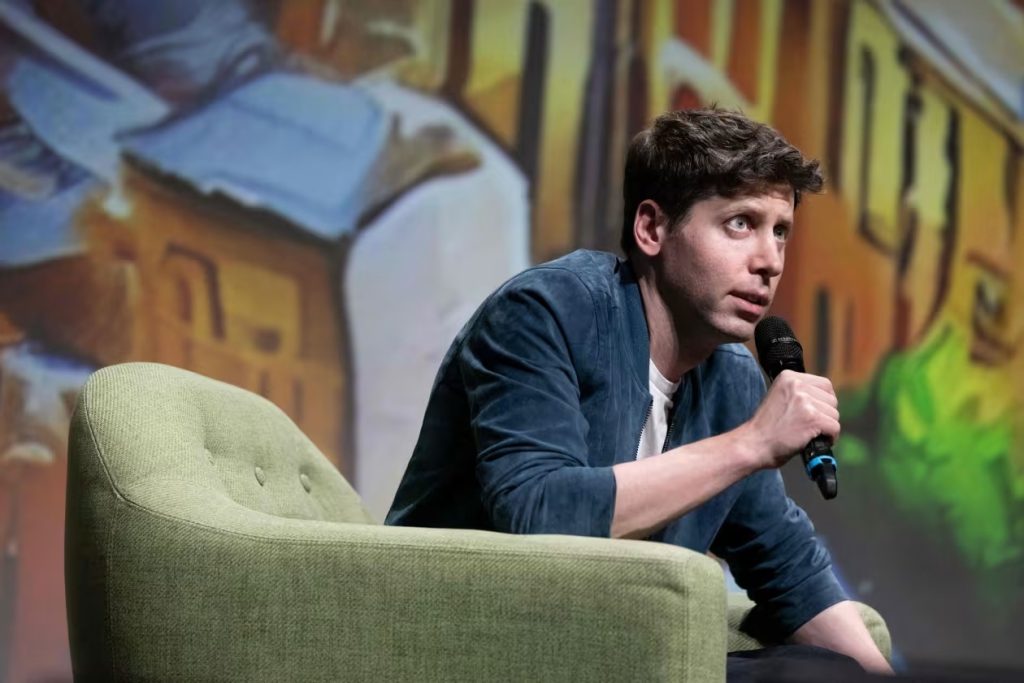


OpenAI CEO Sam Altman has cautioned that the artificial intelligence sector could be entering bubble territory, drawing comparisons to the dot-com era of the late 1990s. Speaking to a small group of reporters last week, Altman said, “Are we in a phase where investors as a whole are overexcited about AI? My opinion is yes. Is AI the most important thing to happen in a very long time? My opinion is also yes.”
Altman elaborated that “when bubbles happen, smart people get overexcited about a kernel of truth,” highlighting a dynamic in which investors chase opportunities without fully accounting for underlying risks or fundamentals. His comments echo broader concerns within the industry, with prominent figures including Alibaba co-founder Joe Tsai, Bridgewater Associates founder Ray Dalio, and Apollo Global Management chief economist Torsten Slok sounding similar warnings about the rapid pace of AI investment.
The AI bubble conversation has intensified over recent months. Slok, in particular, suggested that today’s AI market may be even more overvalued than internet companies were during the 1990s, with the largest S&P 500 firms potentially trading at inflated valuations. While some experts caution against widespread alarm, they acknowledge that speculative capital is increasingly flowing to companies with limited fundamentals, creating pockets of overvaluation that could pose risks if the market corrects.
Altman’s cautionary stance comes amid rapid growth at OpenAI itself. The company is on track for annual recurring revenue surpassing $20 billion this year, though it remains unprofitable. OpenAI recently released its GPT-5 model, which received mixed reviews from users, prompting the company to restore access to previous GPT-4 models for paying customers. Altman has also signaled a more measured perspective on some of the industry’s aggressive claims, noting that the term artificial general intelligence, or AGI, is becoming less meaningful in public discussions despite being a long-term goal for the company.
The company continues to expand across multiple fronts, including consumer hardware, brain-computer interfaces, and social media. Altman projected that OpenAI would spend trillions of dollars on data center infrastructure in the near future and indicated interest in acquiring Chrome if U.S. regulators were to mandate a sale by Google.
Investor interest in OpenAI remains robust, however. The company is reportedly preparing a secondary stock sale worth around $6 billion, which would value it at roughly $500 billion. Earlier this year, OpenAI raised $40 billion at a $300 billion valuation, marking one of the largest private funding rounds in tech history.
Industry analysts are weighing Altman’s comments carefully. Ray Wang, research director at Futurum Group, said the CEO’s warnings are valid but company-specific. Wang noted that while speculative investments in some AI startups may present bubble-like conditions, the overall fundamentals in AI and semiconductor supply chains remain strong, supporting continued investment.
Altman’s remarks serve as a reminder that while AI’s long-term potential is vast, investor enthusiasm may have outpaced current realities, echoing lessons from prior technology booms. “Maybe an AI is CEO in three years,” Altman quipped when asked about his role at OpenAI in the near future, underscoring the uncertain but transformative trajectory of the industry.

 Pump Radar
 Stock Alerts