
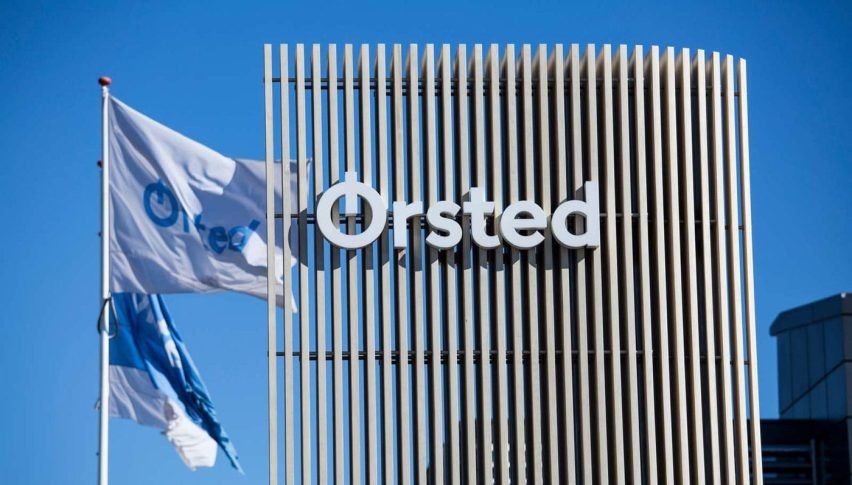


Shares of Ørsted (ORSTED.CO), the world’s largest offshore wind developer, fell more than 16% on Monday, hitting a record low following a stop-work order issued by the Trump administration on the company’s nearly completed Revolution Wind project off the coast of Rhode Island. The order, issued late Friday by the Department of the Interior’s Bureau of Ocean Energy Management (BOEM), has temporarily frozen construction on what had been one of the most ambitious U.S. offshore wind projects.
At the time of the order, Ørsted reported that the project was 80% complete. All foundations were in place, and 45 of the 65 planned wind turbines had already been installed. Once completed, the offshore wind farm was expected to deliver electricity to approximately 350,000 homes across Rhode Island and Connecticut, significantly expanding the region’s clean energy capacity.
The BOEM cited “national security interests” as the reason for the halt but did not provide details on the specific concerns. Ørsted, which is 50.1% owned by the Danish government, confirmed it is complying with the stop-work directive while “evaluating all options to resolve the matter expeditiously,” including potential legal proceedings.
Rhode Island Governor Dan McKee criticized the administration’s decision, calling it a major setback for regional energy reliability. “The Trump administration’s stop-work order on Revolution Wind undermines efforts to expand our energy supply, lower costs for families and businesses, and strengthen regional reliability,” McKee said in a statement. “We are working with our partners in Connecticut to pursue every avenue to reverse this decision.”
This is not an isolated incident. Earlier this year, the BOEM temporarily halted Norwegian energy company Equinor’s $2.5 billion Empire Wind 1 project, which aims to power 500,000 homes in New York. That stop-work order was lifted after about a month, allowing construction to resume. Analysts warn that repeated government interventions could increase project costs, delay timelines, and discourage investment in the U.S. offshore wind sector.
The halt comes amid broader federal pressures on the renewable energy industry. During his second term, President Trump has taken multiple actions restricting wind and solar development. On August 20, he posted on Truth Social calling wind and solar power “THE SCAM OF THE CENTURY!” while linking renewable energy to rising electricity costs. Early in his administration, Trump temporarily paused all federal wind permits—a restriction that remains in effect. Furthermore, last Thursday, the administration opened a Section 232 investigation into imported wind turbines, which could pave the way for new tariffs, raising project costs even further.
Construction on the Revolution Wind project began in 2023 after the project received all federal and state permits under the Biden administration. It had been slated for full operation by 2026, marking a significant step toward expanding the United States’ offshore wind capacity.
Ørsted has faced additional financial pressures this year. Last week, the company announced a $9.4 billion share offering to strengthen its balance sheet and ensure completion of both Revolution Wind and its Sunrise Wind project in New York. Despite these efforts, Ørsted stock has fallen 45% year-to-date, reflecting mounting investor concerns about regulatory risks, rising costs, and delays in key projects.
The stop-work order highlights the tension between federal energy policy and renewable energy expansion in the United States. While states like Rhode Island and Connecticut push aggressively for offshore wind as a source of clean, reliable energy, federal actions—citing national security concerns—can abruptly stall projects that are already well underway.
Investors and industry watchers will now be closely monitoring Ørsted’s response, including any legal challenges or negotiations with federal regulators, as the company seeks to resume work on Revolution Wind and protect its substantial investments in the U.S. market.




 Pump Radar
 Stock Alerts