
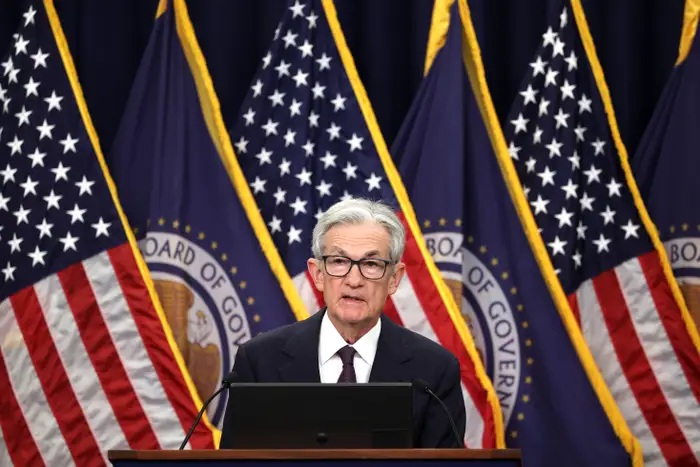


Federal Reserve Chair Jerome Powell announced on Wednesday that the central bank would cut its benchmark interest rate by 0.25 percentage point—the first such reduction since December—at a time when the Fed is under unusual political pressure from President Donald Trump.
The rate cut comes as inflation has remained elevated, a dynamic intensified by Trump’s “Liberation Day” tariffs that took full effect last month. Powell has repeatedly cautioned that tariffs can add to inflationary pressures, a warning that has gained new relevance as prices continue to climb. Traditionally, the central bank raises interest rates to counter rising prices. But under its dual mandate—stabilizing prices while also promoting maximum employment—the Fed faces a more complex challenge. The two most recent jobs reports showed lackluster growth in the labor market, adding urgency to Powell’s move despite high inflation.
Trump’s approach has also sparked a broader confrontation over the independence of the Federal Reserve, a principle long viewed as fundamental to U.S. monetary policy. The President has repeatedly criticized Powell in public—calling him “too late” and a “stupid person” for resisting earlier cuts—and has taken aim at Fed operations ranging from policy decisions to renovation plans for its Washington headquarters. During a visit to the building this summer, Trump reportedly clashed with Powell over the projected costs of those renovations.
This week has brought fresh flashpoints. On Monday, the U.S. Court of Appeals for the District of Columbia blocked the Trump administration’s attempt to remove Lisa Cook from the Fed’s Board of Governors. A lower court had already allowed Cook to remain after Trump tried to dismiss her following accusations from Federal Housing Finance Agency Director Bill Pulte that she had made false statements on mortgage requirements.
Meanwhile, the Senate voted to confirm Stephen Miran to the Fed’s Board of Governors even though he still chairs the White House Council of Economic Advisers—an unusual overlap that critics say blurs the line between politics and monetary policy. Miran dissented from the Fed’s decision, arguing instead for a larger 0.5 percentage point cut in interest rates.
Powell, nominated by Trump in 2017 and renominated by President Joe Biden, is serving a five-year term that expires in May of next year. His leadership tenure has been marked by a delicate balancing act—steering the Fed through the pandemic recovery, persistent inflation, and a series of political attacks that challenge the institution’s independence.
The Federal Reserve’s rate cut underscores that balancing act. While inflation remains above the 2% target, the Fed’s decision signals a willingness to support the labor market at a time of political and economic uncertainty. The move also sets the stage for renewed debate over the future direction of U.S. monetary policy—and over whether the central bank can maintain its traditional independence amid intensifying White House pressure.


 Pump Radar
 Stock Alerts