
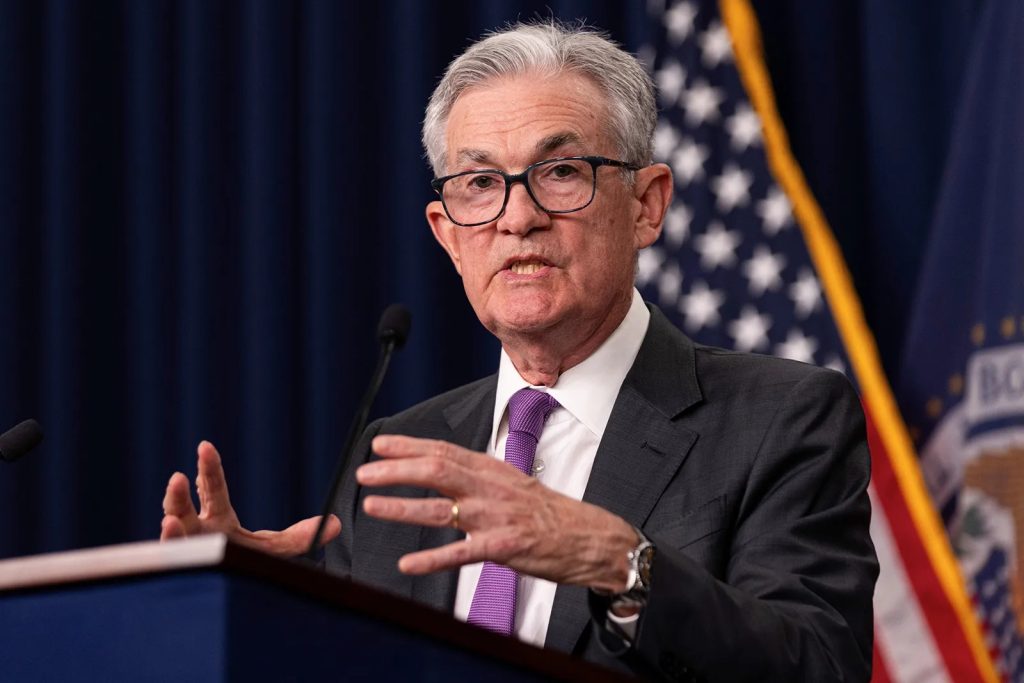


For months, the Federal Reserve has navigated one of the most complex economic landscapes in recent memory, balancing stubbornly high inflation against a labor market showing signs of cooling. On Wednesday, Fed Chair Jerome Powell emphasized just how precarious the current situation is, delivering the first rate cut since December while cautioning that “there are no risk-free paths now.”
The central bank’s recent decision to reduce the benchmark interest rate by 25 basis points marks a clear shift from its prior focus on fighting inflation at all costs. Earlier in the year, when the labor market was robust, policymakers could afford to prioritize price stability, raising rates aggressively to counter inflationary pressures amplified by trade tariffs and supply chain disruptions. However, as job growth has slowed and unemployment edged upward, the Fed’s calculus has shifted. Powell stressed that policymakers now face a dual mandate: stabilize prices while promoting maximum employment, a balancing act that has rarely been more fraught.
“It is quite a difficult situation for policymakers,” Powell said during Wednesday’s press conference. The chair underscored that while the framework guiding the Fed’s decisions remains clear—assessing how far inflation and employment are from their targets and how long it may take to reach those targets—the path forward is increasingly uncertain. The risks of missteps have grown, he warned, and decisions that were once straightforward now require delicate judgment.
Economists note that the Fed is operating under a scenario that Powell described as “quite unusual,” where inflation remains above the 2% target but labor market data signals weakening demand for workers. The last two jobs reports, showing softer-than-expected hiring, have made a case for easing monetary policy sooner rather than later. In this context, the rate cut is both a proactive and cautious maneuver, intended to support economic growth without igniting further inflation.
Looking ahead, Fed officials anticipate additional easing. The latest “dot plot,” a scatter of officials’ projections, suggests a median expectation of two more 25-basis-point cuts before the end of 2025. However, Powell acknowledged that dissent remains, with newly confirmed Fed governor Stephen Miran advocating a more aggressive half-point reduction. The presence of such differing views highlights the continued debate within the central bank and signals that future decisions may not be unanimous.
Amid this backdrop, questions about the Fed’s independence have gained prominence. The White House has applied pressure in recent months, prompting public scrutiny over whether political influence could sway monetary policy. Powell sought to reassure the public, noting that the Fed’s institutional culture and deliberative process act as bulwarks against outside interference. “The only way for any voter to really move things around is to be incredibly persuasive,” he said, signaling confidence in the Fed’s internal safeguards.
The timing of the rate cut is significant. By loosening the moderately restrictive policy stance, the Fed is attempting to navigate a delicate trade-off: supporting a labor market that has shown signs of slowing while keeping inflationary expectations anchored. The decision also serves as a signal to markets that the central bank is willing to adjust policy in response to evolving economic conditions, even when the path forward is far from certain.
Financial markets responded with volatility, reflecting investor uncertainty over the Fed’s next moves. Analysts expect that upcoming labor, inflation, and growth reports will heavily influence future decisions, and the potential for market swings remains high. The rate cut, while modest, demonstrates the Fed’s readiness to act and underscores the challenges of steering an economy through conflicting pressures.
Powell concluded his remarks with a reminder that there are no easy answers. Every policy decision carries trade-offs, and the balance between price stability and employment growth is delicate. As the Fed continues to navigate this unprecedented environment, the chair’s warning that “there are no risk-free paths now” may serve as a guiding principle for the months ahead, emphasizing caution, careful judgment, and responsiveness to shifting economic signals.

 Pump Radar
 Stock Alerts