
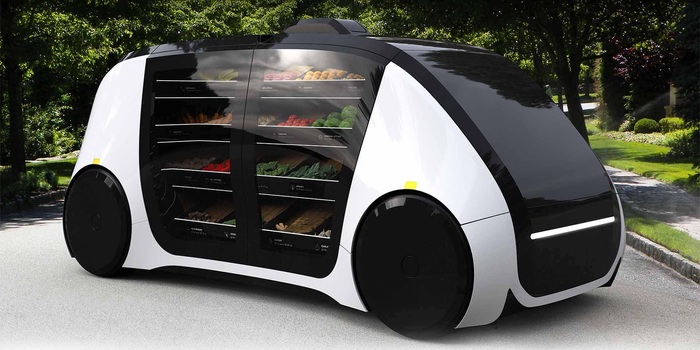


Robomart, the Los Angeles–based startup known for developing self-driving delivery vehicles, is making a bold push into the competitive food and retail delivery market. On Monday, the company unveiled its newest model, the Robomart RM5, a fourth-generation autonomous delivery robot designed to make on-demand delivery both cheaper and more profitable. The announcement signals the company’s most ambitious move yet, positioning it as a challenger to major incumbents like Uber Eats, DoorDash, and Grubhub.
The RM5 is built for scale and efficiency. The robot can carry up to 500 pounds of goods and is equipped with 10 individual lockers, allowing it to fulfill multiple customer orders on a single trip. This batch delivery model is intended to reduce operating costs and maximize efficiency — two of the biggest challenges in on-demand logistics. According to Robomart co-founder and CEO Ali Ahmed, the vehicle is classified as a Level 4 autonomous system, capable of fully self-driving in most conditions without human intervention.
But Robomart’s biggest selling point isn’t just the technology — it’s the pricing. Unlike established delivery apps that tack on multiple service, convenience, and small-order fees (not to mention driver tips), Robomart’s service is built around a single flat $3 delivery fee. Customers will place orders through the Robomart app, where retailers can host their own storefronts, similar to the model pioneered by DoorDash and Uber Eats. Ahmed believes this transparent, low-cost structure will be far more appealing to both consumers and retailers weary of high delivery fees. “We see this as building our own autonomous marketplace,” Ahmed said. “That is something unique — an on-demand delivery ecosystem powered entirely by self-driving robots.”
Robomart plans to launch its service later this year, beginning in Austin, Texas. Retailers are expected to begin onboarding onto the platform in the coming months, giving them an alternative to existing delivery apps with lower margins and tighter cost controls. For Robomart, the RM5 represents a natural evolution from its earlier experiments. The company originally debuted a “store on wheels” concept in 2020, where autonomous vehicles stocked with items like snacks, ice cream, and pharmacy goods drove directly to customers. While that model attracted attention, Ahmed said the long-term goal was always to enter on-demand delivery — but with a model that could achieve profitability.
Ahmed’s focus on automation comes from experience. Before founding Robomart in 2017, he launched Dispatch Messenger, a U.K.-based delivery platform in 2015. That business struggled to stay profitable due to the high cost of human drivers, a lesson that shaped Robomart’s mission to cut labor costs out of the equation. “Our robots bring the cost of a delivery down by up to 70%,” Ahmed explained. “If you’re paying a driver $18 an hour, your cost for that delivery is $9 or $10 just for labor. Robots eliminate that entirely.”
Remarkably, Robomart has gotten this far with only modest outside investment. The company has raised just under $5 million from backers including Hustle Fund, SOSV, and Wasabi Ventures. Despite the lean funding, Robomart has built five generations of robots, culminating in the RM5 and its vision for the first fully autonomous delivery marketplace. “I’m proud of our team, and it’s a testament to how much we’ve been able to achieve with so little,” Ahmed said.
Whether Robomart can disrupt an industry dominated by heavily funded giants remains to be seen. DoorDash, Uber Eats, and Grubhub still control the vast majority of U.S. delivery orders, and their apps have deep user loyalty. But Ahmed is betting that price-conscious consumers and retailers will flock to a cheaper, simpler alternative — one that strips away hidden markups and tips while leveraging robotics to reduce costs. “At $3 flat, it’s an incredible proposition,” Ahmed said. “People don’t even realize how much they’re paying in markups and fees on other platforms. We think once they see the difference, they’ll switch.”
 Pump Radar
 Stock Alerts