
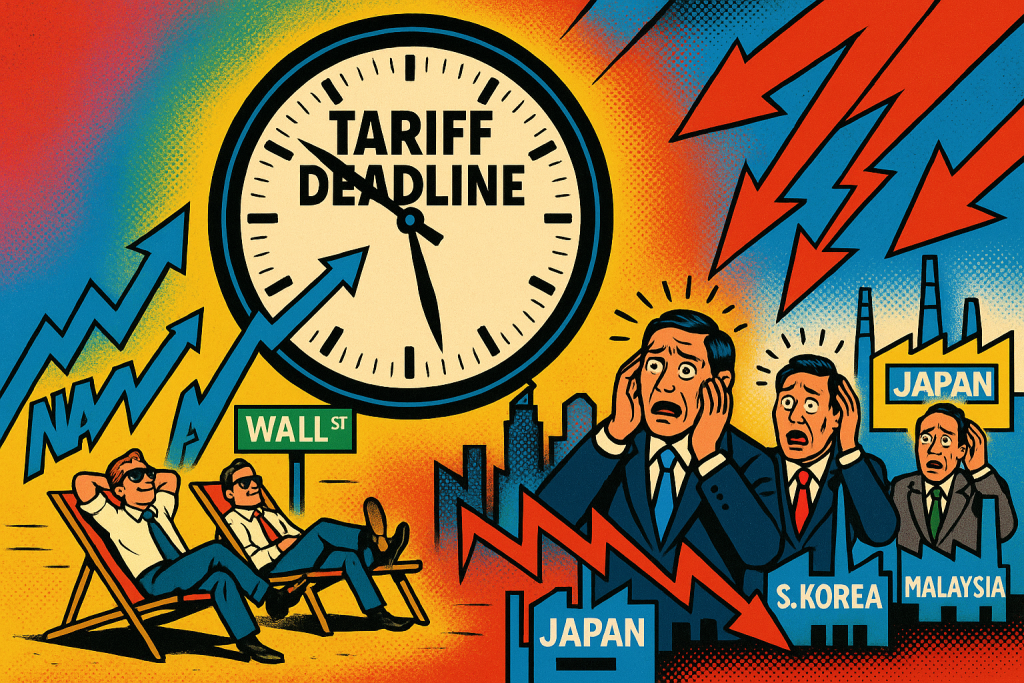


As earnings season heats up and U.S. equities hover near all-time highs, an old threat is quietly creeping back into view: tariffs. On July 8, the Trump administration officially extended the global tariff notice deadline to August 1, targeting a dozen U.S. trade partners including Japan, South Korea, and Malaysia. While investors continue focusing on tech earnings and inflation signals, markets may be dangerously underestimating what’s coming next.
With new 25%–50% tariffs poised to hit sectors ranging from autos to semiconductors to consumer goods, traders may need to recalibrate their optimism – fast.
A Quiet Policy Bomb: What’s in the Executive Order?
Last week’s executive order, signed behind closed doors at Mar-a-Lago, updated the timeline for Trump’s long-threatened reciprocal tariffs. The move would impose 25% tariffs on autos and parts from Japan and South Korea, with up to 40% levies on certain Southeast Asian imports like microchips and consumer electronics. The Department of Commerce confirmed in a press briefing that enforcement will begin August 1, with letters of intent already sent to embassies of affected nations.
Trump justified the action as “leveling the playing field,” citing trade imbalances and what he called “persistent unfair practices” in Asian manufacturing.
But while the policy is gaining political attention abroad – Japan and South Korea’s foreign ministries responded with alarm – Wall Street’s reaction has been muted at best.
Source: Reuters – Executive Order Details
Three Sectors in the Crosshairs
The risk isn’t abstract. These tariffs could directly impact some of the most market-sensitive industries.
1. Autos and Auto Parts
Japan and South Korea export billions in vehicles and components to the U.S. Toyota , Honda , Hyundai , and Kia all stand to be affected. Analysts warn that production costs may rise as manufacturers consider relocating or absorbing new duties. While shares in Ford and GM remain relatively steady, automakers face serious supply-chain uncertainty if tariffs hit full force.
2. Semiconductors and Electronics
Malaysia and South Korea are key links in the chip supply chain, exporting raw materials and components to American firms like Intel and Qualcomm . Tariffs in this space could disrupt lead times and squeeze margins. Meanwhile, U.S. firms reliant on those imports may see costs rise just as the AI race accelerates.
3. Retail and Consumer Goods
Think Walmart , Target , and Best Buy – companies that rely heavily on imports for inventory. Even if tariffs target raw materials, ripple effects will hit finished goods. With retail stocks leading part of the summer rally, a sudden shift in pricing or supply chains could be a catalyst markets haven’t priced in.
Source: AInvest – Sector Exposure Analysis
Market Complacency: Why the VIX May Be Lying
Despite the looming deadline, volatility remains subdued. The VIX index – Wall Street’s fear gauge – has hovered near multi-month lows, signaling investor confidence. But that could be a trap.
According to AInvest data, implied volatility for options tied to auto and semiconductor stocks has barely moved, even after the executive order announcement. That’s typically a sign that markets don’t expect significant turbulence – or that they’re simply not paying attention.
Source: Barron’s – Market Complacency on Tariffs
“Everyone’s staring at CPI and jobs reports right now,” said Nancy Tomlinson, head of macro strategy at D&M Capital. “But this tariff escalation is a real volatility event hiding in plain sight.”
Option Traders: Hedging or Sleeping?
Options traders are typically early movers when risks begin to price in. But so far, data from the CME and CBOE suggests the broader market is treating the August 1 deadline as a non-event.
Implied volatility on consumer discretionary and industrial ETFs remains low. There’s no significant rise in put-call ratios, and large institutional players haven’t shown a rush toward hedges – yet.
Some hedge funds, however, are beginning to take contrarian positions. Multiple sources noted growing interest in inverse ETFs, out-of-the-money puts, and sector-specific short plays. But this remains tactical, not widespread.
Why Now Matters: Catalysts Colliding
Markets have been buoyed by strong earnings expectations, cooling inflation data, and hope for a soft landing. But adding a geopolitical trade flare-up to that mix could change the equation.
The risk isn’t just economic – it’s psychological. Another round of trade uncertainty could shake investor confidence at a time when valuations are already stretched and growth signals are mixed.
The S&P 500 and Nasdaq may be near record highs, but a well-timed tweet, press conference, or tariff confirmation could erase weeks of gains in days.
Final Thoughts: Underpricing Risk in Plain Sight
Wall Street has learned to tune out Trump’s trade threats – until they hit. With official deadlines, executive orders, and diplomatic letters already underway, this is no longer political posturing. It’s policy.
Whether markets react now or wait until August 1, the tariff shockwave is coming. The only question is who will be caught off guard.
Investors may want to revisit sector exposure, reassess volatility strategies, and prepare for a market that could shift faster than the headlines suggest.


 Pump Radar
 Stock Alerts