
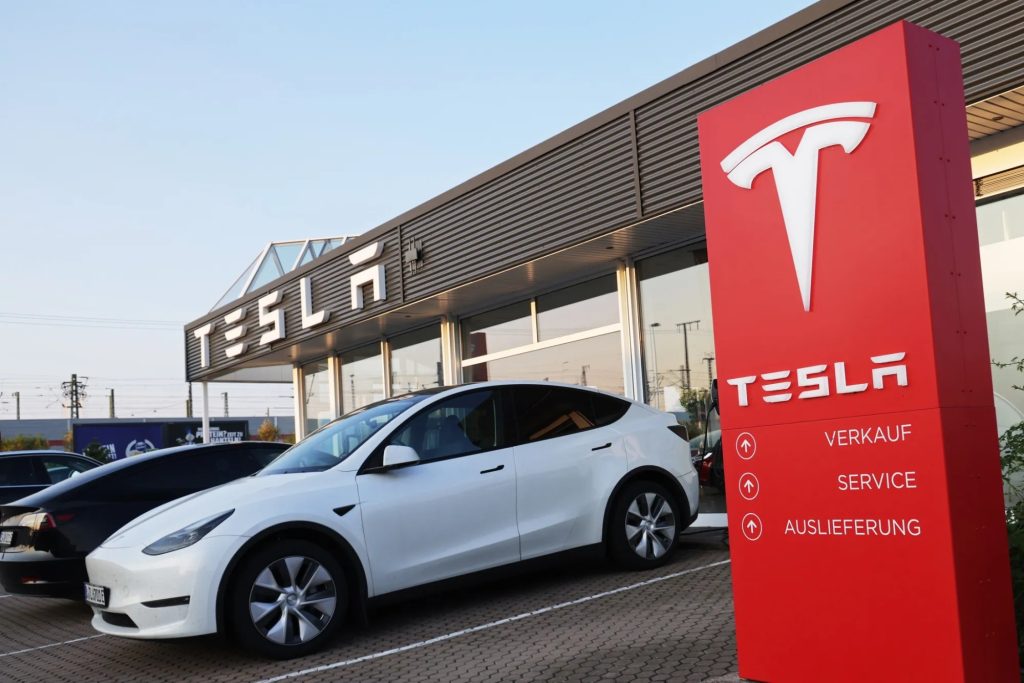


Tesla (TSLA) is feeling the heat in Europe.
Tesla (TSLA) continues to face mounting challenges in Europe, where sales have now fallen for eight consecutive months. According to the European Automobile Manufacturers’ Association (ACEA), Tesla EV registrations—a proxy for sales—dropped to just 14,831 units in August, representing a 22.5% decline compared with the same month last year. By contrast, overall EV registrations in Europe—including the UK and EFTA countries—rose 26.8%, while total vehicle registrations across all powertrains increased 4.7%.
The August figure, while still a significant decline, was an improvement over July’s staggering 40.2% year-over-year drop, when only 8,837 units were sold. Nevertheless, Tesla stock fell more than 3% in midday trading, reflecting investor concern over the company’s ongoing struggles in the European market.
Tesla’s sales slump has been pronounced in several key markets. In France, registrations fell 47.2% to just 1,331 vehicles, despite overall auto sales rising 2.2% in the month, according to the PFA auto lobby. Sweden and Denmark also saw steep declines, with Tesla sales down 84% and 42%, respectively. Norway offered a rare bright spot, reporting a nearly 22% increase in Tesla sales, while Germany and the UK, two of Tesla’s largest European markets, are expected to release August data later this month.
The broader picture for 2025 paints a challenging year for Tesla in Europe. Through the first eight months, sales have fallen 32.6% to 133,857 units, and the company’s market share in the region has dropped to 1.5% from 2.3% a year ago. Tesla CEO Elon Musk had cautioned investors following Q2 earnings that the company would face “a few rough quarters,” largely due to delays in launching more affordable EV models until U.S. federal tax credits expired.
However, Tesla’s difficulties extend beyond timing issues. Rising competition from Chinese EV manufacturers, shifting consumer preferences toward hybrids, and Musk’s political involvement in the U.S. have added to the company’s reputational headwinds. Research firm Escalent notes that 47% of European buyers would now consider purchasing a Chinese EV, compared with only 44% for U.S. vehicles—a reversal from 2024, when American cars were the preferred choice for 51% of respondents versus 31% for Chinese vehicles. Companies like BYD, which offer a mix of EVs and plug-in hybrids, are increasingly capturing buyers who might otherwise have chosen Tesla, particularly in key markets like France, Germany, and the UK.
The sales decline highlights a broader trend in Europe, where EV adoption continues to accelerate overall, but the competitive landscape is shifting rapidly. Tesla’s reliance on premium electric vehicles, while successful in previous years, faces pressure from more affordable and feature-rich alternatives from Chinese and European automakers. Analysts suggest that unless Tesla adapts with new pricing strategies, expanded model options, and improved market positioning, its European growth may remain limited despite global EV demand surging.
With rising competition and changing buyer behavior, Tesla’s European strategy will be a key focal point for investors as the company navigates what Musk described as a period of rough quarters. The coming months will test Tesla’s ability to maintain its foothold in a market increasingly receptive to foreign EV alternatives, particularly those from China.

 Pump Radar
 Stock Alerts