
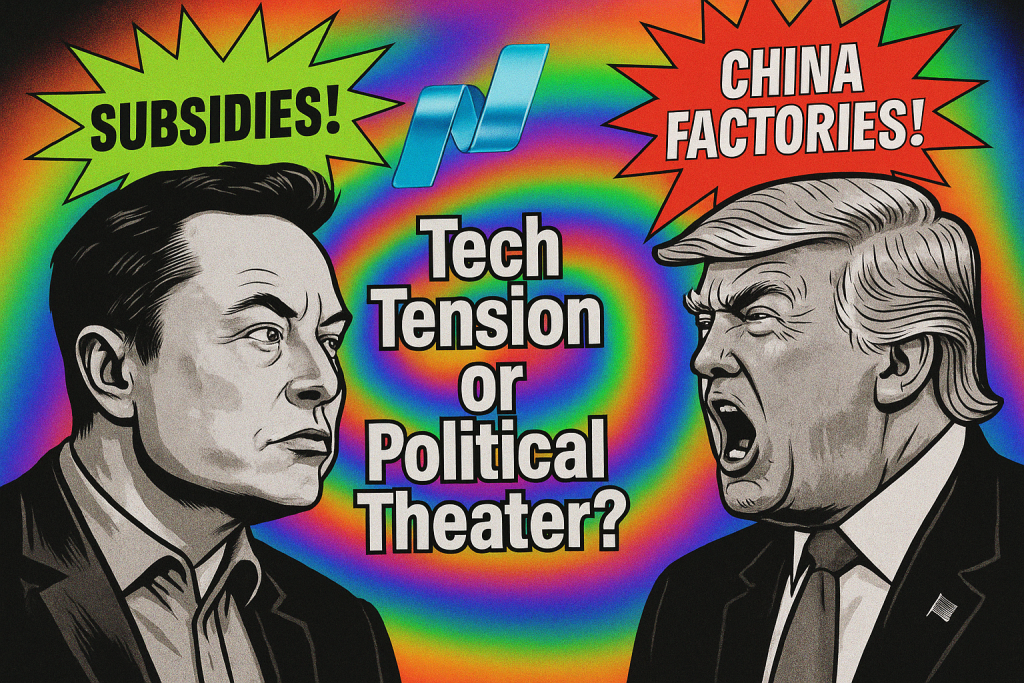


On Sunday evening, a seemingly small spark ignited a storm across financial headlines. Former President Donald Trump, in an interview that was meant to be about trade, took an unexpected swipe at Tesla CEO Elon Musk, calling him “unreliable,” and claiming Musk “owes his fortune to government subsidies and Chinese factories.” By Monday morning, the market was already bracing for the fallout – especially in the tech and EV sectors.
This isn’t the first time Trump and Musk have exchanged jabs, but the timing of this particular spat – combined with rising political and economic tensions – has left many investors wondering: is this just noise, or does it signal deeper market instability?
Let’s break down the stakes.
Tesla in the Crosshairs
Tesla shares slid 2.3% in pre-market trading on Monday, with some analysts citing the Trump comments as a contributing factor. While the move isn’t massive in isolation, the context matters. Tesla’s stock has been under pressure in recent weeks as investors digest slower EV sales growth in key global markets, increased competition from Chinese manufacturers like BYD, and a shifting U.S. policy landscape around clean energy.
Trump’s remarks may not change fundamentals overnight, but they do resurface political risks that many had shelved. In particular, the former president has hinted at revisiting EV subsidies and China-linked regulations if he returns to office. For a company as globally exposed as Tesla – with significant revenue and supply chain ties to China – that possibility is no small matter.
Musk Responds – and Adds Fuel
Elon Musk didn’t stay silent. Within hours, he responded on X (formerly Twitter), stating, “Without innovation, there’s no future. Some politicians want to drag us backward. Tesla builds the future.”
The response was predictably polarizing, drawing support from Musk loyalists and criticism from Trump allies. The clash continued trending into Monday morning, ensuring that both Tesla and Trump dominated the news cycle.
What This Means for Tech
But this isn’t just about one company. Tesla is one of the most heavily weighted stocks in the Nasdaq 100 and S&P 500 . Any meaningful move in its price can ripple across the entire tech sector. When Tesla moves, ETFs like QQQ and XLK often follow. This time was no different – futures on tech-heavy indices dipped slightly in tandem with Tesla’s slide.
The risk here is sentiment-driven. Investors don’t like uncertainty, especially when it’s political. If Trump-Musk tensions escalate or become a recurring theme, some institutions may begin pricing in regulatory or reputational risk – not just to Tesla, but to the broader EV and innovation ecosystem Musk represents.
EV Sector Sentiment Sours
Tesla’s pre-market stumble coincided with minor losses in other electric vehicle stocks. Rivian , Lucid Motors , and Fisker (FSR) all opened lower, even without direct references from Trump or Musk.
It’s a classic example of what traders call “sympathy movement” – when the perception of risk in one high-profile company spills into peer stocks. And this spillover is magnified in sectors like EVs, which are already facing a mix of macro pressures: rising interest rates, softening demand, and shifting government policy around emissions and energy incentives.
Investors in the space are already jittery. Now, with Trump stirring the pot, that caution is turning into real sell pressure.
Nasdaq and Risk Appetite
Beyond Tesla, the broader Nasdaq landscape is also worth watching. After a strong run in May driven by AI momentum and chip stock performance, some traders are starting to question whether the rally can hold up if political uncertainty grows.
The Tesla-Trump spat may be a minor headline on the surface, but it highlights a growing divergence in tech narratives. On one hand, AI and innovation continue to be hot themes. On the other, political headwinds – from tariffs to antitrust rhetoric to public feuds – threaten to undercut investor confidence.
Market makers are now watching closely for signs that the spat will escalate. If Musk becomes a regular target in campaign speeches or policy debates, expect volatility in Tesla and related names. And because of Tesla’s outsized role in the Nasdaq 100, that volatility could bleed into index funds, options markets, and tech-heavy portfolios.
Wall Street’s Next Move
For now, most analysts are chalking up the spat to political theater. But some see an opportunity.
“This kind of headline risk can trigger short-term dislocations,” one tech fund manager told StockBurger. “For long-term investors, that’s a buying opportunity. But if you’re trading the next few weeks, you need to be watching sentiment like a hawk.”
Traders are also eyeing Tesla’s upcoming shareholder meeting and earnings guidance as potential catalysts. If Musk uses those events to take more political shots – or if he announces strategic shifts in response to geopolitical pressure – volatility could rise sharply.
What Should Investors Watch?
- Trump Campaign Messaging: If Trump continues targeting Tesla or the EV industry in general, sector sentiment could worsen.
- Musk’s Public Statements: Every tweet matters. If Musk engages further, the story will stay in the headlines.
- ETF Flows: Watch funds like QQQ , XLK , and ARKK for signs of retail or institutional risk-off behavior.
- EV Subsidy News: The White House is likely to respond if the political conversation continues. Any changes to tax credits or tariffs will affect valuations.
- China Developments: Tesla’s reliance on Chinese battery suppliers and factories remains a vulnerability. If trade tensions rise, so do Tesla’s risks.
Final Thoughts
Tesla and Trump are two of the most polarizing names in American business and politics. When they collide, markets listen.
While Monday’s drop was modest, it’s a reminder that politics and tech are more intertwined than ever. Investors chasing innovation-fueled growth must now account for a new layer of volatility – driven not just by earnings reports or economic data, but by personalities and power plays.
For traders, the message is clear: Keep your stop losses tight. And for long-term investors, buckle in. This could just be the opening round.



 Pump Radar
 Stock Alerts