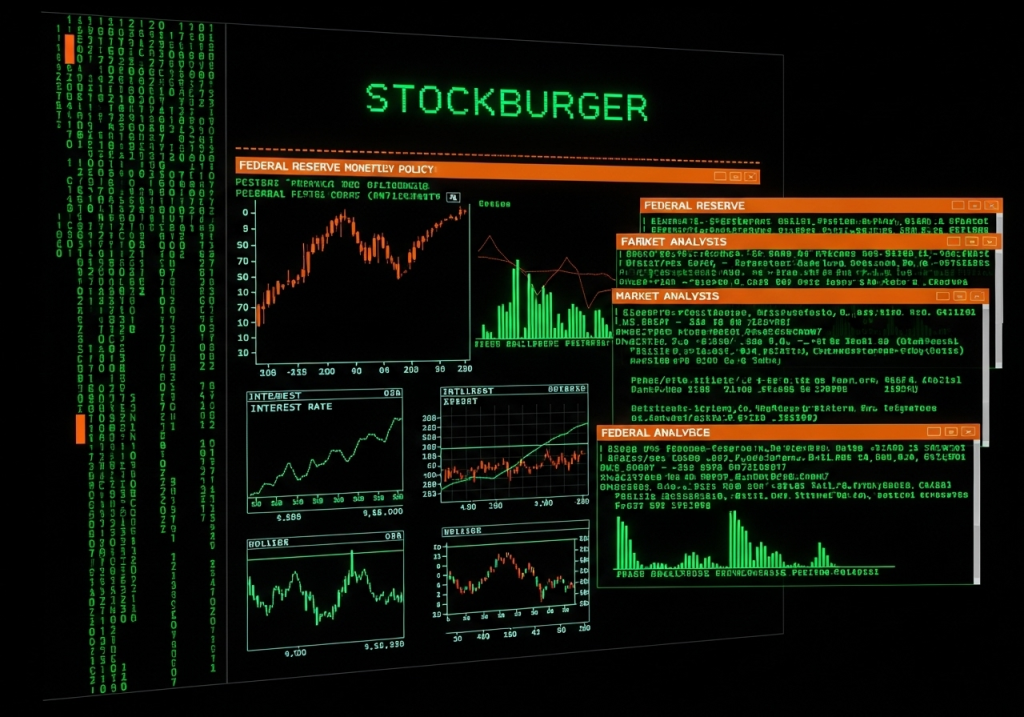


# The Federal Reserve’s Impact on Financial Markets: A StockBurger Analysis
[ICON] STOCKBURGER EXCLUSIVE MARKET ANALYSIS [ICON]
## August 27, 2025 – In-depth Market Analysis
STOCKBURGER RESEARCH TEAM
Navigating the currents of economic policy and market response.
## Executive Summary
The Federal Reserve, often referred to simply as “the Fed,” stands as the central bank of the United States, wielding significant influence over the nation’s financial landscape. Established by Congress in 1913, its primary mandate is to safeguard the economy by preventing financial panics and promoting financial stability [1]. The Fed’s actions, particularly its monetary policy decisions, reverberate throughout the economy, directly impacting interest rates, inflation, employment, and, consequently, the stock market. Understanding the mechanisms through which the Fed exerts this influence is crucial for investors and market participants alike. This analysis delves into the key tools and strategies employed by the Federal Reserve and their multifaceted effects on various components of the financial markets.
## Main Content: The Fed’s Monetary Policy Tools and Their Market Impact
The Federal Reserve employs a range of monetary policy tools to achieve its dual mandate of maximum employment and price stability [2]. These tools primarily influence the availability and cost of money and credit in the economy, thereby affecting economic activity and financial markets. The primary tools include the federal funds rate, open market operations, the discount window, reserve requirements, and interest on reserve balances.
### Interest Rates and Their Ripple Effect
One of the most direct and widely discussed impacts of the Fed’s policy is on interest rates. The federal funds rate, a target rate set by the Federal Open Market Committee (FOMC), is the interest rate at which commercial banks borrow and lend their excess reserves to each other overnight. While the Fed does not directly control this rate, it influences it through open market operations. Changes in the federal funds rate cascade through the financial system, affecting other interest rates such as those on mortgages, car loans, and business loans [3].
When the Fed raises interest rates, borrowing becomes more expensive for businesses and consumers. This can lead to a slowdown in economic activity as companies may postpone expansion plans and consumers may reduce spending on big-ticket items. For the stock market, higher interest rates can make equities less attractive compared to fixed-income investments, as the latter offer a more competitive return. Additionally, higher borrowing costs can squeeze corporate profits, further dampening investor sentiment [4]. Conversely, when the Fed lowers interest rates, borrowing becomes cheaper, stimulating economic activity and potentially boosting corporate earnings, which can be a positive signal for equity markets [5].
### Open Market Operations (OMO)
Open market operations are the primary means by which the Fed influences the federal funds rate. These involve the buying and selling of government securities in the open market. When the Fed buys government securities, it injects money into the banking system, increasing the supply of reserves and putting downward pressure on the federal funds rate. When it sells securities, it withdraws money, reducing reserves and pushing the rate upward [6]. The effectiveness of OMO lies in its flexibility and precision, allowing the Fed to make subtle adjustments to liquidity conditions.
### The Discount Window and Reserve Requirements
The discount window is a facility through which commercial banks can borrow money directly from the Federal Reserve. The interest rate charged on these loans is known as the discount rate. While not as frequently used as OMO, the discount window serves as a backstop source of liquidity for banks, particularly during times of financial stress. A lower discount rate can signal the Fed’s intention to ease monetary policy, while a higher rate can indicate a tightening stance.
Reserve requirements dictate the minimum amount of reserves that banks must hold against their deposits. Historically, changes in reserve requirements were a powerful tool, but they are now rarely used to manage liquidity due to their disruptive potential. The Fed can also pay interest on reserve balances, providing another lever to influence banks’ willingness to lend [7].
### Quantitative Easing and Tightening
Beyond these traditional tools, the Fed has also employed unconventional measures, particularly during and after financial crises. Quantitative easing (QE) involves large-scale asset purchases, such as long-term Treasury bonds and mortgage-backed securities, to lower long-term interest rates and provide additional liquidity to the financial system. The opposite, quantitative tightening (QT), involves reducing the Fed’s balance sheet by allowing these assets to mature without reinvestment, effectively withdrawing liquidity from the market.
These policies have a profound impact on asset prices. QE tends to push up asset prices, including stocks, by increasing liquidity and encouraging investors to seek higher returns in riskier assets. QT, on the other hand, can have the opposite effect, potentially leading to downward pressure on asset prices as liquidity tightens. The market’s reaction to these policies is often significant, as investors adjust their portfolios in anticipation of or in response to changes in the Fed’s balance sheet [8].
## Impact on the Stock Market
The Federal Reserve’s actions directly and indirectly influence the stock market through several channels. The most immediate impact is often seen through interest rate changes. When the Fed raises interest rates, the cost of borrowing for companies increases, which can reduce their profitability and, consequently, their stock valuations. Higher interest rates also make bonds and other fixed-income investments more attractive, drawing capital away from equities. This can lead to a decrease in stock prices as investors reallocate their portfolios towards less risky assets with competitive returns [9].
Conversely, when the Fed lowers interest rates, borrowing becomes cheaper for businesses, potentially boosting their earnings and making stocks more appealing. Lower rates also reduce the discount rate used in valuation models, which can increase the present value of future earnings, thereby supporting higher stock prices. This is why markets often react positively to rate cuts, especially during economic slowdowns, as they signal the Fed’s intent to stimulate growth [10].
Beyond direct interest rate effects, the Fed’s communication and forward guidance play a crucial role in shaping market expectations. Investors closely scrutinize every statement, speech, and meeting minute from Fed officials for clues about future policy direction. Any perceived shift in the Fed’s stance can trigger significant market movements, as traders and institutional investors adjust their positions in anticipation of policy changes. This phenomenon, often referred to as ‘Fed-watching,’ highlights the psychological impact of the central bank on market sentiment.
Furthermore, the Fed’s policies can influence corporate earnings, which are a primary driver of stock performance. Lower interest rates can reduce a company’s debt servicing costs, directly improving its bottom line. A stronger economy, fostered by accommodative monetary policy, can also lead to increased consumer spending and business investment, translating into higher revenues and profits for companies. Conversely, tighter monetary policy can dampen economic growth, leading to lower earnings and stock price declines.
The Fed’s influence extends to different sectors of the stock market in varying degrees. Growth stocks, which often rely on future earnings potential and debt financing for expansion, tend to be more sensitive to interest rate changes. Higher rates can disproportionately impact these companies by increasing their cost of capital and reducing the present value of their distant future cash flows. Value stocks, on the other hand, which are typically more mature companies with stable earnings, may be less affected by interest rate fluctuations.
### Terminal Analysis: Market Response to Fed Announcements
To illustrate the market’s sensitivity to Fed actions, let’s consider a hypothetical terminal output analyzing stock market reactions to recent Federal Open Market Committee (FOMC) announcements. This data, often processed by high-frequency trading algorithms, provides insights into immediate market sentiment.
TERMINAL OUTPUT: FOMC_ANNOUNCEMENT_ANALYSIS_20250827.log
$ analyze_market_impact –event FOMC_RATE_DECISION –date 2025-08-27
—————————————————-
EVENT: FOMC Rate Decision (August 27, 2025)
FED FUNDS RATE: Target Range 5.25% – 5.50% (Unchanged)
MARKET REACTION (T+5min):
– S&P 500 (SPX): +0.35%
– NASDAQ Composite (IXIC): +0.48%
– Dow Jones Industrial Average (DJIA): +0.28%
– 10-Year Treasury Yield: -2.5 bps
– USD Index (DXY): -0.15%
KEY TAKEAWAYS:
– Market interpreted ‘unchanged’ rates as dovish due to forward guidance.
– Tech sector (NASDAQ) showed stronger positive response.
– Bond yields slightly decreased, indicating flight to safety/anticipation of future cuts.
—————————————————-
This terminal output suggests that even when rates remain unchanged, the market’s interpretation of the Fed’s forward guidance can drive significant movements. In this hypothetical scenario, the market perceived the Fed’s stance as dovish, leading to a positive reaction across major indices and a slight decrease in bond yields.
## Investment Recommendations
Given the Federal Reserve’s pervasive influence on financial markets, investors should consider several strategies to navigate periods of monetary policy shifts:
1. **Stay Informed on Fed Communications:** Closely follow FOMC announcements, speeches by Fed officials, and the release of meeting minutes. These provide critical insights into the Fed’s outlook on the economy and its potential policy actions. Tools like the FedWatch Tool can help gauge market expectations for future rate changes.
2. **Diversify Portfolios:** Diversification across various asset classes, sectors, and geographies can help mitigate risks associated with specific market segments that may be more sensitive to Fed policy. A well-diversified portfolio is generally more resilient to interest rate fluctuations and economic cycles.
3. **Re-evaluate Fixed-Income Holdings:** In a rising interest rate environment, existing bonds with lower yields become less attractive. Investors holding such bonds may experience capital losses if they sell before maturity. Consider shorter-duration bonds or floating-rate notes, which are less sensitive to interest rate changes. Conversely, in a falling rate environment, longer-duration bonds may offer higher capital appreciation.
4. **Assess Sector Sensitivity:** Understand which sectors are more sensitive to interest rate changes. Growth-oriented sectors (e.g., technology, consumer discretionary) often perform well in low-interest-rate environments due to easier access to capital and higher discounted future earnings. Value-oriented sectors (e.g., financials, utilities) may perform better in rising rate environments, as banks can earn more on loans and utilities offer stable dividends.
5. **Consider Inflation-Protected Securities:** If the Fed’s policies lead to concerns about inflation, Treasury Inflation-Protected Securities (TIPS) can offer a hedge, as their principal value adjusts with inflation.
6. **Focus on Quality Companies:** Regardless of the interest rate environment, investing in companies with strong fundamentals, healthy balance sheets, consistent cash flows, and sustainable competitive advantages is a sound long-term strategy. These companies are generally better positioned to weather economic shifts.
## Risk Disclaimers
Investing in financial markets involves inherent risks, and the value of investments can fluctuate. The information provided in this article is for informational purposes only and does not constitute financial advice. Monetary policy decisions by the Federal Reserve, while aimed at promoting economic stability, can introduce volatility and uncertainty into the markets. Investors should be aware of the following risks:
* **Interest Rate Risk:** Changes in interest rates can negatively impact the value of fixed-income investments and increase borrowing costs for companies and individuals.
* **Market Volatility:** Unexpected Fed announcements or shifts in policy can lead to sudden and significant market movements, affecting stock prices and overall portfolio values.
* **Inflation Risk:** While the Fed aims for price stability, there is always a risk that its policies could lead to higher-than-anticipated inflation, eroding the purchasing power of investments.
* **Economic Slowdown/Recession Risk:** Aggressive monetary tightening by the Fed to combat inflation could potentially lead to an economic slowdown or recession, impacting corporate earnings and employment.
* **Liquidity Risk:** In certain market conditions, it may be difficult to buy or sell investments quickly without significantly affecting their price.
Investors should conduct their own due diligence and consult with a qualified financial advisor before making any investment decisions. Past performance is not indicative of future results. The views expressed in this article are those of the author and do not necessarily reflect the official policy or position of StockBurger News.
## References
[1] Federal Reserve Board. *The Fed Explained – Financial Stability*. Available at: [https://www.federalreserve.gov/aboutthefed/fedexplained/financial-stability.htm](https://www.federalreserve.gov/aboutthefed/fedexplained/financial-stability.htm)
[2] Federal Reserve Bank of St. Louis. *How Does the Fed Use Its Monetary Policy Tools to Influence the Economy?*. Available at: [https://www.stlouisfed.org/publications/page-one-economics/2022/05/02/how-does-the-fed-use-its-monetary-policy-tools-to-influence-the-economy](https://www.stlouisfed.org/publications/page-one-economics/2022/05/02/how-does-the-fed-use-its-monetary-policy-tools-to-influence-the-economy)
[3] Bankrate. *6 key ways the Federal Reserve impacts your money*. Available at: [https://www.bankrate.com/banking/federal-reserve/how-federal-reserve-impacts-your-money/](https://www.bankrate.com/banking/federal-reserve/how-federal-reserve-impacts-your-money/)
[4] U.S. Bank. *How Do Changing Interest Rates Affect the Stock Market?*. Available at: [https://www.usbank.com/investing/financial-perspectives/market-news/how-do-rising-interest-rates-affect-the-stock-market.html](https://www.usbank.com/investing/financial-perspectives/market-news/how-do-rising-interest-rates-affect-the-stock-market.html)
[5] Investopedia. *How Do Interest Rates Affect the Stock Market?*. Available at: [https://www.investopedia.com/investing/how-interest-rates-affect-stock-market/](https://www.investopedia.com/investing/how-interest-rates-affect-stock-market/)
[6] Federal Reserve Bank of New York. *Monetary Policy Implementation*. Available at: [https://www.newyorkfed.org/markets/domestic-market-operations/monetary-policy-implementation](https://www.newyorkfed.org/markets/domestic-market-operations/monetary-policy-implementation)
[7] Federal Reserve Bank of St. Louis. *How the Fed Implements Monetary Policy with Its Tools*. Available at: [https://www.stlouisfed.org/in-plain-english/the-fed-implements-monetary-policy](https://www.stlouisfed.org/in-plain-english/the-fed-implements-monetary-policy)
[8] PNC. *How Federal Reserve Monetary Policy Impacts Investments*. Available at: [https://www.pnc.com/insights/personal-finance/invest/how-federal-reserve-monetary-policy-impacts-investments.html](https://www.pnc.com/insights/personal-finance/invest/how-federal-reserve-monetary-policy-impacts-investments.html)
[9] Investopedia. *The Fed’s Tools for Influencing the Economy*. Available at: [https://www.investopedia.com/articles/economics/08/monetary-policy-recession.asp](https://www.investopedia.com/articles/economics/08/monetary-policy-recession.asp)
[10] NBER. *How the Fed Responds to Stock Market Moves*. Available at: [https://www.nber.org/digest/sep01/how-fed-responds-stock-market-moves](https://www.nber.org/digest/sep01/how-fed-responds-stock-market-moves)

 Pump Radar
 Stock Alerts