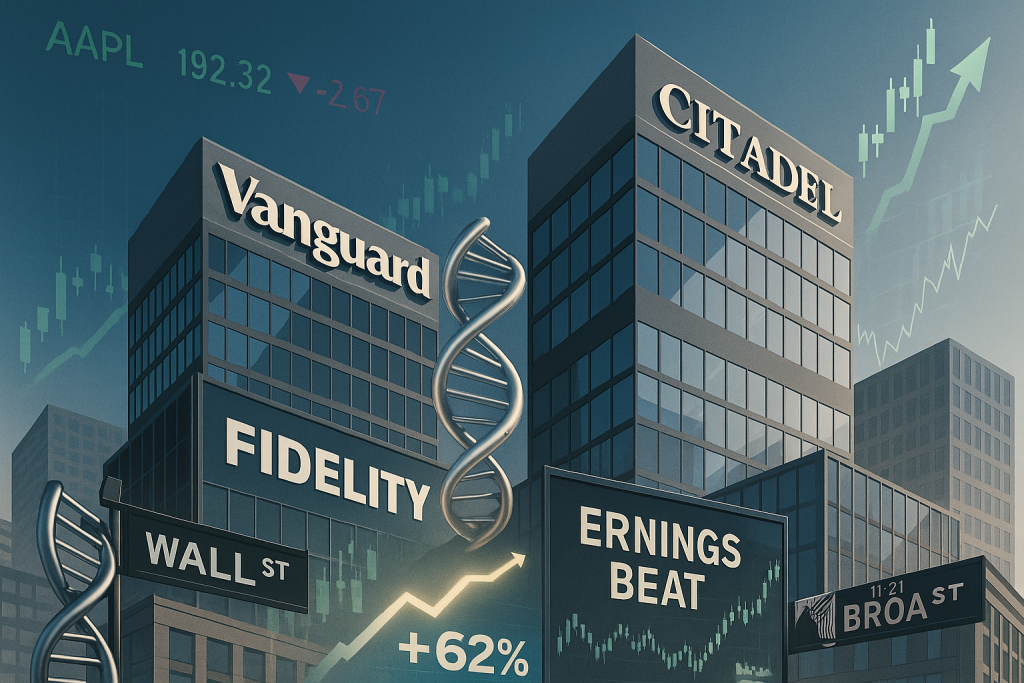


When people think of Wall Street giants, names like Vanguard, Fidelity, and Citadel often top the list. These firms – and others like Renaissance Technologies and Millennium Management – aren’t just financial institutions; they’re market-moving behemoths with trillions in assets, high-frequency trading arms, or secretive quant funds that set the pace for institutional investing worldwide.
If you’re curious about how these firms shape the financial markets or just want to understand what makes each one unique, here’s a closer look at eight major players dominating everything from retail investing to algorithmic trading.
Vanguard Group Inc.
Vanguard is the Goliath of passive investing. Founded by Jack Bogle in 1975, the firm pioneered the index fund – a low-cost, diversified investment product that now forms the backbone of most 401(k)s and retirement portfolios.
With over $7 trillion in global assets under management (AUM), Vanguard is one of the largest asset managers in the world. It’s best known for offering retail and institutional investors access to mutual funds and ETFs with rock-bottom fees. Vanguard operates as a unique structure: it’s owned by the funds themselves, which in turn are owned by investors. This alignment helps keep expenses low and investor interests front and center.
Its reach is massive, holding significant stakes in almost every major U.S. company – from Apple and Microsoft to Tesla and JPMorgan.
Fidelity Investments
Founded in 1946, Fidelity is a privately held financial services corporation that offers a mix of retail investing, wealth management, and institutional services. As of 2024, the firm managed over $4.5 trillion in assets.
What sets Fidelity apart is its robust mix of actively managed funds alongside a growing suite of low-cost index offerings. The company also runs one of the most popular retail brokerage platforms, attracting both beginner investors and high-net-worth individuals.
Fidelity has long been a leader in research and innovation, being one of the early adopters of cryptocurrency custody and Web3 investment infrastructure. Their research arms and Fidelity Labs continue to push the envelope on fintech integration.
Renaissance Technologies
If the stock market had a Hogwarts, Renaissance Technologies would be its Slytherin house – brilliant, secretive, and almost mythic in its ability to generate returns.
Founded by mathematician Jim Simons, Renaissance is a hedge fund that operates on quantitative strategies and data science. Its Medallion Fund is considered one of the most successful investment vehicles of all time, reportedly generating annual returns of over 60% before fees (and it’s closed to outside investors).
Unlike traditional asset managers, Renaissance employs physicists, cryptographers, and statisticians to uncover patterns in data that most human traders never see. The fund’s strategies are so closely guarded that even internal staff are often siloed from the core algorithmic models.
Geode Capital Management
Geode may not be a household name, but it plays a central role in one of the biggest asset management operations on the planet. Geode manages index funds on behalf of Fidelity, making it the sub-advisor for many of Fidelity’s passive investment products.
Headquartered in Boston, Geode oversees nearly $1 trillion in AUM. It focuses on systematic investing and low-cost replication of major indices like the S&P 500. In many ways, Geode is Fidelity’s quiet engine for scaling index products to match competitors like Vanguard and BlackRock.
Millennium Management
Millennium operates under a multi-manager model, with over 280 independent investment teams operating in relative autonomy under one firm. With more than $60 billion in AUM, it’s one of the largest hedge funds globally.
The firm, founded by Israel Englander in 1989, is known for its risk control, rigorous hiring standards, and technological investment in risk-adjusted alpha generation. Millennium’s structure allows it to diversify strategy risk while amplifying internal competition for capital allocation. Its global presence and sophisticated approach to portfolio construction make it a pillar of the modern hedge fund ecosystem.
Lane Street Capital
Lane Street is a lesser-known but rising player among institutional investors. Specializing in alternative credit strategies, Lane Street focuses on niche opportunities often overlooked by traditional players.
The firm partners with banks, insurance companies, and family offices to source, underwrite, and service esoteric credit assets – ranging from equipment leasing to structured finance. While not managing trillions, Lane Street exemplifies the growing trend of specialization and targeted alpha strategies in the private credit and structured investment space.
Citadel
If Renaissance is the most secretive quant fund, Citadel is the most influential market participant across both investing and market-making. Founded by Ken Griffin in 1990, Citadel operates both a hedge fund arm (Citadel LLC) and a market-making division (Citadel Securities).
Citadel LLC manages over $60 billion in assets and is renowned for its multi-strategy approach: fixed income, macro, equity, quant, and commodities. Citadel Securities, meanwhile, is one of the largest market makers in the world, providing liquidity to retail and institutional markets alike. It processes a significant share of U.S. equity volume daily and plays a central role in the ETF ecosystem.
Cubist Systematic Strategies
Cubist is the quantitative arm of Point72, Steve Cohen’s multi-billion-dollar hedge fund. Cubist focuses on algorithmic and systematic trading strategies, leveraging big data, machine learning, and real-time analytics.
While Point72 is known for its discretionary long/short equity investments, Cubist gives the firm an edge in the highly competitive world of quant hedge funds. Cubist manages billions and is always recruiting top-tier talent from academia and tech to maintain its competitive edge.
Final Thoughts: Why These Firms Matter
These firms don’t just manage money – they shape markets. Whether you’re investing in an S&P 500 ETF, trading tech stocks, or watching macro headlines, odds are one or more of these names is quietly behind the move.
Their models, mandates, and philosophies vary widely – from Renaissance’s math-driven mystique to Vanguard’s populist mission – but each plays a role in how capital flows through the global economy.
Understanding who they are helps you better grasp how Wall Street works – and why it moves the way it does.


 Pump Radar
 Stock Alerts