


President Donald Trump has been diagnosed with chronic venous insufficiency following recent swelling in his legs, the White House announced Thursday.
According to White House press secretary Karoline Leavitt, Trump, 79, underwent a “comprehensive examination, including diagnostic vascular studies” performed by the White House Medical Unit. She read a statement from the president’s physician, Capt. Sean Barbabella.
Barbabella’s letter, which was later made public, stated: “Bilateral lower extremity venous Doppler ultrasounds were performed and revealed chronic venous insufficiency, a benign and common condition, particularly in individuals over the age of 70.”
Leavitt said the exam followed Trump’s own observation of “mild swelling in his lower legs” over recent weeks.
“Importantly, there was no evidence of deep vein thrombosis (DVT) or arterial disease,” the letter continued, noting that lab results were “within normal limits.” Trump also underwent an echocardiogram. “No signs of heart failure, renal impairment, or systemic illness were identified,” Barbabella wrote.
Chronic venous insufficiency occurs when vein valves don’t function properly, causing blood to pool in the legs. The condition affects about 150,000 people annually, with risk increasing with age. Symptoms include leg or ankle swelling, aching or cramping, varicose veins, pain, or skin changes. Treatments range from medication to medical procedures in more advanced cases.
“It’s basically not alarming information, and it’s not surprising,” said Dr. Jeremy Faust, an emergency medicine professor at Harvard Medical School, in an interview with CNN. “This is a pretty normal part of aging, and especially for someone in the overweight to obese category, which is where the president has always been. But the bigger concern … is that symptoms like this do need to be evaluated for more serious conditions, and that is what happened.”
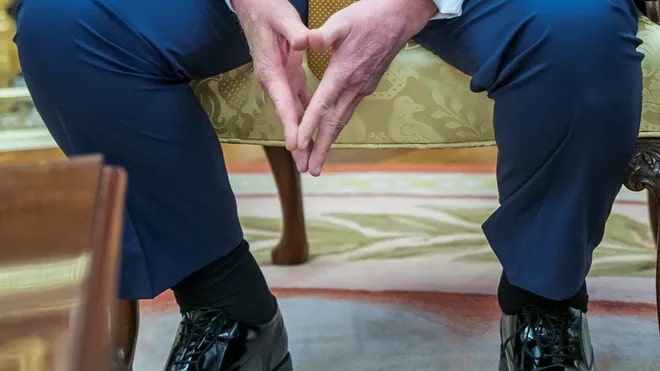
A cropped photo of Trump’s feet taken during the FIFA World Cup final on July 13 in East Rutherford, New Jersey, had circulated online, sparking speculation about his health.
Dr. Bernard Ashby, a cardiologist, told CNN that chronic venous insufficiency can be linked to other conditions. “Even though he’s diagnosed with a benign condition, venous insufficiency, by itself doesn’t necessarily mean it’s benign. The question is, what’s causing the venous insufficiency? And so I would want to know whether or not he has any evidence of, again, increased pressures in the heart or increased pressures in the lungs, which can be contributing to that, and if so, what is the primary cause of that?”
Ashby added that Trump’s medical team was “covering all their bases” by screening for heart failure and other contributing issues.
Dr. Chris Pernell also noted risk factors like age, obesity, and inactivity. “If a person is older, a person is overweight, a person is not engaging in regular physical activity or exercise, if a person is sitting or standing for prolonged amounts of time, you can get chronic venous insufficiency,” she said. “And while it is not life-threatening, it can be debilitating.”
Leavitt added that Trump is experiencing “no discomfort.”
She also addressed the bruising visible on the back of Trump’s hand, attributing it to “frequent handshaking” and the use of aspirin. According to Barbabella’s letter, “This is consistent with minor soft tissue irritation from frequent handshaking and the use of aspirin, which is taken as part of a standard cardiovascular prevention regimen.”
Barbabella concluded, “President Trump remains in excellent health.”
If re-elected, Trump would become the oldest president in U.S. history at the start of his second term.
CNN’s Asuka Koda contributed to this report.


 Pump Radar
 Stock Alerts