
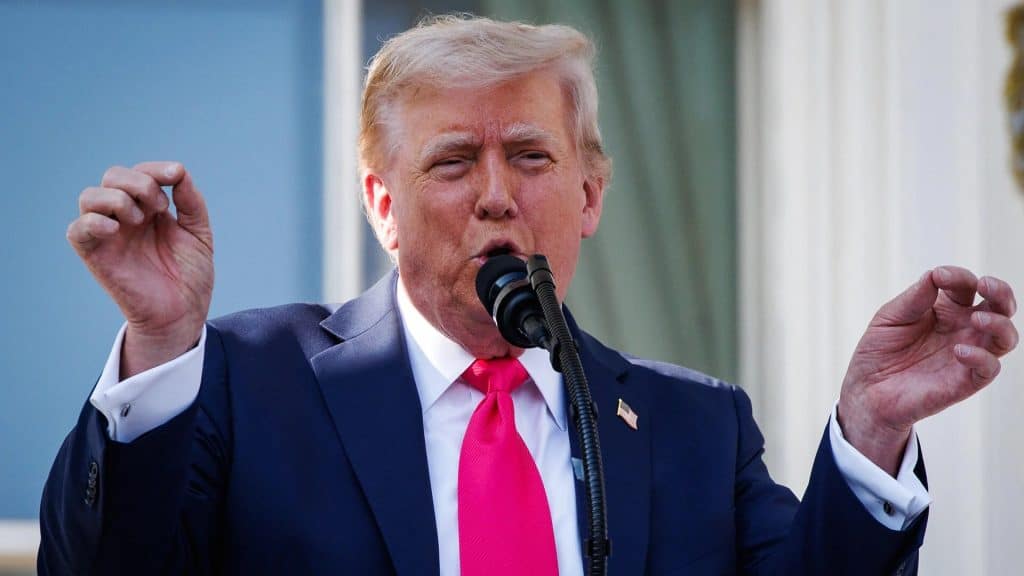


President Donald Trump closed out a whirlwind week of tariff escalations by announcing yet another record-breaking month in customs revenue, adding further complexity to an already tangled global trade landscape.
The chaos began with Trump teasing a mix of “Letters, and/or Deals” and claiming he was “done” with trade talks. Yet by week’s end, the only clear takeaway was that negotiations—and market speculation—are likely to heat up again ahead of the next key deadline on August 1, when a wave of new tariffs is set to take effect.
In the meantime, Trump is touting the cash inflow. On Friday, the U.S. Treasury Department confirmed that tariff revenues in June hit $26.6 billion, setting a new monthly record and surpassing May’s total of $22.2 billion. That brought the fiscal year-to-date total to $108 billion, with the bulk of that amount collected in recent months as Trump’s aggressive trade measures took hold.
Still, tariff revenue remains a small slice of overall federal income. Friday’s Treasury report showed total U.S. government receipts topped $526 billion for the month, underlining that tariffs, while headline-grabbing, are not yet a dominant funding stream.
The new data capped off a week packed with tariff developments—from threats of 35% duties on Canadian goods, to 50% levies on Brazil, to newly issued letters targeting more than 20 countries, along with a surprise unveiling of 50% tariffs on copper.
Markets, however, largely brushed off the volatility. Investors appear to be waiting for clarity closer to the August 1 deadline.
Trump, for his part, made it clear he has no intention of delaying implementation. During a recent cabinet meeting, he declared: “The big money will start coming in on Aug. 1.”
At this point, Trump is planning blanket tariffs of 15% to 20% on most trading partners—with some nations facing significantly higher rates.
Brazil drew particular attention this week, after receiving a notice of a potential 50% tariff. Trump linked the move to what he described as a political vendetta against the former Brazilian president—his ally—who faces allegations of trying to overturn election results in 2022.
“Maybe at some point I’ll talk to him,” Trump said of possible talks with Brazil. “Right now I’m not.”
Canada, too, was unexpectedly targeted by a 35% tariff threat, though officials suggested that certain key goods, like oil, may be exempt as negotiations continue. The ongoing talks now center not just on the August 1 deadline, but also the upcoming joint review of the U.S.-Mexico-Canada Agreement (USMCA) scheduled for next July.
Canadian Prime Minister Mark Carney responded to Trump’s announcement by affirming his country’s readiness to engage: “We will continue to do so as we work towards the revised deadline of Aug. 1.”
Despite the political fireworks, Wall Street appeared largely unfazed. While the S&P 500 (^GSPC) dipped on Friday and was flat for the week overall, it reached fresh record highs earlier in the week—a stark contrast to the selloff in April when Trump’s “Liberation Day” tariffs rattled markets and forced him to walk back the announcement.
Back then, Trump admitted he saw people were “yippy” and “afraid.” This week, however, he struck a confident tone, celebrating stock market records and hosting Nvidia (NVDA) CEO Jensen Huang at the White House.
“Tech Stocks, Industrial Stocks, & NASDAQ, HIT ALL-TIME, RECORD HIGHS!” Trump wrote Thursday on Truth Social. “USA is taking in Hundreds of Billions of Dollars in Tariffs. COUNTRY IS NOW ‘BACK.'”
Looking ahead, market watchers are bracing for more volatility. As Raymond James policy analyst Ed Mills put it: “The tariff landscape is evolving rapidly” with headline risks rising and rates likely ranging from 10% to 50%, depending on the country.
But Mills added that post–August 1, “the base case is for tariffs to settle in the 10–30% range.”

 Pump Radar
 Stock Alerts