
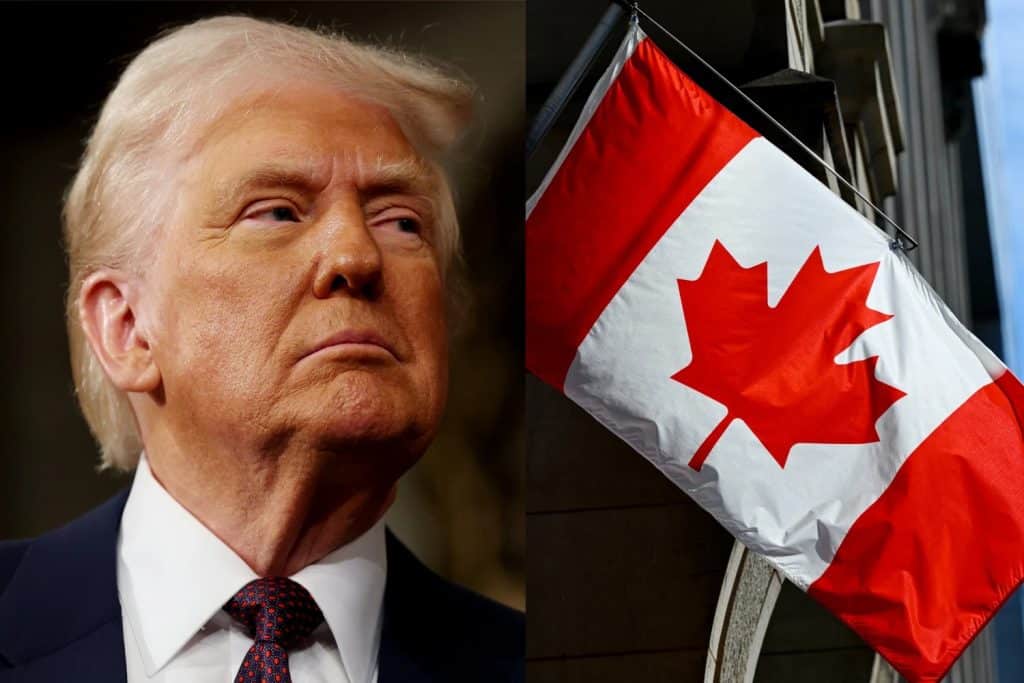


President Donald Trump announced Friday that he is suspending trade negotiations with Canada in response to its decision to move forward with a digital services tax on tech companies—a policy he labeled “a direct and blatant attack on our country.”
In a post on his social media platform, Trump said Canada had confirmed it would implement the tax, which targets Canadian and international businesses with digital operations in the country. The measure, set to take effect Monday, will levy a 3% charge on revenue generated from Canadian users, affecting major U.S. firms such as Amazon, Google, Meta, Uber, and Airbnb. The tax will also apply retroactively, leaving American companies with an estimated $2 billion bill due by month’s end.
“Based on this egregious Tax, we are hereby terminating ALL discussions on Trade with Canada, effective immediately. We will let Canada know the Tariff that they will be paying to do business with the United States of America within the next seven day period,” Trump declared.
Canadian Prime Minister Mark Carney responded diplomatically, saying Canada would “continue to conduct these complex negotiations in the best interests of Canadians. It’s a negotiation.”
Trump later stated he believes Canada will back down on the tax, but issued a warning: “Economically we have such power over Canada. We’d rather not use it. It’s not going to work out well for Canada. They were foolish to do it.”
When asked whether Canada could take any steps to resume negotiations, Trump suggested repealing the tax, but added, “It doesn’t matter to me.”
The development marks another sharp turn in U.S.-Canada trade relations under Trump’s second term. The relationship has been marked by volatility, with Trump previously floating the idea that Canada might one day be absorbed as a U.S. state.
Carney visited Trump in May at the White House, while Trump traveled to Alberta last week for the G7 summit, during which both countries agreed to a 30-day window to finalize a new trade framework.
Meanwhile, the U.S. is preparing to roll out a new round of tariffs, with Trump stating that letters would soon be sent to various countries outlining updated tariff rates. Currently, his administration has imposed 50% tariffs on steel and aluminum and 25% on autos, with a baseline 10% import tax in place for most countries. That rate could increase after a 90-day review period ends on July 9.
Canada and Mexico already face additional tariffs of up to 25% linked to efforts to curb fentanyl smuggling. However, some protections remain under the 2020 U.S.-Mexico-Canada Agreement (USMCA), signed during Trump’s first term.
Treasury Secretary Scott Bessent, after a closed-door meeting with Republican senators, declined to comment on Trump’s decision, saying only, “I was in the meeting,” before taking another question.
Canada remains a vital trade partner for the U.S., supplying roughly 60% of its imported crude oil and 85% of electricity imports. It is also the largest foreign source of steel, aluminum, and uranium, and boasts 34 critical minerals that the Pentagon considers essential. Roughly 80% of Canadian exports are destined for the U.S.

 Pump Radar
 Stock Alerts