
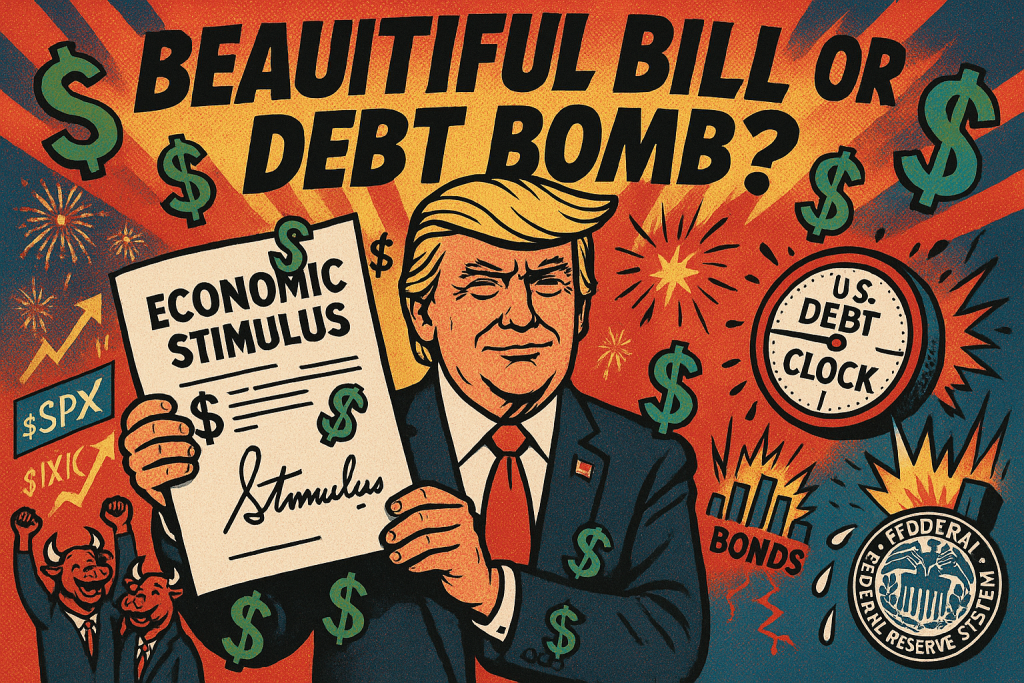


In a move that’s both celebrated and criticized, former President Donald Trump signed the “One Big Beautiful Bill Act” into law on July 4, locking in the largest tax cut extension in U.S. history. This $3.4 trillion package permanently enshrines the 2017 Trump-era tax reductions while combining new spending provisions and a $5 trillion increase in the debt ceiling. Financial markets initially cheered, with the S&P 500 and Nasdaq notching record highs. But beneath the surface of investor optimism lies growing anxiety about what this could mean for the U.S. economy long-term – especially as inflation pressures build and the Federal Reserve watches closely.
Let’s break it all down: what’s in the bill, why investors initially rallied, and why economists are warning this euphoria could turn into a debt-fueled hangover.
What’s in the $3.4 Trillion “Beautiful Bill”?
Dubbed by some as “Trump’s Legacy Lock,” the bill makes permanent the 2017 Tax Cuts and Jobs Act provisions, which were set to expire in 2026. This includes lower income tax brackets, increased standard deductions, and business tax incentives that had significantly reduced corporate tax liabilities over the past seven years. In addition, the new law adds spending on immigration enforcement, national defense, and new refundable credits like child tax bonuses and tip income relief for service workers.
But it doesn’t stop there. According to Reuters, the law includes cuts to Medicaid growth, a repeal of some Biden-era clean energy tax credits, and a full suspension of the debt ceiling through 2029 – setting up a high-stakes showdown for the next administration.
Wall Street’s Initial Reaction: Euphoria and All-Time Highs
When news broke of the bill’s passage in both the House and Senate, stock markets surged. The S&P 500 and Nasdaq rallied on July 5, with traders celebrating what they saw as a pro-growth stimulus boost. Investors interpreted the tax cut permanence as a tailwind for corporate earnings – particularly in financials, energy, and consumer sectors.
But not everyone was celebrating.
As reported by MarketWatch, there’s growing concern that the market is “pricing in Goldilocks” while ignoring mounting structural risks. The contradiction is striking: while equities rally on stimulus, bond yields are flashing warning signs.
Bond Markets Sound the Alarm: Higher Yields, Bigger Risks
Bond investors, unlike equity traders, were not entirely thrilled. Yields on the 10-year Treasury spiked above 4.4% following the bill’s signing. The reason? Ballooning supply expectations and fears that the massive spending package could reignite inflation.
According to Reuters, foreign demand for U.S. Treasuries has begun to wane, a potential problem for funding America’s debt binge. Some economists even raised the specter of “bond vigilantes” returning – investors who demand higher yields in exchange for funding government excess.
Moody’s weighed in too, warning that the U.S. fiscal position could deteriorate fast enough to challenge its creditworthiness. While no immediate downgrade is expected, the tone is starkly different from the party atmosphere in equities.
Inflation and the Fed’s Tightrope
Then there’s the Federal Reserve. With this fiscal stimulus hitting the economy at a time when inflation is still above the 2% target, the Fed now faces a difficult path forward. Rate cuts, which markets were hoping for in September, could now be delayed.
As Barron’s reports, the sudden spike in long-term yields is tightening financial conditions before the Fed even acts. That makes any dovish move riskier – potentially adding fuel to the fire if inflation expectations resurface.
Some Fed officials are already cautioning that the bill’s stimulus effect could keep rates higher for longer. Data-dependence might now mean staying restrictive as the fiscal side keeps pushing.
The Debt Hangover: Long-Term Worries Mount
While Wall Street may be partying now, economists are sounding the alarm about long-term consequences. The U.S. debt-to-GDP ratio is projected to exceed 130% by 2035 if no corrective action is taken. According to the Wall Street Journal, America is entering “default mode” on deficits – meaning continuous reliance on debt without real fiscal reform.
Axios went further, describing the bill as “a budgetary sugar rush with no offsetting plan,” adding that fiscal conservatives are furious about the potential damage to future generations. Critics argue that permanent tax cuts, layered on top of aggressive spending, set the stage for fiscal reckoning.
Investor Sentiment: Split Between Relief and Risk
Despite all the concern, investors remain conflicted. On the one hand, corporate America stands to benefit from lower taxes and consumer spending boosts. On the other, long-duration assets like growth tech and real estate are under pressure from rising yields and a potential Fed delay.
Institutional players are reportedly rotating into cyclical sectors – banks, defense, industrials – while hedging with commodities and short-term bonds. Volatility remains elevated as markets digest the implications.
Final Thought: A Rally with a Shadow
Trump’s “One Big Beautiful Bill” may have sparked cheers on Wall Street, but it’s also stirred fear among fiscal hawks and bond traders. The big question now: will this bill boost the economy just enough to delay a reckoning, or is it laying the groundwork for an inflationary spike and higher interest rates?
Markets have made their initial call. But as yields rise and inflation whispers return, the real verdict is still to come.




 Pump Radar
 Stock Alerts