
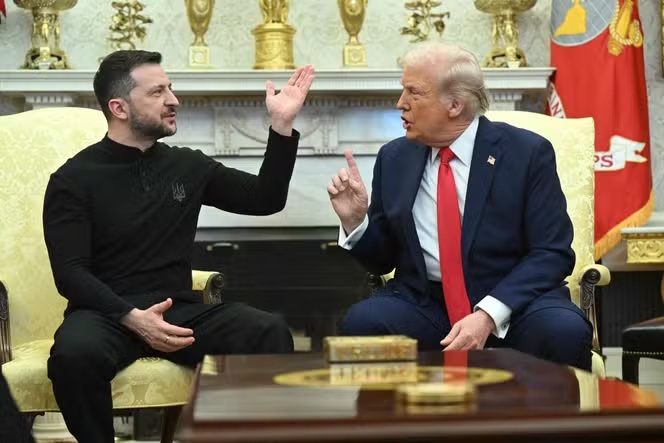


Donald Trump will host Ukrainian President Volodymyr Zelensky in Washington on Monday following the U.S. president’s decision to abandon calls for an immediate ceasefire in Ukraine. The visit comes as Russian President Vladimir Putin renewed his long-standing demand that Kyiv cede control of the Donbas region in peace talks.
Trump told Zelensky and European leaders during a call that Putin wants Ukraine to relinquish the entire eastern Donbas region, according to sources familiar with the matter. The conversation occurred as Trump returned from a high-profile summit with Putin in Alaska, which ended without a breakthrough to end the war now in its fourth year. Trump described the meeting as productive and signaled he would urge Zelensky to negotiate a deal, increasing pressure on the Ukrainian leader.
Several senior European diplomats expressed concern after the Alaska summit, arguing that Putin appeared to benefit the most, both symbolically—by securing a U.S. invitation—and substantively, as Trump shifted focus to a long-term peace plan rather than pressing for an immediate ceasefire.
Ahead of Monday’s meeting, European allies in the coalition supporting Kyiv will hold a video call Sunday, and some leaders may join Zelensky in Washington, sources said. Zelensky has repeatedly rejected giving up Donetsk and Luhansk, which Russian forces control only partially. Russia would also freeze its claims over other parts of Zaporizhzhia and Kherson regions it does not currently hold, sources added.
German Chancellor Friedrich Merz expressed skepticism about Putin’s intentions, noting that while prior agreements have been signed, the promise of peace is far from certain. “At least, it’s the beginning of a conversation,” he said in an interview.
Trump indicated to European leaders that he is willing to help guarantee Ukraine’s security as long as NATO is not involved, and sources said he suggested Putin would accept such an arrangement. Following a Saturday call with Trump, Zelensky tweeted that Ukraine is prepared to work toward peace. Trump confirmed Zelensky’s visit in a Truth Social post, noting that a potential trilateral meeting with Putin could be scheduled if feasible.
“The best way to end the war is a peace agreement, not a mere ceasefire,” Trump wrote, emphasizing a shift from his earlier insistence that a ceasefire be the first step. He previously threatened to leave the Alaska summit or impose new sanctions if Russia did not agree to a pause in fighting but suggested on Friday that he would delay any fresh penalties on Russia’s trade partners.
An Uneasy Partnership
Monday’s White House visit will be pivotal for Zelensky, who has had a tense relationship with Trump. Their last Oval Office meeting in February ended in a shouting match and briefly halted U.S. military aid, weakening Ukraine’s capabilities. Since then, the leaders have met multiple times, including at NATO summits and the Vatican, repairing ties.
European officials praised Trump’s efforts during recent calls and reiterated the value of a trilateral meeting with Putin, without mentioning prior demands for an immediate ceasefire. Russian state media reported that the idea of such a summit was not raised in Alaska. European leaders stressed that any decisions about Ukraine’s territory rest with Kyiv, asserting that international borders cannot be changed by force.
Some European officials expressed concern that Trump may pressure Zelensky to make territorial concessions to reach a deal. EU foreign policy chief Kaja Kallas noted, “President Trump’s resolve to get a peace deal is vital, but Russia has no intention of ending this war anytime soon.” She added that Putin left Alaska without committing to halt the violence.
Putin described his Alaska talks with Trump as “very frank and meaningful,” saying Russia respects the U.S. administration’s desire to end military action and hopes for a peaceful resolution.
In a Fox News interview after the summit, Trump acknowledged that a few issues remain unresolved with Putin and shifted attention to Zelensky, emphasizing that it is ultimately up to Ukraine to find a path forward. European leaders reiterated that Ukraine must have strong security guarantees, unrestricted use of its armed forces, and freedom to cooperate with third countries. Russia cannot veto Ukraine’s potential EU or NATO membership.
Meanwhile, the conflict continues on the ground. Ukraine’s Air Force reported that Russia launched 85 drones and a ballistic missile overnight, signaling Moscow’s intent to maintain pressure. Zelensky warned that Russian forces may escalate attacks to gain leverage in upcoming negotiations with global actors.


 Pump Radar
 Stock Alerts