
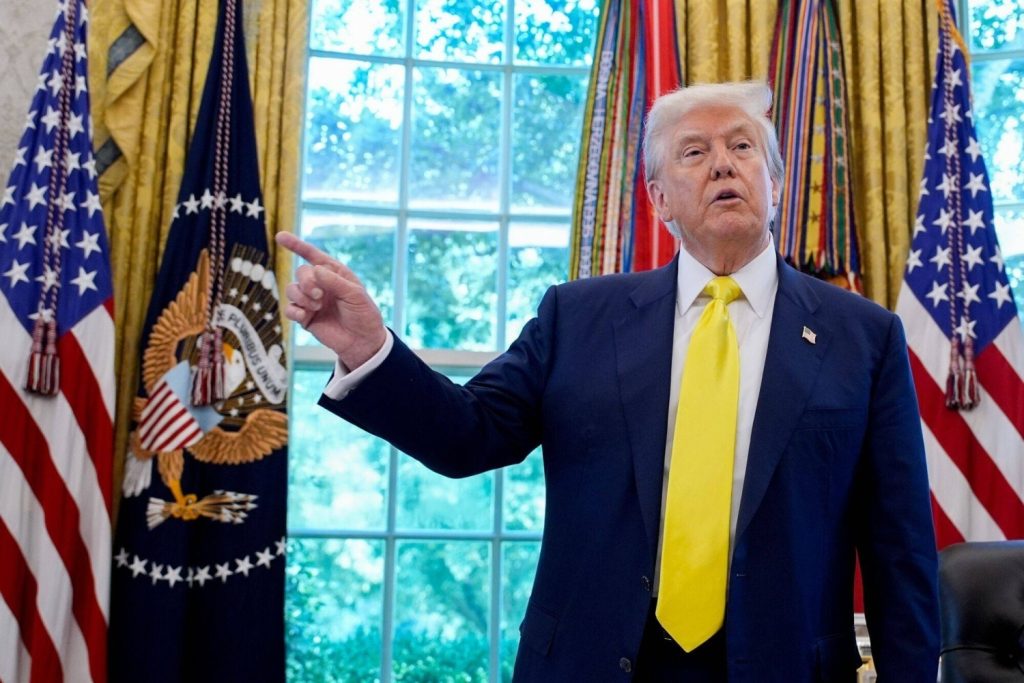


President Donald Trump’s sweeping new tariffs on imports from more than 90 countries officially took effect Thursday, marking a dramatic escalation in his effort to rewrite the rules of global trade. Just moments before a deadline passed for countries to strike new trade agreements with Washington, Trump posted on Truth Social boasting that “billions of dollars” were now flowing into the U.S. thanks to his import levies.
The tariffs—which cover industries ranging from metals and machinery to consumer electronics, autos, and agricultural goods—push America’s average import tax rate above 17%, the highest in nearly a century. While Trump says the goal is to bring manufacturing and jobs back to the U.S. and reduce the trade deficit, the moves have also become a central lever for achieving foreign policy objectives.
Steep Rates and Varied Targets
Rates vary widely, with some of the heaviest penalties falling on export-driven economies in Southeast Asia. Manufacturing hubs Laos and Myanmar face tariffs of 40%, while Switzerland has been hit with a 39% levy after failing to reach a last-minute deal with Washington—prompting Bern to call an extraordinary cabinet meeting. Taiwan, a key U.S. ally in Asia, was handed a 20% tariff, though President Lai Ching-te described the rate as “temporary” and said talks were ongoing.
Some allies have managed to negotiate softer landings. The UK, Japan, South Korea, and the European Union reached agreements to keep tariffs far lower than the levels Trump initially threatened in April. Brussels, for example, agreed to a 15% tariff on EU goods as part of a broader framework deal with Washington.
Political and Geopolitical Leverage
Beyond trade balances, Trump is using tariffs as a pressure tactic in global diplomacy. On Wednesday, he threatened to double tariffs on Indian imports—from 25% to 50%—if New Delhi doesn’t stop purchasing Russian oil by August 27. India’s government denounced the move as “unfair, unjustified and unreasonable,” vowing to protect its national interests.
The same day, Trump announced plans for a 100% tariff on foreign-made semiconductors, a move clearly aimed at encouraging tech companies to expand production in the U.S. Hours later, Apple pledged $100 billion in new U.S. investments, following weeks of pressure from the White House. According to officials in Taiwan and South Korea, major chipmakers such as TSMC, Samsung, and SK Hynix would be exempt from the new levy because of their existing commitments to American manufacturing.
Months in the Making
Many of the tariffs were first unveiled in April but temporarily paused due to market turbulence and to give countries time to strike deals. Trump ultimately set a hard negotiating deadline of August 7. While some agreements were finalized, others stalled or collapsed, leaving several nations facing sharp increases overnight.
In Asia, the rollout was met with relative calm despite months of uncertainty. Major share indexes in Japan, Hong Kong, South Korea, and mainland China closed slightly higher Thursday, while markets in India and Australia ended lower. Economist Bert Hofman of the National University of Singapore said the new rates may bring some predictability after months of shifting targets. “This is supposed to be it,” he said. “Now you can start to analyse the impact of the tariffs.”
Focus on Top Trading Partners
Since returning to the White House in January, Trump has trained particular attention on America’s top three trading partners—China, Canada, and Mexico. Last week, he increased tariffs on Canadian goods from 25% to 35%, citing a lack of cooperation in curbing the flow of fentanyl and other drugs across the border. However, most Canadian exports to the U.S. are shielded by the United States-Mexico-Canada Agreement (USMCA). Higher tariffs on Mexican goods have been postponed for 90 days while negotiations continue.
Talks with Beijing are also underway to extend a 90-day pause on tariffs between the world’s two largest economies, set to expire on August 12.
Tariffs and the Russia-Ukraine War
Some of Trump’s latest tariff threats are tied directly to his push for a resolution to Russia’s war in Ukraine. He has floated “secondary tariffs” on countries that maintain trade relations with Moscow if a ceasefire isn’t reached by Friday. Analysts warn that India may not be the only target, raising concerns among other nations currently in talks with Washington.
Market Impact and Next Steps
While critics accuse Trump of throwing the global economy into turmoil, U.S. markets have recently shown resilience, with investors seemingly adapting to the new trade landscape. Still, economists caution that the scale and scope of these tariffs could disrupt supply chains, push up consumer prices, and invite retaliatory measures.
For now, the White House appears committed to using tariffs as its Swiss Army knife—solving trade disputes, advancing geopolitical aims, and pressuring companies to “bring it home.” With sector-specific hikes on semiconductors, pharmaceuticals, aircraft, and critical minerals still in the pipeline, the world’s trading partners are bracing for more turbulence in the months ahead.


 Pump Radar
 Stock Alerts