
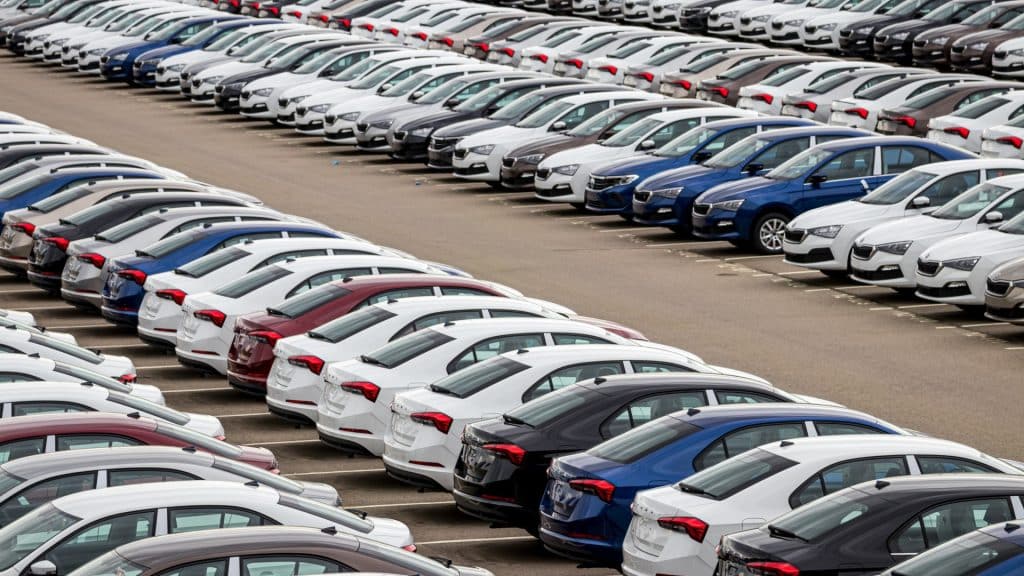


President Donald Trump’s newly announced trade deal with Japan is drawing concern from U.S. automakers, who say the 15% tariff on Japanese vehicles gives foreign rivals an edge while domestic manufacturers continue to face steeper import taxes on key materials and components.
“We need to review all the details of the agreement, but this is a deal that will charge lower tariffs on Japanese autos with no U.S. content,” said Matt Blunt, president of the American Automotive Policy Council, which represents Detroit’s Big Three: General Motors (GM), Ford (F), and Jeep-parent Stellantis (STLA).
Blunt noted that American manufacturers and workers “definitely are at a disadvantage” under the current system, where they face a 50% tariff on steel and aluminum and a 25% tariff on auto parts and finished vehicles. Some products remain exempt under the United States-Mexico-Canada Agreement (USMCA), enacted in 2020.
The domestic backlash underscores the challenges of balancing global trade policy with local economic realities. Trump has framed the deal as a significant victory, saying it will generate hundreds of thousands of jobs and reduce the long-standing trade imbalance with Japan. The agreement replaces a proposed 25% import tax that was set to take effect on August 1, while also pledging $550 billion in Japanese investments into U.S. projects, according to the White House.
The deal also promises to eliminate regulatory hurdles for American cars sold in Japan. Trump administration officials said vehicles built in Detroit could now be shipped directly to Japan and sold without added modifications.
But Blunt questioned whether this will translate into actual sales. “Tough nut to crack, and I’d be very surprised if we see any meaningful market penetration in Japan,” he said, noting that U.S., European, and South Korean automakers hold just a 6% share of the Japanese market.
Japanese auto giants Toyota, Honda, and Nissan declined to comment on the agreement, as did industry groups Autos Drive America and the Alliance for Automotive Innovation.
Some analysts say the Japan deal could eventually open the door for other countries and automakers to seek adjustments to the broader U.S. tariff framework. Trump has previously emphasized his willingness to be flexible in trade talks. With the USMCA set for review next year, that could become a new point of leverage.
“Ford, GM and Stellantis do ‘have every right to be upset,’” said Sam Fiorani, vice president at AutoForecast Solutions. But he added that “Honda, Toyota, and Nissan still import vehicles from Mexico and Canada, where the current levels of tariffs can be higher than those applied to Japanese imports. Most of the high-volume models from Japanese brands are already produced in North America.”
He cited the Toyota 4Runner, Mazda CX-5, and Subaru Forester as exceptions still imported to the U.S., but said many Japanese imports fill niche segments too small to justify domestic production.
“There will be negotiations between the U.S. and Canada and Mexico, and it will probably result in tariffs no higher than 15%,” Fiorani added. “But nobody seems to be in a hurry to negotiate around the last Trump administration’s free trade agreement.”

 Pump Radar
 Stock Alerts