
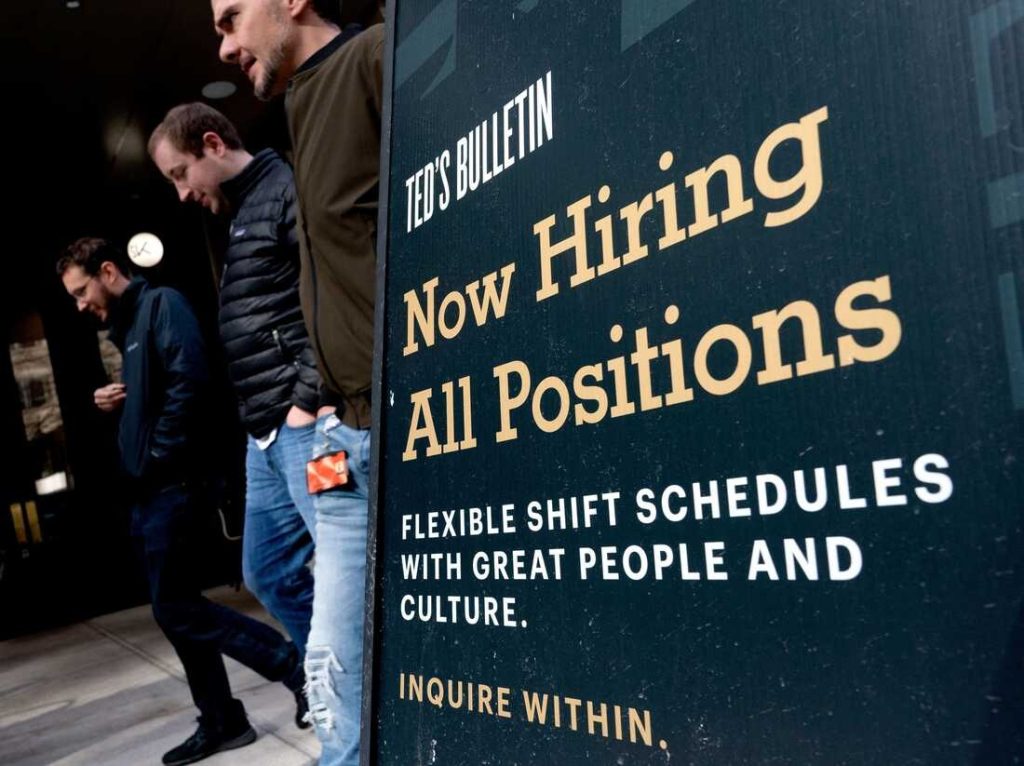


The U.S. labor market showed resilience in May despite growing economic uncertainty and shifting trade policy under President Trump.
Employers added 139,000 nonfarm payrolls last month, topping economist forecasts of 126,000. The unemployment rate remained unchanged at 4.2%. April’s job gain was revised down to 147,000 from an initially reported 177,000, and combined revisions for March and April showed 95,000 fewer jobs were created than previously estimated.
Markets responded positively to the report: the Dow jumped 435 points (1%), the S&P 500 rose 0.9%, and the Nasdaq gained 1.1% in early trading.
“This is not a freeze, but a temporary chill,” said Ger Doyle, North America regional president at ManpowerGroup. “Employees are staying put, employers are holding steady, and everyone is waiting for clearer signs,” he wrote in commentary Friday.
While job growth remains above the critical 100,000 monthly threshold—often viewed as the minimum needed to absorb population growth—momentum has clearly slowed. So far in 2025, the economy has added an average of 124,000 jobs per month. That’s the weakest January-to-May average for a non-recession year in three decades, based on Bureau of Labor Statistics data.
Economists remain cautious. Although the job market hasn’t collapsed, it’s showing signs of fatigue, with slower hiring, reduced job switching, and employers largely standing pat.
Daniel Zhao, lead economist at Glassdoor, summed it up: “The May jobs report still has everyone waiting for the other shoe to drop,” Daniel Zhao, Glassdoor’s lead economist, wrote Friday. “This report shows the job market standing tall, but as economic headwinds stack up cumulatively, it’s only a matter of time before the job market starts straining against those headwinds.”
President Trump’s sweeping and often unpredictable tariff policies—paired with significant federal spending cuts, government layoffs, and immigration restrictions—are fueling unease among businesses.
Business leaders say the lack of clarity around tariff schedules and trade terms makes it nearly impossible to plan ahead. “They don’t know what their costs will be in three months—or even three days,” one economist noted. The result: hiring slowdowns and frozen investment decisions.
Dozens of major public companies have suspended earnings forecasts, while many small businesses have been forced into a holding pattern. Even as layoffs remain low, the lack of job movement is slowing the churn that typically underpins a vibrant labor market.
With rising uncertainty and mixed signals, the May report leaves the market and policymakers in “wait-and-see” mode—watching for signs that the job market could begin to falter under mounting pressure.


 Pump Radar
 Stock Alerts