
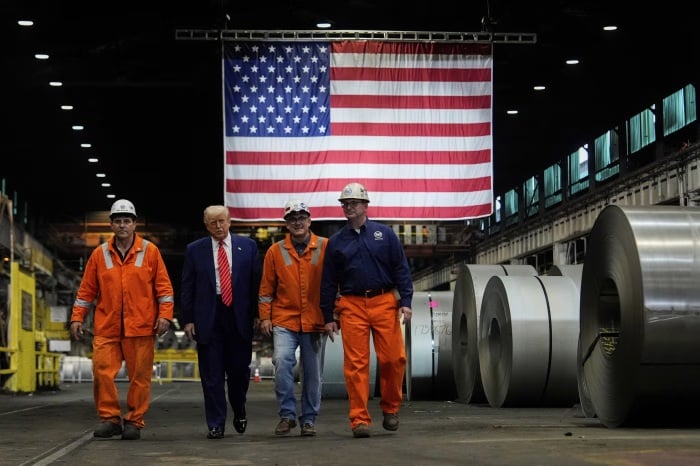


U.S. Steel shares rallied Monday after President Donald Trump gave the green light to its high-profile merger with Japan’s Nippon Steel, following months of scrutiny and negotiation.
Trump issued an executive order Friday allowing the companies to proceed, contingent on signing a national security agreement with the U.S. government. That agreement includes a unique provision — a so-called “golden share” for the U.S., giving it significant control over key aspects of the company’s future operations.
U.S. Steel confirmed the signing of the agreement, completing the final major step toward closing the deal. The company said Friday that the agreement includes a golden share, but did not detail the specific powers granted.
Trump, however, stated Thursday that the golden share gives the U.S. president “total control,” though he didn’t elaborate. Republican Sen. Dave McCormick of Pennsylvania previously told CNBC the share would provide control of multiple board seats.
Commerce Secretary Howard Lutnick shared more specifics in a social media post Saturday, saying the golden share gives the U.S. president veto power over major decisions such as relocating U.S. Steel’s headquarters, moving the company abroad, renaming it, transferring production or jobs overseas, and closing or idling plants within specified timeframes.
Though Trump has avoided calling the deal a merger — instead referring to it as a “partnership” — U.S. Steel confirmed in a Monday SEC filing that it will become a wholly owned subsidiary of Nippon Steel North America.
“All regulatory approvals required for the completion of the Transaction have been received,” U.S. Steel stated in its filing. “The Transaction remains subject to the satisfaction of customary closing conditions, and is expected to be completed promptly.”
While Trump had criticized Nippon’s bid during the 2024 election campaign and even after returning to office, his stance began to shift following a February 7 meeting with Japanese Prime Minister Shigeru Ishiba. At a joint press conference, Trump said Nippon Steel would “invest heavily” in U.S. Steel without taking a majority stake and added he would “mediate and arbitrate” the deal directly. Still, confusion lingered, as Nippon insisted it still intended to acquire the company, while Trump continued to frame it as a “partnership.”
In the months that followed, pressure mounted. GOP lawmakers from Pennsylvania and other states with U.S. Steel facilities warned that blocking the deal could result in significant job losses. Trump acknowledged receiving appeals from members of Congress and local steel unions, and ultimately appeared swayed by their arguments.
Nippon Steel also argued the transaction aligned with the Trump administration’s goals of boosting domestic manufacturing, creating jobs, and encouraging investment in the U.S. On June 13, Trump echoed that sentiment, posting on social media that the partnership would “create at least 70,000 jobs and add $14 billion dollars to the U.S. economy.”
Nippon’s revised offer also helped seal the deal. The Japanese firm raised its bid from $2.7 billion in September 2024 to $14 billion, including funding for a new steel mill. The increased investment supported Trump’s manufacturing-first economic agenda. At a May 30 rally at a U.S. Steel plant near Pittsburgh, Trump said, “the deal got better and better and better for the workers.”
To ensure the deal’s viability, Trump intervened directly. On April 7, he ordered the Committee on Foreign Investment in the U.S. (CFIUS) to revisit the merger and evaluate whether new steps proposed by the companies addressed prior national security concerns. He also requested that an appeals court pause related litigation until June 5, citing the potential for CFIUS to “fully resolve” the issues. The committee submitted its final recommendation to the president on May 21, paving the way for Trump to finalize a deal on his terms.
 Pump Radar
 Stock Alerts