
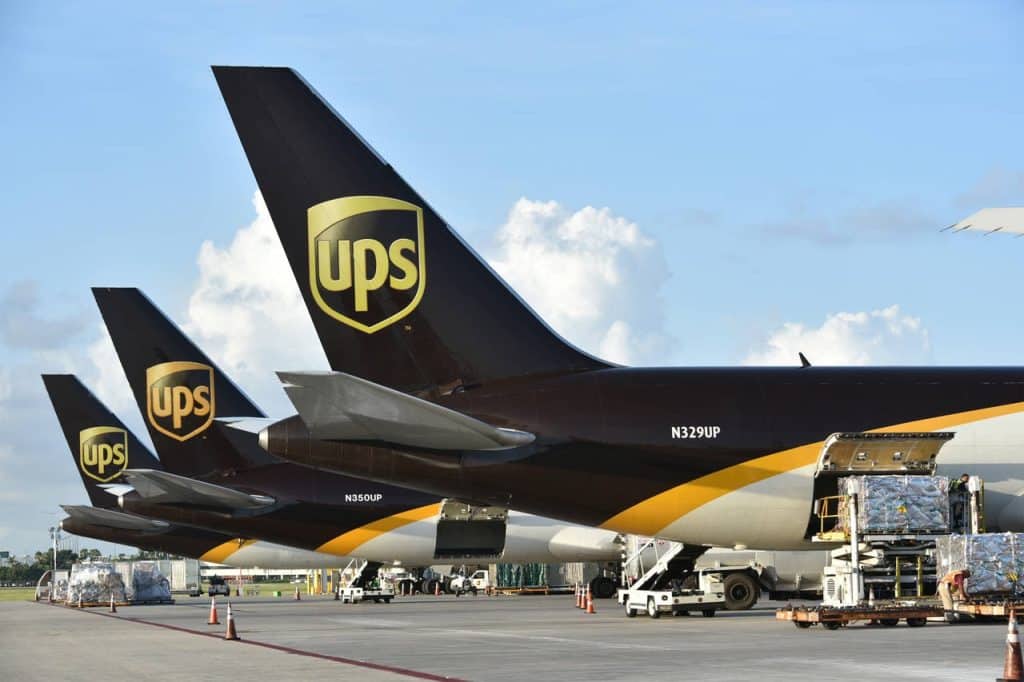


UPS (NYSE: UPS) shares tumbled more than 10% Tuesday after the company reported weaker-than-expected second-quarter results, citing ongoing challenges from international tariffs, restructuring efforts, and a continued retreat from low-margin Amazon business.
UPS’s average daily domestic package volume fell 7.3% in Q2, dragging total revenue down 2.7% to $21.2 billion. Adjusted operating income declined 9.1% year over year to $1.9 billion, while adjusted EPS slid 13.4% to $1.55. Although both figures slightly beat Wall Street forecasts, investors reacted to UPS pulling its financial guidance and struggling to realize cost savings from its transformation efforts.
CEO Carol Tomé pointed to softer industrial demand and mounting tariff pressure as key headwinds. “Consumers…are trading down to less expensive service and shifting spending from essential items to discretionary categories like restaurants and automobiles,” Tomé said.
Volume declines were partly offset by a shift toward higher-margin deliveries. Domestic revenue dipped just 0.8%, and excluding Amazon, air volume rose 1.4% on demand from healthcare and tech clients. However, total air volume still fell 11.6%, and ground volume was down 6.6%, with the budget-focused Ground Saver segment plunging 23.3% due to price hikes.
Delivery-related expenses rose by $85 million, largely because UPS was unable to eliminate as many delivery stops as projected. That undercut the benefit of a 5.5% year-over-year rise in revenue per piece.
CFO Brian Dykes said, “We are laser focused on improving revenue quality and the changes we are making are beginning to show up in our results.”
Small business demand remained flat, while enterprise volume (excluding Amazon) declined 10.4%. Within that group, B2B volume slipped 2.3% and B2C dropped nearly 11%.
International volume increased 3.9%, lifting segment revenue by 2.6%, though margins declined due to geographic mix and reduced surcharges. But volumes on the critical China-to-U.S. lane plunged 35% in May and June following the Trump administration’s 30% tariffs and removal of the de minimis exemption for low-value goods.
“UPS exports from China to the rest of the world [were] up 22.4%,” said Tomé, as shippers diverted away from the U.S. toward other regions. UPS adjusted by adding or canceling more than 100 international flights and nearly doubling capacity between India and Europe.
Meanwhile, freight forwarding within UPS’s Supply Chain Solutions unit took a hit, with revenue down 44% to $132 million, part of an 18.3% decline for the segment. The company cited both divestitures and soft global demand.
Tomé said UPS is still working to close its acquisition of Mexico-based express carrier Estafeta. “We remain confident” about expanding in Mexico, she added, citing reshoring efforts driven by U.S.-China trade tensions. So far in 2025, UPS has conducted over 600 supply chain mapping consultations.
UPS has now closed 74 facilities this year — one more than previously projected — under its five-year plan to streamline operations by consolidating into automated hubs. More closures are expected in the second half, including in New Orleans.
In April, UPS announced plans to cut 20,000 jobs and eliminate 25 million work hours, targeting excess labor as Amazon volumes dwindle. But uptake on voluntary exit packages has been slower than anticipated. Just 9,500 jobs have been cut out of a workforce that began the year at 490,000.
So far, “fewer than 10% of workers depart in the first month after a facility closes,” the company said, though part-time attrition tends to accelerate over time.
UPS also offered package car drivers a voluntary buyout of $1,800 per year of service, which has seen “a lot of interest,” despite the Teamsters union advising members to decline. According to U.S. Region President Nando Cesarone, top-scale drivers with 25 to 40 years of tenure are most likely to accept.
Dykes said 64% of UPS volume now flows through automated facilities, up from 60% last year. “Those automated facilities give us more flexibility… and ultimately will help us scale more efficiently,” he noted.
The company expects $3.5 billion in annualized savings from the network overhaul, automation, and operational redesign. Amazon’s package volume, which fell 13% in the first half, is projected to drop 30% year-over-year in Q3 and Q4. UPS removed 1 million Amazon packages from its network in the first half and anticipates another 500,000 will exit in Q3 alone.
UPS declined to provide revenue or earnings guidance for the rest of the year. Management cited macroeconomic volatility, pricing changes to Ground Saver, and uncertainty over how many drivers will take buyouts.
Tomé noted that July volumes looked strong but may have been influenced by Amazon Prime Day and retailer promotions. Additionally, many shippers may have accelerated orders ahead of August tariff deadlines.
“Small businesses, in particular, may hold back on orders if their tariff risk rises,” she warned.

 Pump Radar
 Stock Alerts