
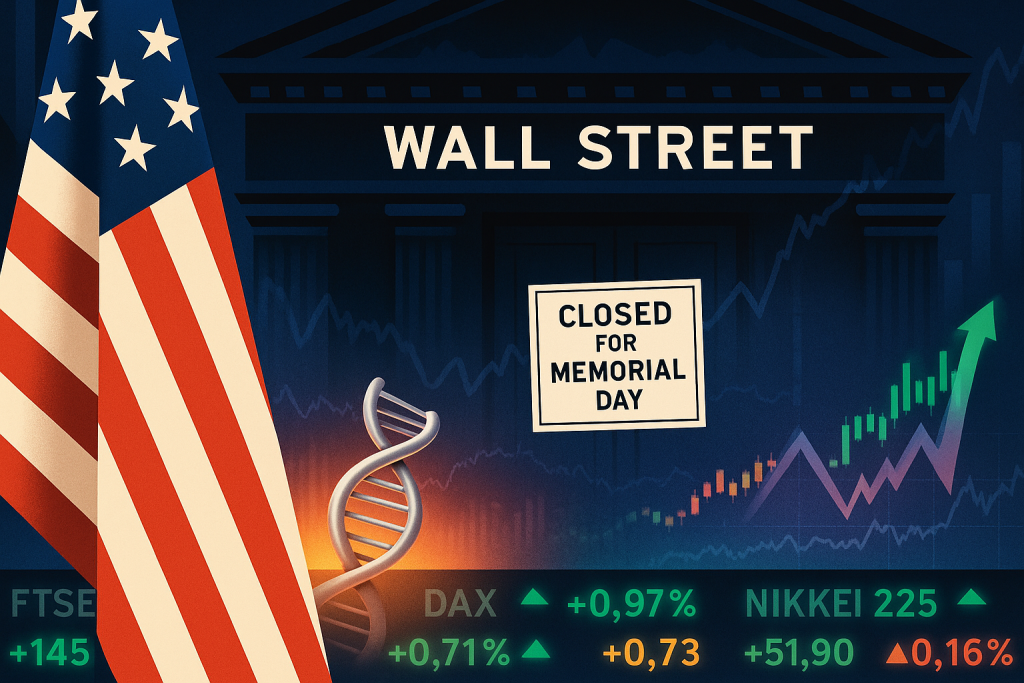


While Americans observed Memorial Day on Monday, May 26, with parades, cookouts, and a moment of remembrance, global traders were anything but idle. The U.S. stock exchanges – including the NYSE and Nasdaq – were officially closed for the holiday, as they are every last Monday of May. But if you thought that meant a quiet day for markets, think again.
From a sudden spike in U.S. stock futures to strong movement in European indices, Monday was anything but boring for anyone watching the global financial stage. And with a stack of important economic reports coming later this week – including inflation and GDP data – the day off served as a short pause before what’s shaping up to be a pivotal stretch for investors.
Let’s break down what happened while Wall Street took the day off – and what’s coming next.
Futures Rally on Trade Optimism
Even though the physical trading floors in New York were dark, the futures market was wide awake. And it had reason to be.
President Donald Trump announced over the weekend that his administration would postpone a proposed 50% tariff on European Union goods. Originally set to take effect in early June, the tariffs are now on hold until at least July 9, giving negotiators more time to reach a deal.
This news immediately lifted sentiment across the board. S&P 500 futures jumped over 1%, Nasdaq futures rose by a similar margin, and Dow Jones Industrial Average futures also traded higher during overnight sessions.
It wasn’t just the delay itself that drove the optimism – it was what it signaled. Many investors saw the move as a step back from the brink of a trade standoff, suggesting that diplomacy might win out over escalation, at least in the short term.
Europe Cheers the Pause
The impact of the tariff delay was felt most sharply in Europe, where equities rallied in response to the news. The Stoxx Europe 600 index gained about 1%, buoyed by strength in industrials, luxury goods, and autos – all sectors that would have been directly affected by U.S. tariffs.
Germany’s DAX rose nearly 1.1%, while France’s CAC 40 climbed 0.9%. Analysts cited a combination of reduced trade anxiety and improved sentiment in the wake of steady earnings results from several large European companies.
Even the bond markets relaxed a bit. Yields on European sovereign debt edged slightly higher as traders pulled out of safe havens and into equities.
The takeaway? For Europe, this wasn’t just about tariffs. It was about momentum. After a sluggish start to the year, European indices have begun to find their footing – and Monday’s move may have added some fuel to that fire.
What U.S. Investors Should Watch This Week
While Memorial Day served as a welcome breather for many American traders, it’s not the kind of breather that comes with a guarantee of calm.
This week is loaded with key economic indicators that could significantly shape the direction of the market:
- PCE Inflation Data (April): Due Thursday, this is the Fed’s preferred inflation measure. Analysts are looking for signs of continued moderation, which could impact rate expectations heading into the summer.
- First-Quarter GDP Revisions: Also out Thursday, the GDP revision will give investors a second look at how the economy performed during the first three months of 2025. Any surprise revisions could rattle – or reinforce – confidence in the economic outlook.
- Consumer Confidence (May): Scheduled for release on Tuesday, this figure could show whether Americans are still willing to spend or if recent inflation and geopolitical risks have taken a toll on sentiment.
Each of these data points matters individually. But taken together, they form a crucial narrative: Is the U.S. economy still cooling gradually? Or are signs of resilience pushing the Federal Reserve to keep rates elevated for longer?
Market Mood: Cautious Optimism
So where does all of this leave the market heading into the shortened trading week?
In short: cautiously optimistic.
The tariff delay helped remove an immediate overhang from the market. That doesn’t mean tensions are resolved – just postponed. Investors know how quickly headlines can shift, and there’s little illusion that the U.S.–EU trade spat is over. But for now, the delay offers a chance to focus on fundamentals again.
And the fundamentals? They’re not perfect, but they’re improving in some corners. Corporate earnings from the most recent season came in better than expected for most sectors. Inflation appears to be softening, at least at the consumer level. And while the Federal Reserve has reiterated that it’s not yet ready to cut rates, it has also shown no rush to tighten further.
In other words, it’s not a bull market euphoria – but it’s not panic either.
A Quick Note on Sector Impact
Different sectors may react in different ways to the themes of this week.
- Industrials and exporters could benefit the most from the tariff delay, especially those with large exposure to Europe.
- Consumer staples and utilities, which outperformed last week, may see rotation as risk-on sentiment returns.
- Tech and high-growth stocks will continue to be sensitive to interest rate expectations, especially if the PCE data surprises in either direction.
- Retail and travel stocks might move on the consumer confidence report – watch for names like Target, American Airlines, and Booking Holdings.
Final Thoughts
Even with U.S. markets closed for Memorial Day, Monday gave investors plenty to chew on.
A surprise tariff delay helped spark a global rally. European stocks responded with strength. Futures markets in the U.S. signaled a risk-on tone ahead of a week packed with critical economic data.
As traders return to their desks on Tuesday, the real test will be whether this momentum holds – or if caution creeps back in as the numbers roll out.
One thing’s for sure: Memorial Day gave the markets a break – but the action didn’t stop.



 Pump Radar
 Stock Alerts