


If you opened your brokerage app on May 20 hoping for another green day across the board, you probably squinted a little. The major U.S. indices? Mostly red. The vibe? A little anxious. But as with most market days, the headlines didn’t tell the full story.
Let’s walk through what actually happened – and why it matters if you’re following this market closely.
Big Picture: A Stumble After a Winning Streak
First, let’s start with the scoreboard:
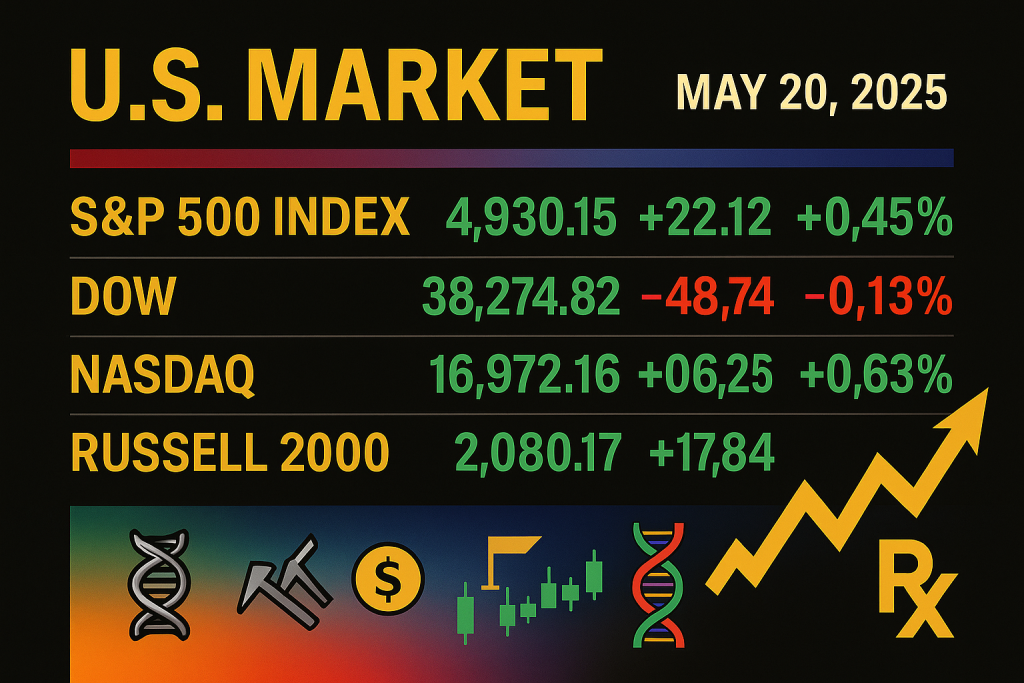
- S&P 500: Down 0.39%, closing at 5,940.46 – and snapping a six-day win streak.
- Dow Jones Industrial Average: Slipped 0.27%, ending the session at 42,677.24.
- Nasdaq Composite: Lost 0.38%, closing at 19,142.71.
- Russell 2000: The lone bright spot – up 0.1%, finishing at 2,105.58.
Yes, the small-cap Russell 2000 index managed to pull out a modest gain – and we’ll get into why that’s interesting in a minute. But the big takeaway is that investors took a breather. After weeks of risk-on momentum, Tuesday was a “pause and reassess” kind of day.
What Spooked the Market?
One word: debt.
Over the weekend, Moody’s downgraded the U.S. credit rating, bumping us down a notch from Aaa to Aa1. The reason? Persistent deficits and growing debt concerns. Now, this wasn’t a complete surprise – the warning signs had been flashing for a while – but it still gave investors a reason to tap the brakes.
Then there was the news out of Washington: President Trump is pushing for a fresh tax cut package, which many fear could widen the federal deficit even further. That raised some eyebrows – and not in a good way. As one analyst put it: “People used the recent rally to quietly trim some risk off the table.”
Can’t say we blame them.
Sector Check: Not All Red
Now, even though the overall mood was cautious, not every sector was down.
Winners of the day?
- Utilities
- Health Care
- Consumer Staples
These are your classic “defensive” plays – the stocks investors rotate into when they’re worried about growth or economic turbulence. Think electric bills, grocery chains, and healthcare providers. Boring? Sure. But when things get shaky, boring is beautiful.
On the flip side, Energy, Consumer Discretionary, and Communication Services all took hits. Travel names – like Norwegian Cruise Line, down nearly 4% – were hit hard. And big tech was wobbly too: Meta, Nvidia, Amazon, Apple, and Microsoft each dropped about 1%.
So yeah, not a tech-led day, for once.
The Outlier: Small Caps Showing Life
Here’s where things get interesting.
While the mega-caps cooled off, small-cap stocks quietly held their ground. The Russell 2000 notched a 0.1% gain – not much, but enough to stand out. Why the strength?
Simple: small caps are generally more domestically focused, and the easing of U.S.–China trade tensions provided a bit of a tailwind. On May 19, news broke that the U.S. and China had agreed to a 90-day pause on new tariffs, trimming duties to around 10% on many goods. That truce gave a boost to the more vulnerable corners of the market – and small caps definitely fall in that camp.
Still, don’t get too comfortable. Most of these names are still underwater for the year, and with Moody’s downgrade, higher borrowing costs could hit these debt-heavy companies hard.
Stock Stories: Who Moved and Why
Let’s talk names.
- Home Depot dipped slightly – around 0.6% – despite beating earnings. Solid quarter, but no one’s rushing to pay a premium for home improvement right now.
- Moderna surged about 6% after the FDA dropped fresh guidance on COVID-19 boosters. That’s a big pop for a name that’s been quietly grinding lower since the pandemic faded from headlines.
- Dollar Tree and Dollar General also caught a bid. Why? Because Walmart warned of tariff-driven price hikes. That’s bad for full-price retail, but great for discount chains.
Economic Indicators: Mixed Signals
The Conference Board’s Leading Economic Index fell 1.0% in April – slightly worse than expected. It’s the latest sign that economic momentum might be slowing. Meanwhile, the 10-year Treasury yield settled around 4.48%, a pullback from Monday’s 4.56% spike post-downgrade.
And guess what rallied?
Gold. It jumped 1.8%, landing around $3,295 per ounce. That tells us investors were looking for a safe place to wait out the headlines. Meanwhile, the U.S. dollar slipped ~0.4%, and oil stayed range-bound around $63 a barrel.
Global Watch
Overseas, there were a few headlines worth tracking:
- Australia’s central bank cut rates by 25 basis points – surprising markets and sending the Aussie dollar lower.
- Canada’s April inflation came in a bit hotter than expected – 1.7% year-over-year vs. 1.6% consensus.
These aren’t deal-breakers for U.S. markets, but they contribute to the global narrative that central banks are still trying to find their footing.
Final Thoughts: What Comes Next?
With the S&P 500 pulling back after a six-day win streak, the market’s now looking for its next catalyst. Will it be more earnings surprises? A breakthrough on tax policy? Another inflation print?
Here’s what we’re watching heading into the week:
- Fed speakers and policy signals (will they pivot, or stay hawkish?)
- Consumer data and housing starts
- Global developments – particularly around trade and geopolitical tensions
For now, volatility is back, with the VIX climbing into the high teens. That tells us investors are bracing for more swings.
So, if you’re thinking about where to allocate next, remember what May 20 showed us:
Defensive stocks are holding. Small caps might be finding a floor. But the macro fog hasn’t lifted yet.
Stay sharp. Stay curious. And don’t chase every bounce – especially when the headlines are this noisy.


 Pump Radar
 Stock Alerts