
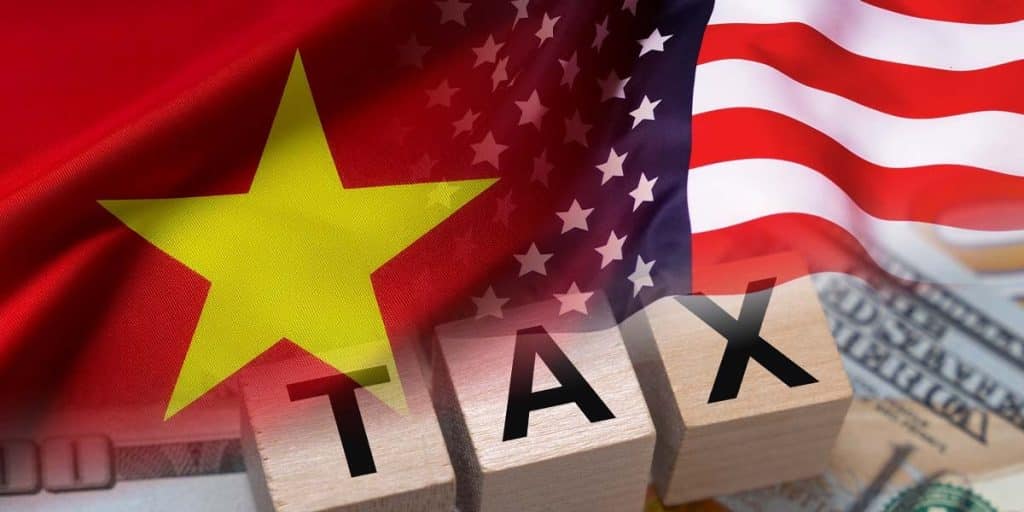


Vietnamese officials were taken by surprise after U.S. President Donald Trump announced that the country had agreed to a 20% tariff—an outcome Hanoi did not anticipate. According to people familiar with the matter, Vietnam is still working behind the scenes to reduce the rate, despite the public silence from state media and leadership.
Immediately following a call with Trump last Wednesday, Vietnam’s Communist Party chief To Lam instructed negotiators to continue pressing for a lower tariff. The 20% figure was unexpected, insiders said, as Vietnam believed it had secured a more favorable agreement. Before the conversation, the Vietnamese side had been aiming for a tariff range between 10% and 15%.
The new rate has barely been mentioned in Vietnam’s state-run media. A government directive viewed by Bloomberg News advised the press not to publish any content considered “unclear or speculative” or lacking consensus between the U.S. and Vietnam.
Vietnam’s Ministry of Foreign Affairs did not immediately respond to a request for comment.
Last year, Vietnam recorded the third-largest trade surplus with the U.S. globally. It is also just the second country—after the UK—with which Trump has announced a new trade deal. Since then, the White House has issued tariff notifications to multiple trade partners, with rates reaching as high as 50% ahead of the August 1 implementation deadline.
The day after Trump posted about Vietnam on Truth Social—calling To Lam “an absolute pleasure” to work with—the Vietnamese Foreign Ministry stated that talks with U.S. officials were ongoing to finalize the deal’s specifics.
Since that announcement, top Vietnamese officials have largely avoided direct comments on the tariff. Prime Minister Pham Minh Chinh shifted focus to the country’s strategy for diversifying export markets and supply chains in response to the new trade policy. His remarks were later echoed by a deputy trade minister.
A U.S. official, speaking anonymously, clarified that Trump’s proposed 20% tariff would replace the current 10% baseline rate but would still be layered on top of other levies, such as ‘Most Favored Nation’ tariffs. This could push the total effective rate above 20%. The new rate would not be cumulative with existing sector-specific tariffs on goods like steel and automobiles—importers would pay one or the other. The White House did not comment when contacted outside of normal hours.
U.S. Secretary of State Marco Rubio confirmed Friday that trade had been briefly discussed during a meeting with his Vietnamese counterpart at a regional forum in Malaysia, though it wasn’t the meeting’s primary focus.
“Clearly, Vietnam feels that if they enter into an agreement with the United States, they want to have a tariff rate that’s at least as good as, if not better than, other countries that don’t have a trade agreement with us,” Rubio told reporters.
As it navigates trade tensions with the U.S., Vietnam is also managing its delicate relationship with China—its largest trading partner. U.S. officials have pushed Hanoi to crack down on Chinese goods being routed through Vietnam to bypass higher tariffs. In response, China warned it is reviewing the deal and may retaliate if its interests are threatened.
In tandem with efforts to lower the tariff, Vietnam’s trade ministry is also working with customs authorities and industry leaders to tighten regulations on goods’ origin, aiming to prevent illegal transshipments, sources said.
Despite the uncertainty, the lack of official detail around the 20% rate—or the proposed 40% levy on rerouted goods—has not spooked investors. Stocks in Vietnam surged to a three-year high this week, with one prominent fund manager calling the tariff “a good deal for Vietnam” during an investment summit in Hanoi.
Meanwhile, during the BRICS summit in Brazil, Prime Minister Chinh met with Chinese Premier Li Qiang. Both sides agreed to deepen economic and investment cooperation and prioritized the development of a cross-border railway—highlighting Vietnam’s continued efforts to maintain close ties with Beijing even amid shifting global trade dynamics.
 Pump Radar
 Stock Alerts