
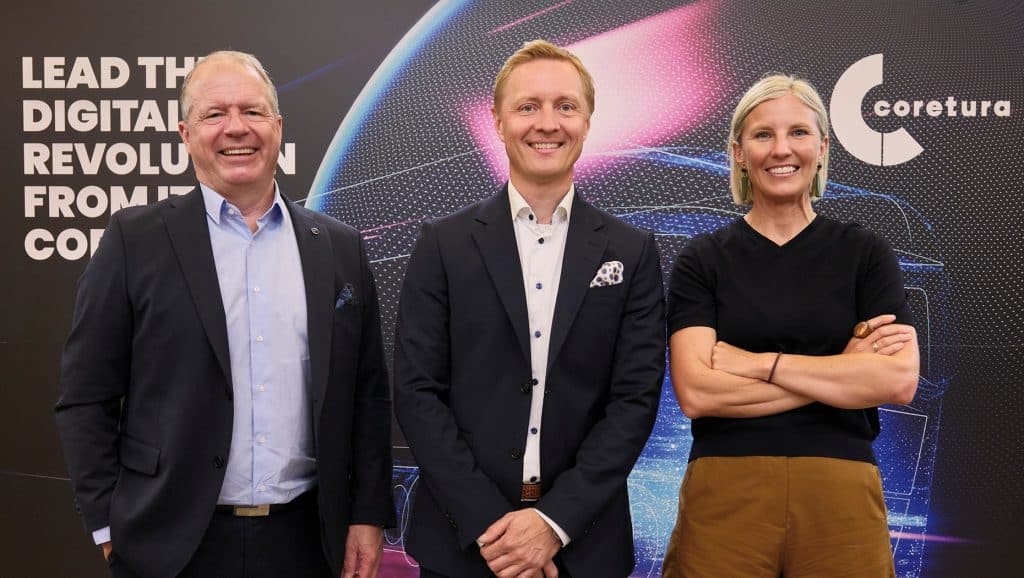


Volvo Group and Daimler Truck have officially launched Coretura, a joint venture focused on creating a standardized software-defined vehicle platform for commercial vehicles. The announcement came Tuesday, following binding agreements signed by both companies in October 2024. With regulatory approvals secured by early June, Coretura has now begun operations in Gothenburg, Sweden.
The new company’s mission is to develop a shared, non-differentiating core software platform and a specialized operating system for commercial vehicles, as original equipment manufacturers (OEMs) compete to lead the digital evolution of the transport sector.
“With Coretura, we are setting a clear strategic focus on software development for commercial vehicles,” said Karin Rådström, President and CEO of Daimler Truck, in the release. “This is a big and really exciting step — not just for us, but for the entire industry and our customers. Together we are starting the digital-driven future of trucks and buses, ultimately making commercial vehicles smarter, more connected, and more efficient than ever before.”
Coretura’s scope includes the specification and procurement of centralized high-performance control units tailored for commercial vehicle demands. These units will manage large volumes of data and support decoupled development cycles for software and hardware. A key advantage is enabling customers to receive wireless, over-the-air updates for digital applications.
The joint venture will be overseen by a four-person Executive Management team, with two representatives from each parent company. Johan Lundén, who previously led Strategic Product Planning, Project, and Innovation Management at Volvo Group, has been named CEO.
“This joint venture blends the agility of a start-up with the stability and expertise of our major shareholders,” said Lundén. “We are proud and energized to lead the digital transformation in the commercial vehicle industry—backed by strong shareholder support and committed to shaping the industry’s future.”
Despite their collaboration, Volvo Group and Daimler Truck will continue to compete in the market, maintaining distinct product and service offerings, including their own digital ecosystems. Coretura also remains open to partnerships with both established and emerging suppliers that align with its vision.
Starting with a workforce of around 50 employees, the company anticipates steady growth and aims to roll out its first products in commercial vehicles by 2030.
Preliminary data from ACT Research shows net trailer orders in the U.S. fell by over 2,300 units from April to May, marking a 26% monthly decline to 6,600 units. Despite the drop, year-over-year orders were still up nearly 12% compared to May 2024. After seasonal adjustment, May’s total rises to 9,200 units, with final figures due later this month. ACT notes that final numbers typically fall within 5% of the preliminary estimates.
“The lower May net order intake was expected, as it is one of the weakest order months of the annual cycle,” said Jennifer McNealy, director of CV market research & publications at ACT Research, in the release. “More concerning, though, is this level of order acceptance does nothing to support backlog growth, particularly with the elevated cancellation rates reported in the past several months.”
Several challenges continue to weigh on the trailer market, including soft demand in the for-hire truck segment, low valuations for used equipment, and high inventory levels. Rising interest rates and policy uncertainty, particularly around tariffs, have also added pressure.
Looking ahead, ACT remains cautious. McNealy added, “With weak for-hire truck market fundamentals, low used equipment valuations, relatively full inventories, high interest rates, and the ambiguity of policy shifts still in play, ACT’s expectations for subdued build and order intake levels during 2025 remain intact.”
 Pump Radar
 Stock Alerts